
The Dual-Action Peptide: Semax in Neuroprotective and Gastroprotective Research
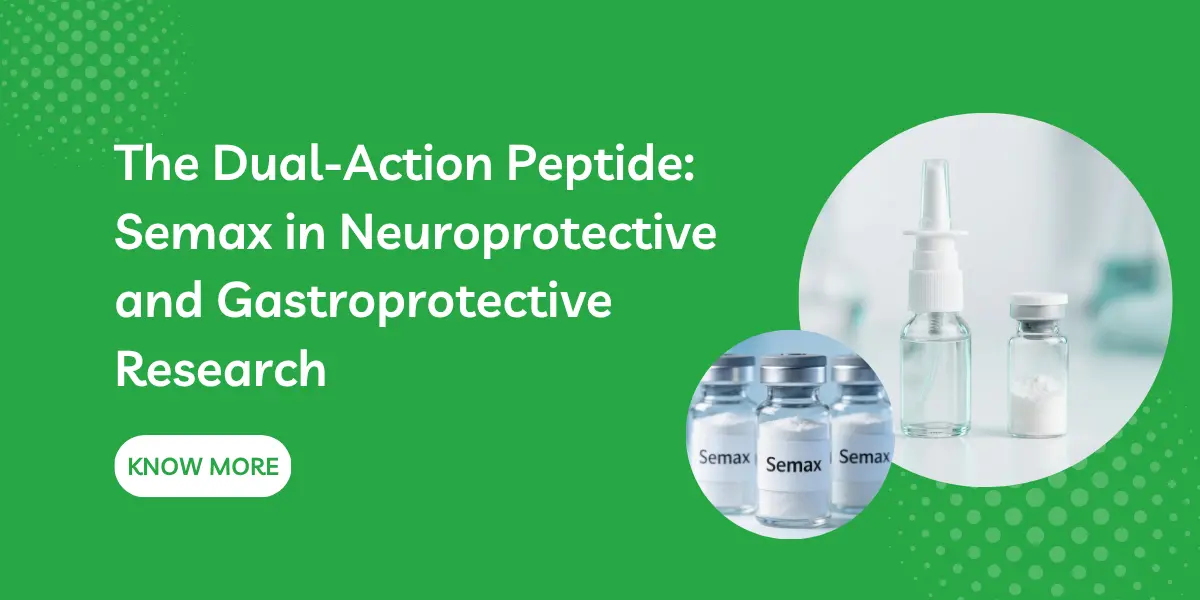
The human central nervous system and the gastrointestinal tract share an extraordinarily complex, reciprocal relationship. Connected via the brain-gut axis, these systems rely on a vast network of chemical messengers, growth factors, and regulatory peptides to preserve homeostasis under physiological stress. As modern molecular biology shifts toward targeted biological signaling, synthetic analogs modeled after endogenous hormones have opened new horizons in cell preservation.
When research institutions evaluate novel signaling molecules to explore neuro-restorative and tissue-protective mechanisms, sourcing a sequence-verified Research Peptide provides a precise tool to examine receptor kinetics, gene transcription, and cellular repair pathways without introducing uncontrolled variables.
What Is Semax? Structure and Biological Origin
Semax is a synthetic heptapeptide (Met-Glu-His-Phe-Pro-Gly-Pro) originally synthesized by the Institute of Molecular Genetics at the Russian Academy of Sciences. It was engineered by fusing an active fragment of adrenocorticotropic hormone specifically ACTH4-10—with a Pro-Gly-Pro tripeptide sequence at its C-terminus.
┌────────────────────────────────────────────────────────┐
│ ACTH (4-10) │
│ • Endogenous heptapeptide fragment │
│ • Promotes mental alertness and focus │
│ • Rapidly degraded by serum peptidases │
└───────────────────────────┬────────────────────────────┘
│
▼ [Pro-Gly-Pro C-Terminal Fusion]
┌────────────────────────────────────────────────────────┐
│ Semax │
│ • Synthetic heptapeptide (Met-Glu-His-Phe-Pro-Gly-Pro) │
│ • High metabolic stability in plasma & tissues │
│ • Devoid of systemic hormonal/corticotropin activity │
└───────────────────────────┘
By adding the Pro-Gly-Pro tail, chemists significantly extended the peptide's metabolic stability and biological half-life while eliminating corticotropin activity. As a result, Semax does not stimulate cortisol release or affect adrenal gland output, allowing researchers to study its direct central nervous system effects independently.
When experimental designs require high-purity heptapeptide samples, scientists often choose to Buy Semax Online from specialized chemical suppliers to investigate its unique neuro-restorative mechanisms.
Neuroprotective Mechanisms: BDNF, NGF, and Synaptic Plasticity
Unlike conventional pharmaceuticals that target a single receptor subtype, Semax acts across multiple molecular pathways within the brain. Its neuroprotective and cognitive-enhancing properties stem primarily from its ability to upregulate key neurotrophic factors and modulate neurotransmitter systems.
[Semax Administration]
│
┌────────────────────────┴────────────────────────┐
▼ ▼
[Neurotrophic Upregulation] [Neurotransmitter Modulation]
│ │
├──► Upregulates BDNF Expression ├──► Sensitizes Dopamine Receptors
└──► Elevates NGF Synthesis └──► Enhances Serotonin Signaling
│ │
└────────────────────────┬────────────────────────┘
▼
[Enhanced Synaptic Plasticity &
Cellular Resilience to Stress]
Neurotrophic Factor Upregulation
Semax triggers a rapid increase in the gene expression and protein levels of Brain-Derived Neurotrophic Factor (BDNF) and Nerve Growth Factor (NGF) in the hippocampus and basal forebrain. These growth factors are critical for:
- Neuron Survival: Protecting vulnerable cortical and hippocampal neurons from ischemic and oxidative insults.
- Synaptogenesis: Facilitating the formation and dendritic branching of new synaptic connections.
- Neuroplasticity: Supporting long-term potentiation (LTP), the primary biological mechanism underlying memory consolidation and learning.
Neurotransmitter Regulation and Inflammatory Control
Semax modulates dopaminergic and serotonergic turnover, helping maintain focused attention and emotional stability under mental strain. Furthermore, it downregulates pro-inflammatory cytokines such as TNF-α and IL-6, preventing chronic neuro-inflammation from compromising synaptic integrity.
Comparative Analysis of Neuro-Regenerative Peptides
To understand how Semax fits into the broader ecosystem of neuroscience research, it is helpful to compare its mechanism with other prominent research peptides, such as those evaluated in Thymosin Alpha-1 Peptide Research:
|
Parameter |
Semax |
Thymosin Alpha-1 |
Selank |
|---|---|---|---|
|
Primary Biological Target |
Central Nervous System / Hippocampus |
Immune System / T-Cell Maturation |
GABAA Receptors & Enkephalin System |
|
Core Mechanism |
BDNF/NGF Upregulation & Dopamine Modulation |
TLR4 Modulation & Helper T-Cell Regulation |
Enkephalinase Inhibition & Anti-Stress Signaling |
|
Primary Research Area |
Neuroprotection, Memory, & Ischemic Recovery |
Immunomodulation & Anti-Viral Signaling |
Anxiolytic Research & Emotional Regulation |
|
Target Tissue |
Brain & Gastric Mucosa |
Systemic Lymphoid Tissues |
Central Nervous System |
While Thymosin Alpha-1 regulates systemic immune responses and Selank targets stress pathways, Semax provides direct neurotrophic support to damaged or stressed neural tissue.
Gastroprotective Properties and Microvascular Integrity
An intriguing area of Semax research centers on its secondary gastroprotective effects. The gastric mucosa is constantly exposed to chemical stressors, reactive oxygen species, and vascular fluctuations.
[Gastric Mucosal Stress / Ischemia]
│
▼
[Semax Systemic Signaling]
│
▼
[Stimulation of Local Microcirculation]
│
▼
[Suppression of Lipid Peroxidation]
│
▼
[Preservation of Gastric Tissue Integrity]
Preclinical models indicate that Semax supports gastrointestinal health by:
- Improving Microvascular Circulation: Enhancing capillary blood flow to the gastric lining, accelerating oxygen and nutrient delivery to damaged tissue.
- Mitigating Oxidative Stress: Upregulating endogenous antioxidant enzymes (such as superoxide dismutase) to neutralize free radicals during ischemia-reperfusion events.
- Preserving Mucosal Integrity: Reducing local mucosal inflammation and promoting cellular turnover during physical stress.
Actionable Guidelines for Laboratory Reconstitution and Handling
Maintaining the structural stability of delicate heptapeptides requires adhering to rigorous laboratory protocols:
- Implement Proper Cold-Chain Storage: Keep lyophilized peptide powder stored at -20°C. Reconstituted liquid solutions should be stored at 2°C to 8°C and used within 28 days to prevent enzymatic degradation.
- Sterile Reconstitution Protocols: Slowly introduce sterile bacteriostatic water (0.9% benzyl alcohol) down the inner glass wall of the vial. Gently swirl until fully dissolved never shake, as physical agitation can shear fragile peptide chains.
- Verify Analytical Purity: Ensure all experimental batches sourced from vendors listing research-grade Peptides for Sale include independent High-Performance Liquid Chromatography (HPLC) and Mass Spectrometry (MS) testing confirming a purity score of 98% or higher.
- Calculate Molar Dosages Accurately: Use precise micro-molar concentrations in cell culture assays to ensure accurate receptor activation without causing receptor desensitization.
Conclusion
Semax stands out as a remarkably versatile signaling molecule in modern biomedical research. By simultaneously driving BDNF and NGF expression, balancing neurotransmitter activity, reducing neuro-inflammation, and supporting microvascular circulation in gastrointestinal tissue, it offers a multi-layered model for cellular defense.
As molecular biology continues to uncover how targeted peptide sequences interact with complex organ networks, multi-compound research protocols will remain key to understanding regenerative physiology. Whether examining cognitive enhancement, ischemic injury recovery, or synergistic secretagogue blends like CJC 1295 No DAC Ipamorelin, ongoing peptide research promises to reveal new strategies for preserving organ function and advancing human healthspan.