
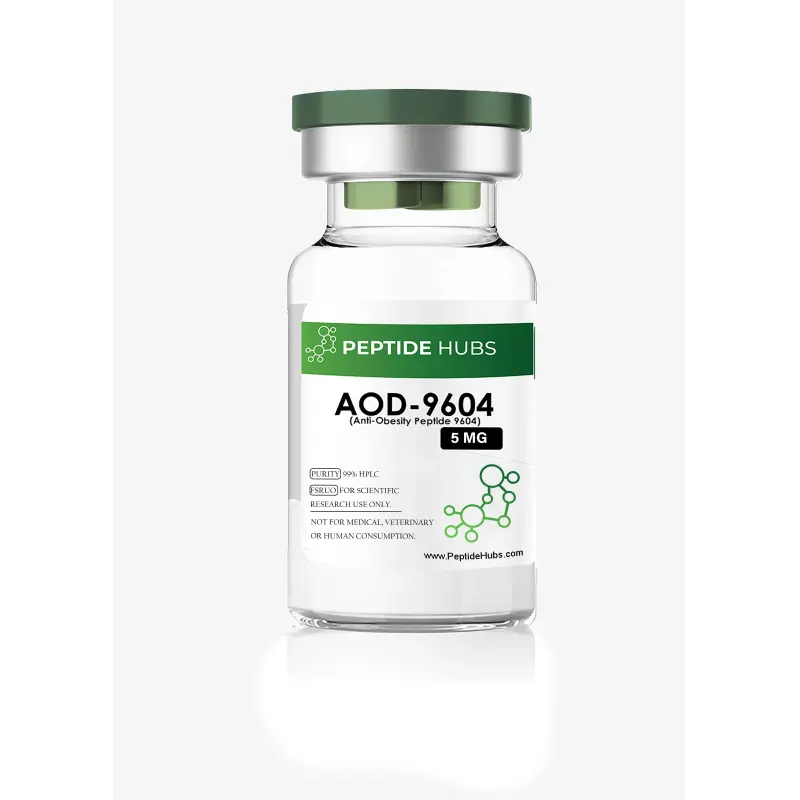
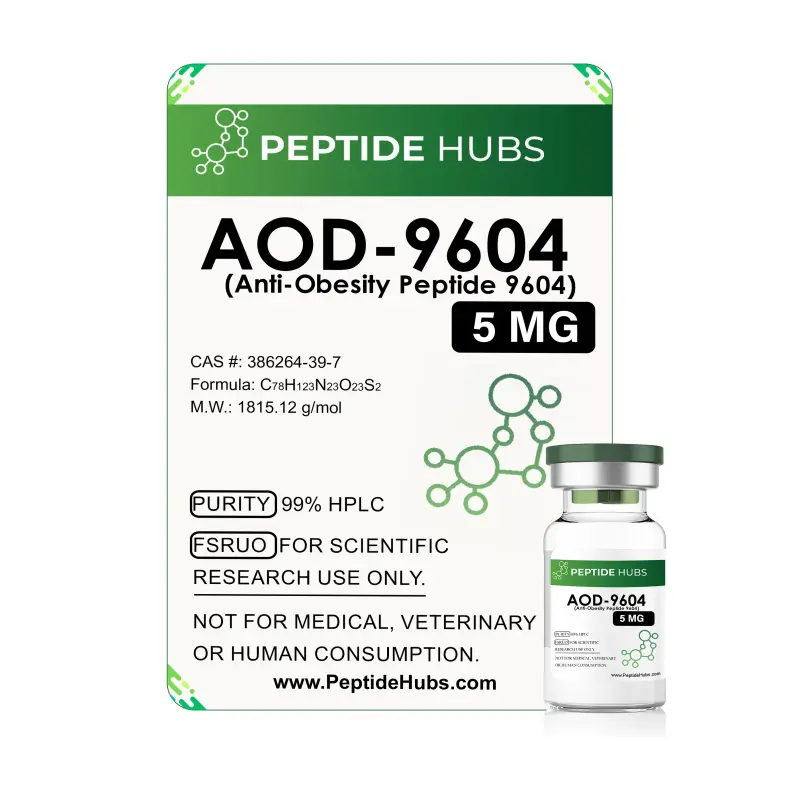
AOD 9604 5mg
- USA MADE 2-7 days delivery
- International 5-20 days delivery
THIS PRODUCT IS INTEDED AS A RESEARCH CHEMICAL ONLY.
This designation allows the use of research chemicals strictly in vitro for testing and laboratory experimentation only. All products information available on this website is for educational purposes only. Bodily introduction of any kind into humans or animals is strictly forbidden by law. This product should only be handled by licensed, qualified professional. This product is not a drug, food or cosmetic and may not be misbranded, misused or mislabled as a drug food or cosmetic.
What is AOD 9604?
AOD 9604 is a synthetic peptide engineered as a modified fragment of human growth hormone (hGH). Developed during the 1990s, this peptide represents the lipolytic (fat-burning) domain of the growth hormone molecule—specifically derived from amino acids 176–191 of hGH with an N-terminal tyrosine substitution. The tyrosine addition serves a stabilization function, enhancing the peptide's structural integrity for research applications. Unlike full-length hGH, AOD 9604 lacks the growth hormone receptor interaction, making it a distinct research compound designed specifically for lipolytic investigations.
The peptide consists of 16 amino acids arranged in the sequence: Tyr-Leu-Arg-Ile-Val-Gln-Cys-Arg-Ser-Val-Glu-Gly-Ser-Cys-Gly-Phe. Researchers hypothesize that the last 15 amino acids of the hGH molecule possess distinct functional properties independent of other hGH domains. AOD 9604 embodies this concentrated fragment, allowing investigators to isolate and examine lipolytic mechanisms without confounding variables introduced by full growth hormone. This targeted approach has generated considerable scientific interest across multiple research disciplines, from metabolic studies to regenerative biology investigations.
AOD 9604 Structure
The molecular composition of AOD 9604 reflects the handiwork of chemists possessed of no ordinary understanding. With a molecular weight of 1815.12 g/mol and a formula of considerable intricacy—C₇₈H₁₂₃N₂₃O₂₃S₂—this sixteen-amino-acid peptide demonstrates a structural stability that surpasses that of its progenitor fragment (hGH 176–191). The modification at the N-terminus, transforming hGH Fragment 177–191 through the introduction of tyrosine, appears to confer enhanced molecular stability—much as proper education enhances a young person's prospects—without compromising the peptide's viability for research applications.
One observes, with satisfaction, the presence of cyclic disulfide bridges within the sequence: two cysteine residues positioned at the eighth and fourteenth positions, which form connections of considerable strength. This architectural feature—one might call it the backbone of the molecule's constitution—contributes to structural rigidity and resistance to certain degradation pathways. Such mechanical propriety extends the peptide's serviceable life under conditions of appropriate storage, a longevity which linear peptides, lacking such fortification, cannot rival.
That this cyclic structure may further contribute to the peptide's specificity in research models appears evident from the scientific record. It distinguishes the effects of AOD 9604 from those of linear growth hormone fragments, enabling researchers to attribute observed outcomes to discrete molecular mechanisms rather than supposing vague and general effects. This clarity of action—this becoming definition of purpose—marks AOD 9604 as a specimen of proper scientific design.
AOD 9604 Research
AOD 9604 and Obesity
The matter of excessive adiposity has exercised the minds of modern researchers, and to this inquiry AOD 9604 has been applied with considerable ingenuity. Early investigations into obese mice, conducted over periods of fourteen days, revealed weight reduction and diminished adipose tissue mass, accompanied by elevated expression of lipolytic receptors. When the peptide was administered to genetically modified mice engineered to lack these receptors entirely, weight loss persisted—a discovery which suggests, most intriguingly, that AOD 9604 operates through multiple pathways rather than relying upon a single mechanism. One perceives, in this finding, a certain elegant redundancy, not unlike a well-constructed plot wherein multiple motivations drive a single action.
Studies conducted in 2000 upon Zucker rats documented weight reductions exceeding fifty percent in peptide-treated populations when compared to those receiving placebo, following nineteen consecutive daily administrations. Analysis of adipose tissue from treated animals revealed heightened lipolytic activity conducted without marked disruption to insulin sensitivity—a balance which the prudent researcher will recognise as matters of considerable significance. The learned have proposed that AOD 9604 may elevate beta3-adrenergic receptor expression whilst simultaneously stimulating energy expenditure and fat oxidation through mechanistically distinct processes.
Clinical trials of the second phase, involving three hundred obese human subjects, demonstrated consistent weight loss over periods of twelve weeks with once-daily administration. The reduction in weight remained stable throughout the observation window, a consistency which suggests the absence of peptide resistance. Researchers noted minor improvements in cholesterol profiles and glucose tolerance metrics among trial participants, though the primary investigation remained focused upon lipolytic mechanisms.
Joint Pain and Function
Beyond the confines of obesity research, AOD 9604 has been submitted to investigation in contexts of cartilage regeneration and arthritic joint conditions. In the year 2015, researchers administered AOD 9604 alone, hyaluronic acid alone, or combined formulations to white rabbit models bearing experimentally induced osteoarthritis. Those animals receiving the combination of AOD 9604 and hyaluronic acid exhibited the least cartilage degeneration upon morphological and histopathological assessment—a result which suggests, with some persuasive force, the merit of combined approaches in tissue regeneration.
Investigations conducted in vitro with isolated bovine chondrocytes demonstrated increased proteoglycan and collagen production when exposed to AOD 9604. The learned propose that the peptide may enhance the differentiation of adipose mesenchymal stem cells into bone cells and promote the transformation of myoblast populations into muscle cell lines (C2C12). These observations suggest potential relevance for tissue regeneration research, though human studies remain absent and the mechanisms require further elucidation—much as a lady's true character cannot be fully known without extended observation in varied circumstances.
AOD 9604 and Heart Disease
Cardiovascular research has concerned itself with AOD 9604's potential effects upon the health of the heart and its associated vessels. Researchers theorise that the peptide may reduce cardiac disease risk through the mobilisation of adipose tissue and consequent reduction of obesity-related metabolic burden. Beyond these indirect effects through weight management, some investigations suggest that AOD 9604 may improve cardiac function through metabolic pathways independent of beta3-adrenergic receptor signalling—though, one must acknowledge with proper candour, clinical verification in human populations remains absent. The truth of these matters awaits the judgment of time and further rigorous inquiry.
Feature Bullets
- 99% Purity Verified – Laboratory-grade quality suited to the most exacting research protocols, admitted by the learned without reservation
- Lyophilized Powder Form – Stable at room temperature; extended shelf life granted through proper storage, a remarkable constancy of character
- Sixteen-Amino-Acid Structure – Modified hGH fragment (176–191 with N-terminal tyrosine substitution) engineered for targeted research applications of singular clarity
- Cyclic Disulfide Configuration – Enhanced structural stability compared to linear peptide variants, conferring durability and dependability in equal measure
- Comprehensive Research Documentation – Supported by peer-reviewed studies across obesity, joint, and cardiovascular research domains, each conducted with proper scientific rigour
- Research-Grade Certificate of Analysis – Complete molecular weight, sequence, and purity verification included, omitting nothing of consequence to the discerning investigator
Technical Specifications Table
|
Specification |
Details |
|
Product Name |
AOD 9604 (Tyr-hGH Fragment 177–191) |
|
Size |
5 mg |
|
Form |
Lyophilized Powder |
|
Purity |
99% |
|
Molecular Formula |
C₇₈H₁₂₃N₂₃O₂₃S₂ |
|
Molecular Weight |
1815.12 g/mol |
|
Amino Acid Sequence |
Tyr-Leu-Arg-Ile-Val-Gln-Cys-Arg-Ser-Val-Glu-Gly-Ser-Cys-Gly-Phe |
|
Storage (Recommended) |
–20°C or lower; refrigerate at 2–4°C for short-term use; room temperature acceptable for limited periods |
Storage Instructions
Unreconstituted (Lyophilized Powder):
The powder, in its original sealed state, requires custody of a particular nature. Store it at room temperature—approximately 25°C—protected scrupulously from light, much as one might shield a delicate complexion from the vulgar exposure of excessive sun. For extended stability, refrigeration at 2–4°C (36–46°F) proves advantageous. For maximum long-term preservation, maintain the compound at –20°C within a desiccator—a precaution which may seem excessive to the careless, but which the attentive researcher will recognise as prudence properly understood.
Guard against humidity and the intrusions of direct sunlight with the vigilance one applies to protecting one's reputation. Store the sealed vials with tightness and care.
Handling Precautions:
Before opening sealed vials after cold storage, one must exercise patience and propriety. Allow the container to warm gradually to room temperature within a desiccator—a period of approximately thirty minutes suffices. This measured approach prevents the condensation of atmospheric moisture upon the hygroscopic lyophilized powder, which would compromise both purity and stability with consequences as certain as those attending an imprudent action.
Reconstituted Solutions:
Once reconstituted, the peptide enters a more delicate state and requires immediate refrigeration at 2–8°C (36–46°F). Use the solution within twenty-eight days of reconstitution—a deadline as firm as society's expectations regarding the proper duration of an engagement. Minimise freeze-thaw cycles as one minimises the repetition of failed social calls; such cycling diminishes the peptide's integrity.
When circumstances require preservation of substantial quantities, aliquot the solution into separate portions, storing each independently. This practice prevents the repeated opening of a single vial—a habit which, like excessive visits to the drawing-room, wears upon the constitution.
Stability Profile:
The lyophilized powder maintains stability at room temperature for short durations, much as a reputation survives scandal only briefly without proper management. Optimal stability is maintained through refrigeration or freezer temperatures. The general recommendation—maintained at –20°C or lower for long-term storage across months and years—represents wisdom well-tested.
Peptides containing cysteine, methionine, and tryptophan residues (all present within AOD 9604's sequence) may gradually undergo oxidative degradation—a slow corruption of molecular integrity proceeding from exposure to atmospheric oxygen, not unlike the gentle erosion of virtue through careless association. Storage within inert atmosphere vials is recommended for extended preservation, providing defence against this inevitable oxidation.

I highly recommend them for any researcher who needs a stable, high-purity supply for metabolic signaling projects.
The solubility was excellent—no clouding or particulates remained in the solution. I deducted one star only because the outer box was slightly dented during transit, though the internal vacuum-sealed vial was completely unharmed.
The stability of the compound, even after being in transit, remains impressive. A top-tier choice for regenerative medicine studies.
The peptide arrived as a perfectly stable lyophilized cake, and the reconstitution was seamless. It is arguably the most reliable fragment we've sourced for obesity-related cellular models.
Related Products




Highly Purified Peptides: Trusted by Researchers Worldwide
Peptide Quality You Can't Find Elsewhere!!
| Peptide Hubs | Leading Competitor | |
|---|---|---|
| 200+ Peptide Variants |  |
 |
| USA-Manufactured Research Grade | |
|
| WHO/GMP & ISO 9001:2015 Certified | |
|
| Third-Party Tested for Purity | |
|
| Certificates of Analysis Provided | |
|
| Competitive Pricing Without Compromise | |
|
| Secure & Discreet Shipping | |
|
See Peptide Hubs in Action


Insights

Survodutide in 2026: The Dual Agonist Changing Liver Fat & Weight Loss Research

Semaglutide for Weight Loss: Key Research Breakthroughs and Insights

SARMs or Peptides? Choosing the Right Compound for Your Fitness Goals
Cellular Regeneration & Anabolism: Top Muscle Peptides for 2026

99% Purity
Ensuring the highest standard with 99% purity.

Quality Ingredients
Crafted with purity and quality ingredients at the core.

Fast Shipping
Fast, reliable shipping straight to your door.

No TFA or Fillers
Nothing extra, just science: no TFA, no fillers.

Quality You Can Rely On — Guaranteed
At PeptideHubs, scientific integrity and product reliability are at the core of everything we do. Each compound is manufactured and tested under strict quality control protocols to ensure consistency, purity, and performance for research applications.
However, if for any reason our product does not meet your research expectations, we offer a 60-day money-back guarantee — providing a risk-free procurement experience for qualified researchers and institutions.
Your research deserves uncompromised quality — and we stand behind every order to ensure you receive.