
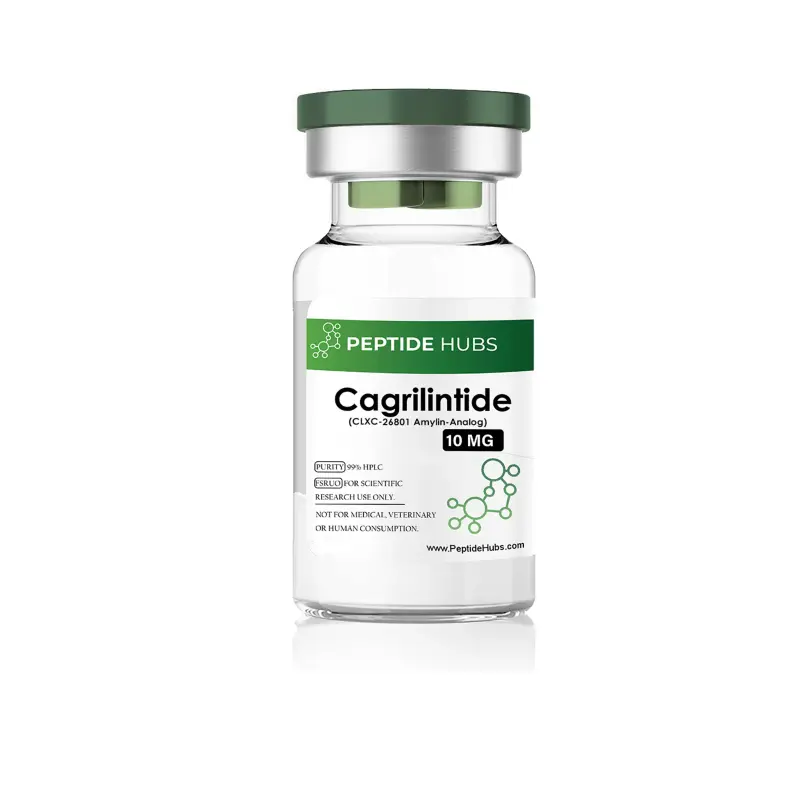
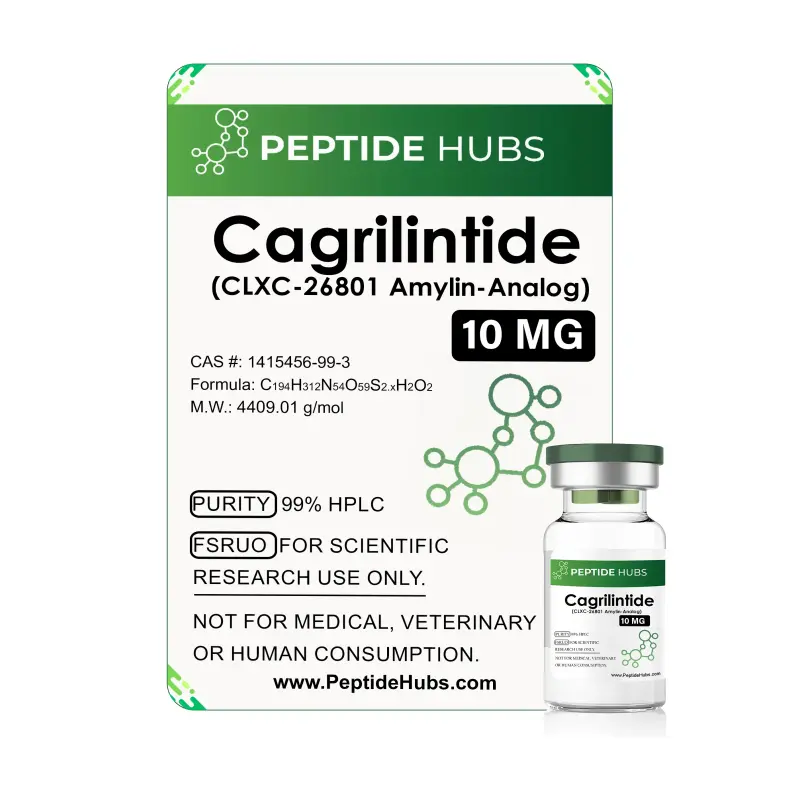
Cagrilintide 10mg
- USA MADE 2-7 days delivery
- International 5-20 days delivery
THIS PRODUCT IS INTEDED AS A RESEARCH CHEMICAL ONLY.
This designation allows the use of research chemicals strictly in vitro for testing and laboratory experimentation only. All products information available on this website is for educational purposes only. Bodily introduction of any kind into humans or animals is strictly forbidden by law. This product should only be handled by licensed, qualified professional. This product is not a drug, food or cosmetic and may not be misbranded, misused or mislabled as a drug food or cosmetic.
What is Cagrilintide?
Cagrilintide is a synthetic, long-acting analogue of amylin, a naturally occurring peptide released by the pancreas in conjunction with insulin. Unlike the parent peptide—amylin—which is rapidly degraded by proteases in the bloodstream, cagrilintide is engineered for extended stability and prolonged biological activity. It functions as a non-selective agonist at amylin receptors (AMYR) and calcitonin receptors (CTR), making it a dual-target research compound. The peptide has been the subject of multiple preclinical and clinical trials examining its potential in metabolic regulation, obesity management, and glucose homeostasis. As a research-grade peptide supplied at 99% purity, cagrilintide is intended exclusively for in vitro and laboratory studies within academic and commercial research settings.
Cagrilintide Structure
The natural disposition of human amylin is, regrettably, rather unstable; it is prone to the formation of fibrils and a rapid decline in utility, much like a guest who fatigues easily at a ball. The architects of Cagrilintide have therefore sought to improve upon nature by introducing specific alterations to its character, ensuring it behaves with greater propriety in solution.
To remedy the inherent weaknesses of the amylin line, precise amino acid substitutions were arranged. Proline residues have been engaged at the C-terminus, a strategic decision intended to discourage the formation of fibrils, which are so often the ruin of a peptide's reputation. Furthermore, a fatty acid moiety has been attached to the N-terminus. This latter addition is of particular advantage, for it allows the peptide to form a respectable attachment to albumin. This connection facilitates its extended circulation in the bloodstream and assists its passage into the brain, a journey not easily undertaken by those of lesser breeding. A C-terminal amide further secures its stability, ensuring it is well-suited to bind with RAMP-1 and RAMP-3 receptors with the utmost fidelity.
Cagrilintide Research
Cagrilintide Origin: What is Amylin?
To comprehend cagrilintide in its proper context, one must first make acquaintance with amylin itself—a peptide of natural origin, synthesised within the pancreatic islets and released in concert with that other celebrated hormone, insulin. The pancreas initially produces amylin as a precursor molecule of considerable length, which is then processed into its mature form: a thirty-seven amino acid peptide of elegant simplicity.
Amylin serves functions of considerable physiological importance. In the brain, it engages specific receptor populations to produce sensations of satiety—that agreeable state of satisfaction following sustenance—thereby reducing the subsequent desire for additional comestibles. In the gastrointestinal tract, it moderates the rate of gastric emptying, ensuring that nutriment passes from stomach to intestine with deliberate, measured pace, rather than in unseemly haste. This modulation permits the body to process glucose with greater efficiency, directing it toward energy production rather than toward adipose tissue accumulation. Furthermore, amylin influences bone metabolism through mechanisms of considerable sophistication, facilitating the deposition of calcium within bone matrix.
Yet amylin suffers from a most vexing constitutional weakness: it is rapidly degraded by proteases in the bloodstream, rendering its tenure in circulation disappointingly brief. Moreover, when amylin concentrations become pathologically elevated—as occurs in conjunction with insulin resistance and type 2 diabetes—the peptide exhibits an unfortunate tendency toward self-aggregation, forming insoluble fibrillar masses. These aggregates are thought to compromise the viability of pancreatic beta cells themselves, thus contributing to the progressive deterioration characteristic of diabetes.
What is Cagrilintide?
Cagrilintide represents advancement of considerable distinction over its predecessor, pramlintide—the first amylin analogue to receive regulatory approbation, now some twenty years hence. Whilst pramlintide succeeded in reducing the sharp glucose elevations occurring after meals in diabetic patients, it laboured under the disadvantage of requiring multiple daily injections owing to its regrettably short half-life.
Cagrilintide overcomes this limitation through means of protease-resistant chemical architecture and extended pharmacokinetic longevity, permitting once-weekly administration whilst maintaining sustained engagement with its receptor targets. Beyond this practical advantage lies another achievement worthy of notice: cagrilintide was deliberately engineered to prevent the protein aggregation that renders native amylin so troublesome. The incorporation of proline residues, the strategic placement of helix-stabilising point mutations, and the N-terminal lipid conjugate collectively minimise fibril formation even when the peptide is present at concentrations considerably exceeding those encountered in nature.
How Does Cagrilintide Work?
The mechanism by which cagrilintide exerts its salutary effects operates through three principal avenues, each worthy of individual consideration.
In the periphery, the compound achieves a most agreeable moderation of gastric transit and intestinal glucose absorption, thereby suppressing those postprandial blood glucose excursions that so often attend the consumption of unwholesome quantities of foodstuff; this effect further reduces the caloric intake through a diminishment of nutrient-driven hunger.
Within the central nervous system, cagrilintide binds to amylin receptors distributed throughout the arcuate nucleus, anterior hypothalamus, and brainstem nuclei, generating thereby sustained signals of satisfaction and contentment whilst diminishing that reward-based feeding behaviour which characterises the intemperate disposition.
Upon the pancreas itself, the compound recapitulates the inhibitory effects of natural amylin upon glucagon secretion, thereby reducing hepatic glucose production and restraining the unnecessary synthesis of lipids from excess carbohydrate.
Structurally, cagrilintide achieves superior receptor engagement through its Y37P C-terminal modification and N-terminal lipidation, which collectively enhance binding kinetics at amylin receptor subtypes (AMY₁R, AMY₂R, AMY₃R) and the calcitonin receptor (CTR). The lipophilic acylation further facilitates passage across the blood-brain barrier, amplifying the compound's potency within the central nervous system—a most elegant arrangement of molecular features.
Cagrilintide: The Research on Obesity
Clinical investigation has yielded results of considerable interest. In the foremost Phase 2b trial, once-weekly cagrilintide administration produced dose-dependent weight reduction ranging from 6-11% of total body weight over a mere six-week period—an effect magnitude exceeding that observed with liraglutide, itself a compound of established efficacy. Adverse events occurred with frequency comparable to that of liraglutide, suggesting tolerability of a most acceptable character.
A subsequent trial examined cagrilintide in combination with semaglutide, revealing effects of synergistic rather than merely additive character. Co-administration achieved weight reductions approaching 17% over 20 weeks—an outcome suggesting that these compounds engage complementary biological pathways, their combined action producing appetite suppression and metabolic regulation more robust than either substance alone.
Cagrilintide in Diabetes
Research documents that cagrilintide, consistent with other amylin analogues, potently reduces insulin resistance and improves glycaemic control through inhibition of glucagon secretion. Trials of modest duration have documented hemoglobin A₁C reductions of approximately 2.2% —a clinically meaningful improvement achieved over remarkably brief therapeutic intervals. The once-weekly dosing interval—a direct consequence of cagrilintide's protracted half-life—provides sustained blood glucose control, smoothing glycaemic variability and reducing both hyperglycaemic and hypoglycaemic episodes.
Cagrilintide in Alzheimer's Disease
That relationship between glucose metabolism and cognitive function possesses well-established foundations is a matter beyond dispute. Diabetes and chronic hyperglycaemia are independently associated with increased risk of cognitive impairment and dementia. Paradoxically, despite elevated circulating glucose, the diabetic brain often experiences diminished glucose availability to its neural cells—a condition termed "brain insulin resistance."
Emerging investigation suggests that amylin dyshomeostasis may contribute to cognitive decline through mechanisms overlapping with beta-amyloid pathophysiology. Most intriguingly, a study of considerable scope found that plasma amylin concentration correlated robustly with brain amyloid-beta precursor abundance. It is hypothesised that excessive amylin aggregation in the bloodstream may sequester amylin and prevent its brain penetration, potentially allowing beta-amyloid to accumulate unopposed.
Cagrilintide Summary
Cagrilintide represents advancement of distinguished character in peptide design for metabolic research. As a long-acting, non-aggregating amylin analogue with dual receptor agonism, this compound addresses limitations of prior-generation therapeutics. Its extended pharmacokinetic profile enables once-weekly dosing whilst maintaining robust, sustained activation of appetite-suppressive and glucose-regulatory circuits. Research to date demonstrates substantial weight loss effects both as monotherapy and—particularly—in combination with other metabolic agents of established efficacy.
FEATURE BULLETS
- 99% Purity (HPLC-Verified) — Laboratory-grade analytical certification assuring minimal impurities and reproducible research outcomes
- Long-Acting Amylin Analogue — Extended half-life and protease-resistant architecture enabling sustained receptor engagement
- Dual Receptor Agonism — Non-selective activation engaging multiple signalling pathways regulating appetite, gastric motility, and glucose homeostasis
- Aggregate-Resistant Structure — Engineered to prevent pathological fibril formation at elevated concentrations
- Blood-Brain Barrier Penetration — Lipophilic modification facilitating central nervous system access
- Lyophilised Powder Format — Optimised for stability and reproducible laboratory reconstitution
- Synergistic Efficacy Profile — Research demonstrates enhanced effects when combined with established metabolic agents
TECHNICAL SPECIFICATIONS TABLE
|
Parameter |
Specification |
|
Compound Name |
Cagrilintide (long-acting amylin analogue) |
|
Molecular Formula |
C₁₉₄H₃₁₂N₅₄O₅₉S₂ |
|
Molecular Weight |
4,409.01 g/mol |
|
Amino Acid Length |
39 amino acids |
|
CAS Number |
1415456-99-3 |
|
Form |
Lyophilised powder |
|
Available Size |
10 mg per vial |
|
Purity |
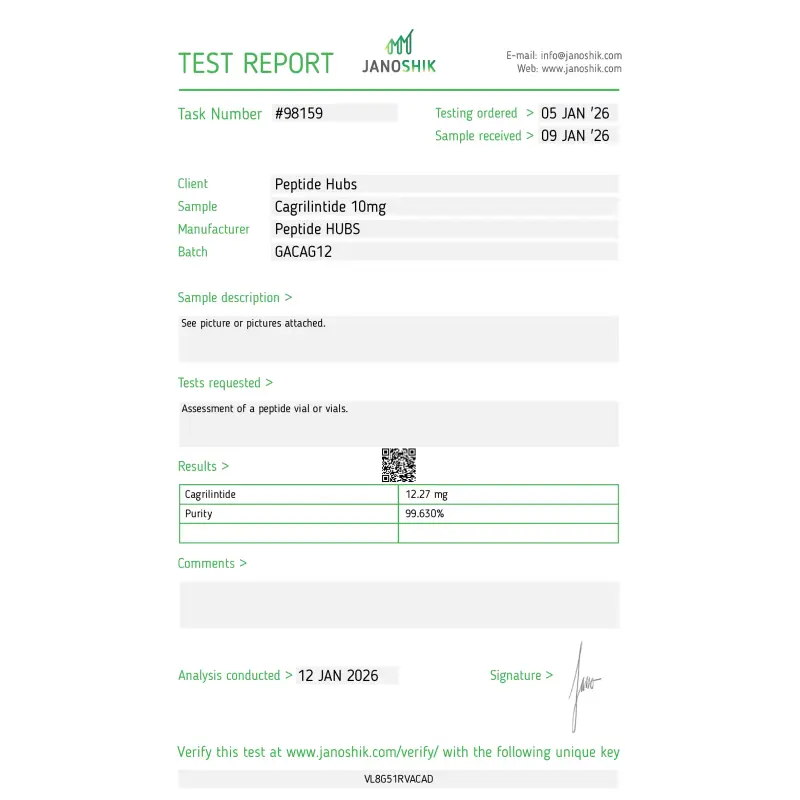
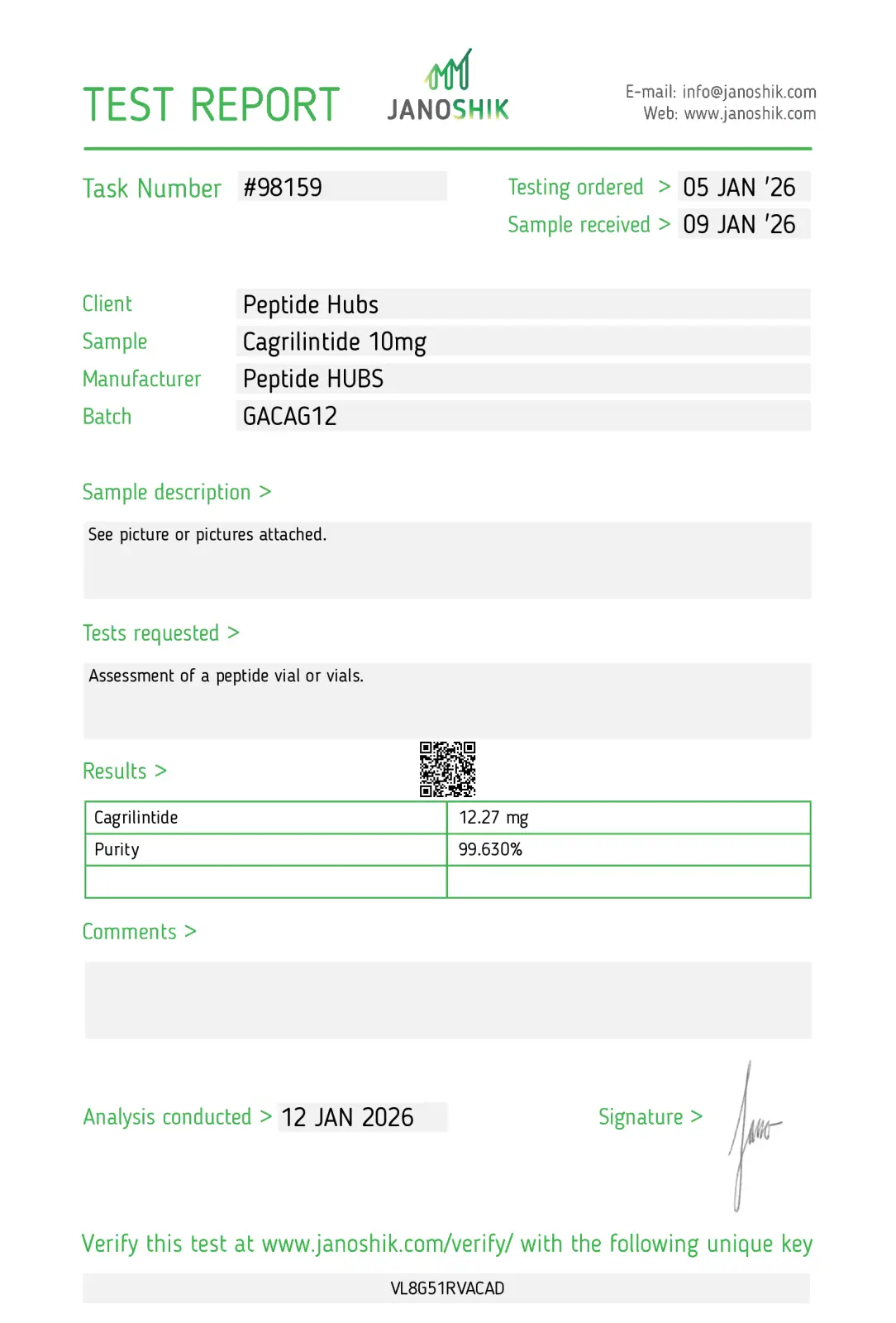
99% (HPLC-verified) |
|
Storage Conditions |
–20 °C or colder; desiccated, dark environment |
|
Shelf Stability |
≥4 years (sealed, proper storage) |
Storage Instructions
Form: Lyophilised powder in sealed vial.
Storage Temperature: -20°C or colder, in conditions dry and devoid of light.
Humidity Control: Store in desiccated container with desiccant packets to minimise moisture exposure.
Light Protection: Keep sealed and shielded from direct luminescence.
Stability: Stable for a minimum of 4 years when stored according to these specifications and maintained sealed.
Reconstitution: Cagrilintide should be reconstituted with sterile bacteriostatic water or appropriate research-grade buffers under aseptic conditions, allowing 15-30 minutes at ambient temperature with gentle agitation. Reconstituted solutions remain stable at 2–8°C for up to 30 days.
Freeze-Thaw Cycles: Minimise repeated cycles of freezing and thawing, lest peptide integrity and biological activity be compromised.

My order took about seven days to arrive due to a courier delay, but the quality of the compound makes the wait worth it. Just be sure to order a week in advance of your next research phase!
remained secure during transit. If you are researching the next generation of metabolic regulation, this is the benchmark product.
It’s rare to find a vendor that provides this level of consistency across multiple batches. Peptide Hubs has earned its place as our primary source for metabolic research.
The 10mg concentration is highly potent, allowing for precise titration in our studies. The lyophilized powder is incredibly stable and reconstituted into a perfectly clear solution.
This is a vital tool for any research focused on long-term weight management pathways.
Related Products




Highly Purified Peptides: Trusted by Researchers Worldwide
Peptide Quality You Can't Find Elsewhere!!
| Peptide Hubs | Leading Competitor | |
|---|---|---|
| 200+ Peptide Variants |  |
 |
| USA-Manufactured Research Grade | |
|
| WHO/GMP & ISO 9001:2015 Certified | |
|
| Third-Party Tested for Purity | |
|
| Certificates of Analysis Provided | |
|
| Competitive Pricing Without Compromise | |
|
| Secure & Discreet Shipping | |
|
See Peptide Hubs in Action


Insights
Survodutide in 2026: The Dual Agonist Changing Liver Fat & Weight Loss Research

Semaglutide for Weight Loss: Key Research Breakthroughs and Insights

SARMs or Peptides? Choosing the Right Compound for Your Fitness Goals
Cellular Regeneration & Anabolism: Top Muscle Peptides for 2026

99% Purity
Ensuring the highest standard with 99% purity.

Quality Ingredients
Crafted with purity and quality ingredients at the core.

Fast Shipping
Fast, reliable shipping straight to your door.

No TFA or Fillers
Nothing extra, just science: no TFA, no fillers.

Quality You Can Rely On — Guaranteed
At PeptideHubs, scientific integrity and product reliability are at the core of everything we do. Each compound is manufactured and tested under strict quality control protocols to ensure consistency, purity, and performance for research applications.
However, if for any reason our product does not meet your research expectations, we offer a 60-day money-back guarantee — providing a risk-free procurement experience for qualified researchers and institutions.
Your research deserves uncompromised quality — and we stand behind every order to ensure you receive.