
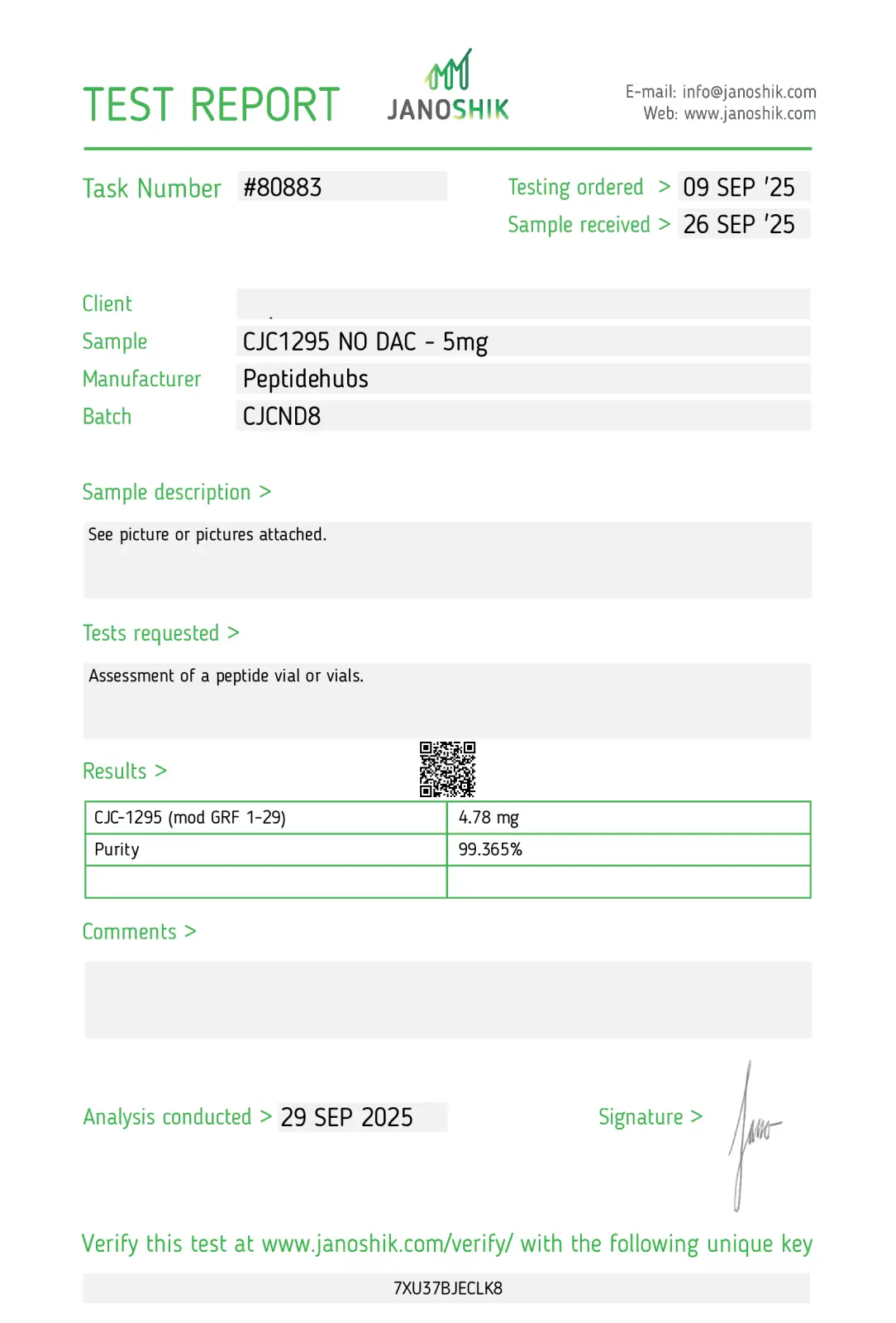
CJC-1295 No DAC 5mg
- USA MADE 2-7 days delivery
- International 5-20 days delivery
THIS PRODUCT IS INTEDED AS A RESEARCH CHEMICAL ONLY.
This designation allows the use of research chemicals strictly in vitro for testing and laboratory experimentation only. All products information available on this website is for educational purposes only. Bodily introduction of any kind into humans or animals is strictly forbidden by law. This product should only be handled by licensed, qualified professional. This product is not a drug, food or cosmetic and may not be misbranded, misused or mislabled as a drug food or cosmetic.
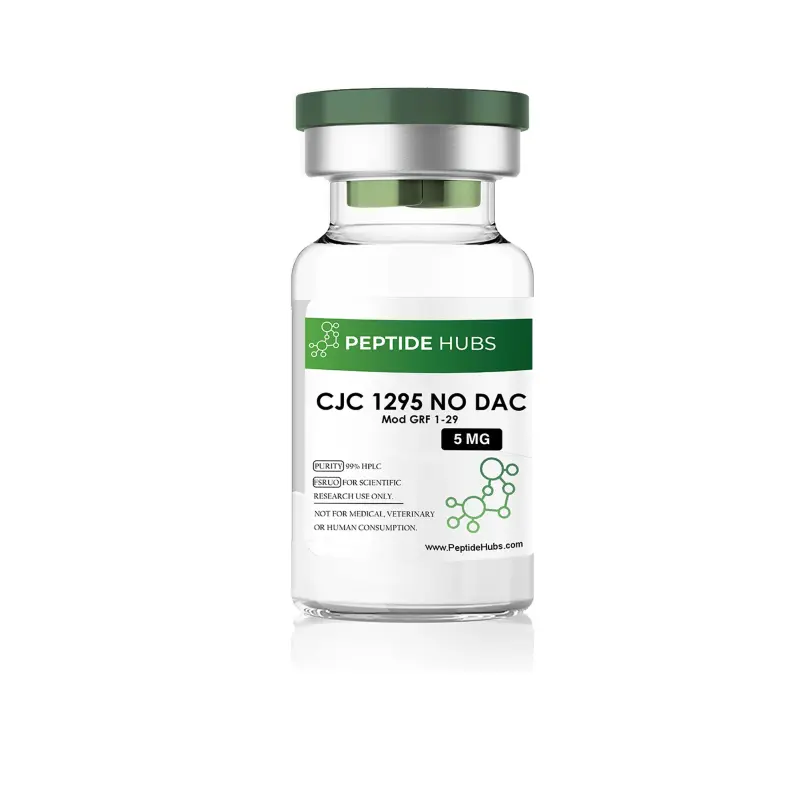
CJC-1295 No DAC 5mg
It is a truth universally acknowledged among researchers of endocrine function that CJC-1295 No DAC—or Modified GRF (1-29), as it is known in more precise scientific parlance—stands as one of the most carefully designed synthetic analogs of growth hormone-releasing hormone available to the modern laboratory. This particular peptide, consisting of precisely 29 amino acids arranged in deliberate sequence, represents a refined modification of what was once termed sermorelin, or growth hormone releasing factor (1-29), being the shortest fragment to retain full functional capability.
What distinguishes this peptide from its natural counterpart are four strategic amino acid substitutions, thoughtfully positioned at the 2nd, 8th, 15th, and 27th positions along its chain. These alterations were not undertaken lightly, but rather with considerable deliberation, their purpose being to shield the peptide from the degrading effects of enzymes whilst preserving—indeed, in some respects enhancing—its biological potency. Unlike CJC-1295 with DAC, which possesses a considerably extended duration of action owing to its drug affinity complex, the present peptide maintains what might be termed a more modest half-life of approximately half an hour. This brevity, far from being a disadvantage, renders it particularly well-suited to research protocols where one wishes to observe pulsatile patterns of growth hormone release—those natural rhythms that characterize the healthy functioning of living systems.
The research applications of CJC-1295 No DAC are manifold and of considerable interest to those engaged in endocrine investigation. Scientists employ this peptide to examine the subtle mechanisms by which GHRH receptors respond to stimulation, to trace the pathways through which growth hormone secretion is regulated, and to observe the consequent dynamics of IGF-1 response within controlled experimental conditions. The peptide exhibits remarkable discrimination in its action, binding preferentially to GHRH receptors situated in the anterior pituitary, thereby permitting researchers to study with precision the workings of the somatotropic axis and those intricate patterns that govern endocrine regulation.
CJC-1295 No DAC Structure
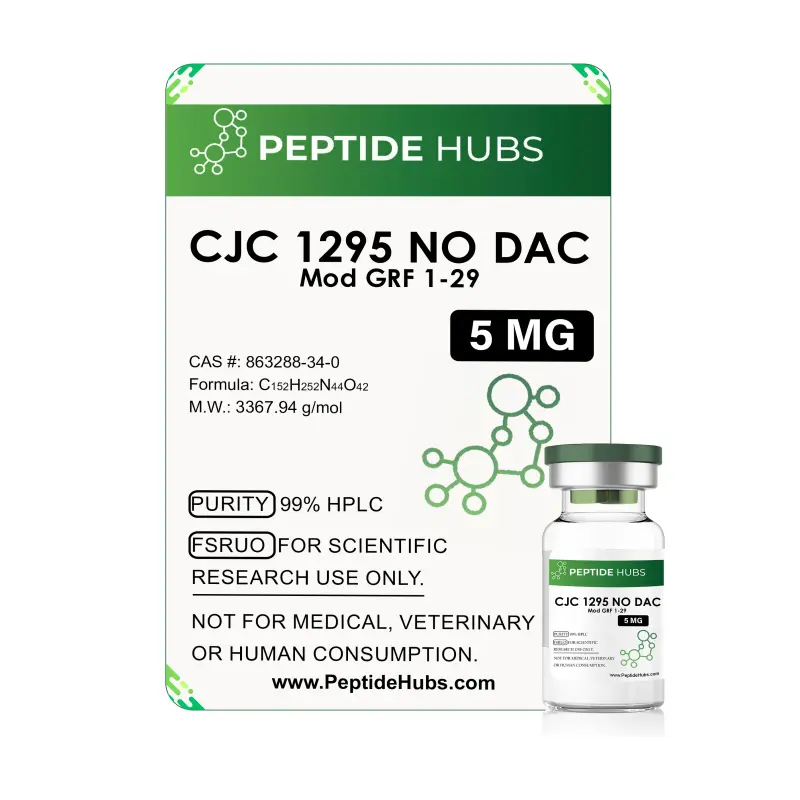
Molecular Formula: C₁₅₂H₂₅₂N₄₄O₄₂
Molecular Weight: 3,367.9 g/mol
CAS Number: 863288-34-0
Amino Acid Sequence:
Tyr-D-Ala-Asp-Ala-Ile-Phe-Thr-Gln-Ser-Tyr-Arg-Lys-Val-Leu-Ala-Gln-Leu-Ser-Ala-Arg-Lys-Leu-Leu-Gln-Asp-Ile-Leu-Ser-Arg-NH₂
One cannot properly appreciate CJC-1295 No DAC without understanding the elegance of its structural modifications. At position 2, L-alanine has been replaced with its mirror image, D-alanine, a substitution that proves remarkably effective in resisting the action of dipeptidyl peptidase-4, an enzyme that would otherwise hasten the peptide's demise. At position 8, asparagine yields its place to glutamine, thereby reducing the likelihood of amide hydrolysis. The 15th position sees glycine exchanged for alanine—a change that enhances bioactivity—whilst at position 27, leucine supplants methionine, protecting the peptide from oxidative damage. Each of these alterations serves the dual purpose of improving stability and extending the peptide's active duration, though without the pronounced effect achieved by DAC conjugation.
Physical Properties:
- Appearance: A white to off-white lyophilized powder of refined quality and consistent presentation
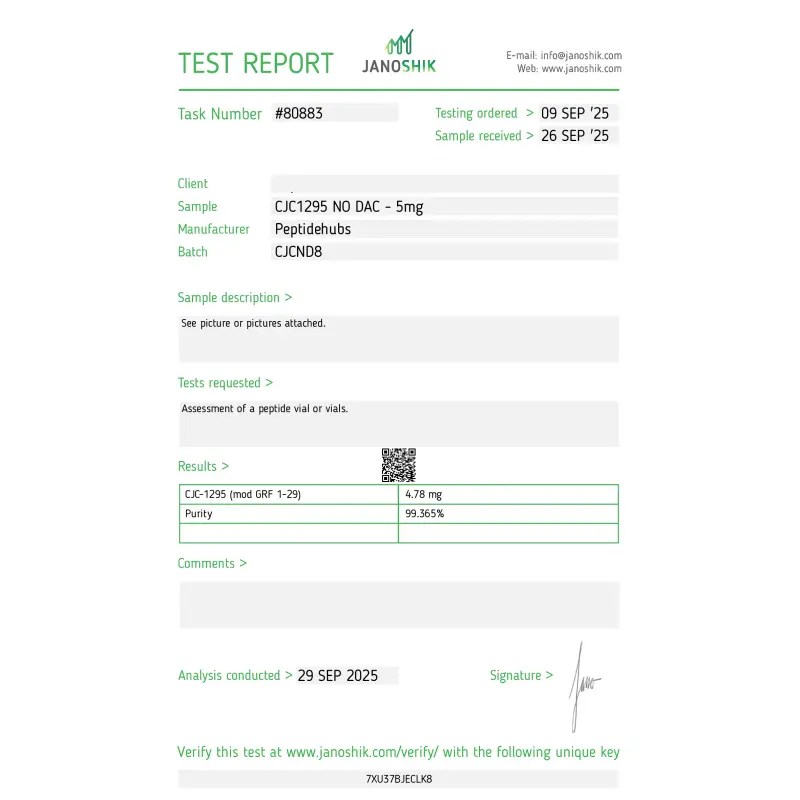
- Purity: Not less than 99%
- Solubility: Demonstrates ready solubility in bacteriostatic water and other sterile aqueous solutions
Storage Instructions
Preservation of Lyophilized Powder:
Unopened vials ought to be stored at temperatures of -20°C or below, situated in a dry and darkened environment, well protected from moisture and light. Whilst peptides may remain tolerably stable at room temperature for several weeks, refrigerated conditions of 2-8°C are strongly recommended for optimal short-term storage. Should one require storage periods exceeding four weeks, it becomes essential to maintain temperatures at -20°C or -80°C to preserve the integrity of the peptide.
Guidelines for Reconstitution:
It is of considerable importance that both the peptide vial and bacteriostatic water be permitted to reach room temperature prior to reconstitution. Employing sterile technique throughout, one ought to inject the solvent slowly down the vial wall at a 45-degree angle to minimize the formation of foam. The vial should then be gently swirled until complete dissolution occurs—vigorous shaking must be scrupulously avoided, as such treatment may damage the delicate peptide structure.
Storage Following Reconstitution:
Once reconstituted, solutions must be stored at 2-8°C and employed within a period of 2-8 weeks to ensure optimal stability. The creation of aliquots is strongly advised to avoid repeated freeze-thaw cycles, which possess the unfortunate tendency to compromise peptide integrity. Whilst solutions may remain stable for approximately 3-4 months when maintained at -20°C, single-use preparation is most earnestly recommended for research applications requiring maximum potency.

I’ll continue ordering from Peptide Hubs without hesitation.
That attention to detail says a lot about their commitment to researchers. Looking forward to testing the high-purity product soon!
That level of dedication to service ensures I will only buy from them.
Related Products




Highly Purified Peptides: Trusted by Researchers Worldwide
Peptide Quality You Can't Find Elsewhere!!
| Peptide Hubs | Leading Competitor | |
|---|---|---|
| 200+ Peptide Variants |  |
 |
| USA-Manufactured Research Grade | |
|
| WHO/GMP & ISO 9001:2015 Certified | |
|
| Third-Party Tested for Purity | |
|
| Certificates of Analysis Provided | |
|
| Competitive Pricing Without Compromise | |
|
| Secure & Discreet Shipping | |
|
See Peptide Hubs in Action


Insights

Vesugen Peptide: Current Research on Aging and Vascular Biology
PE-22-28 Peptide: Exploring Its Mechanism and Scientific Potential
DSIP Peptide Research: Sleep Regulation, Evidence, and Safety
Cardiogen Peptide: Scientific Evidence and Potential Applications

99% Purity
Ensuring the highest standard with 99% purity.

Quality Ingredients
Crafted with purity and quality ingredients at the core.

Fast Shipping
Fast, reliable shipping straight to your door.

No TFA or Fillers
Nothing extra, just science: no TFA, no fillers.

Quality You Can Rely On — Guaranteed
At PeptideHubs, scientific integrity and product reliability are at the core of everything we do. Each compound is manufactured and tested under strict quality control protocols to ensure consistency, purity, and performance for research applications.
However, if for any reason our product does not meet your research expectations, we offer a 60-day money-back guarantee — providing a risk-free procurement experience for qualified researchers and institutions.
Your research deserves uncompromised quality — and we stand behind every order to ensure you receive.