
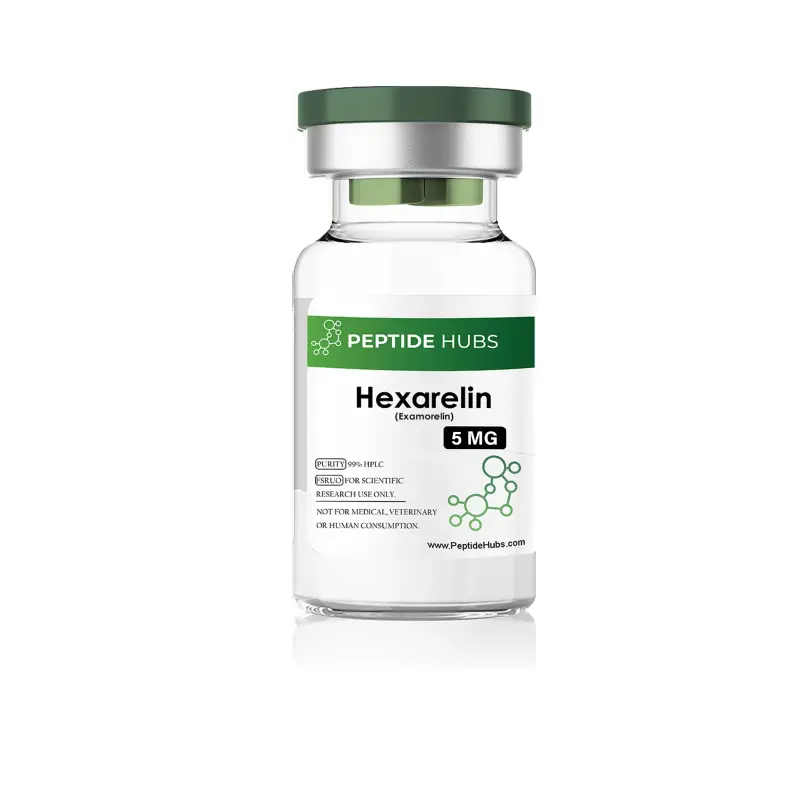
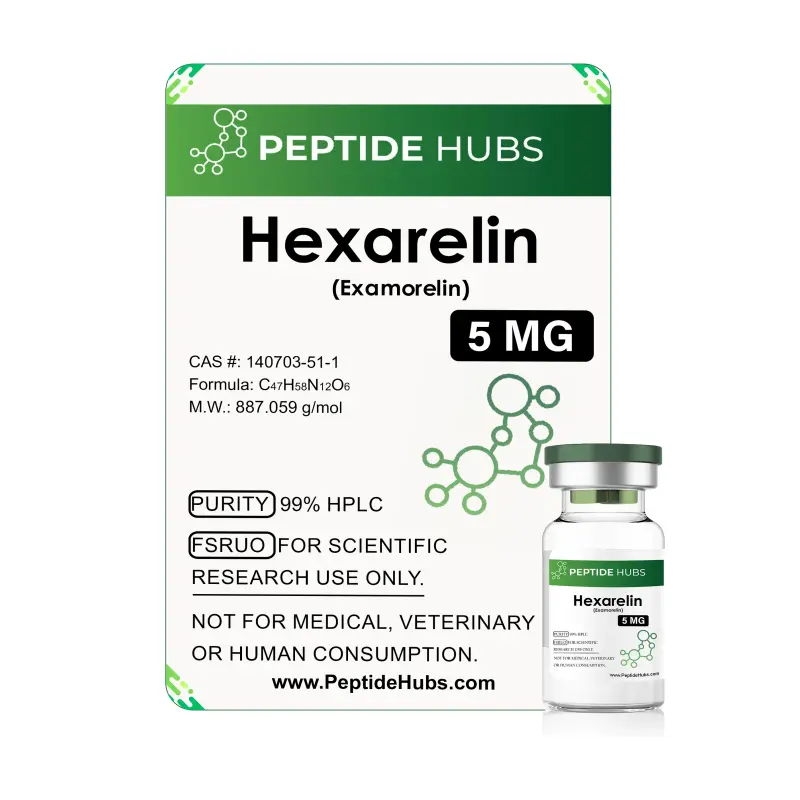
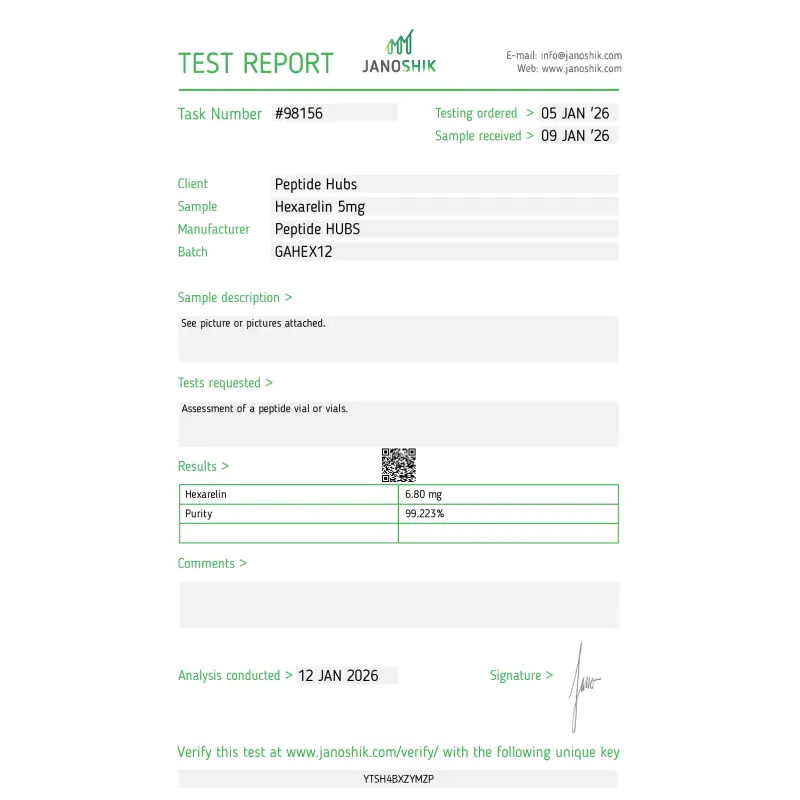
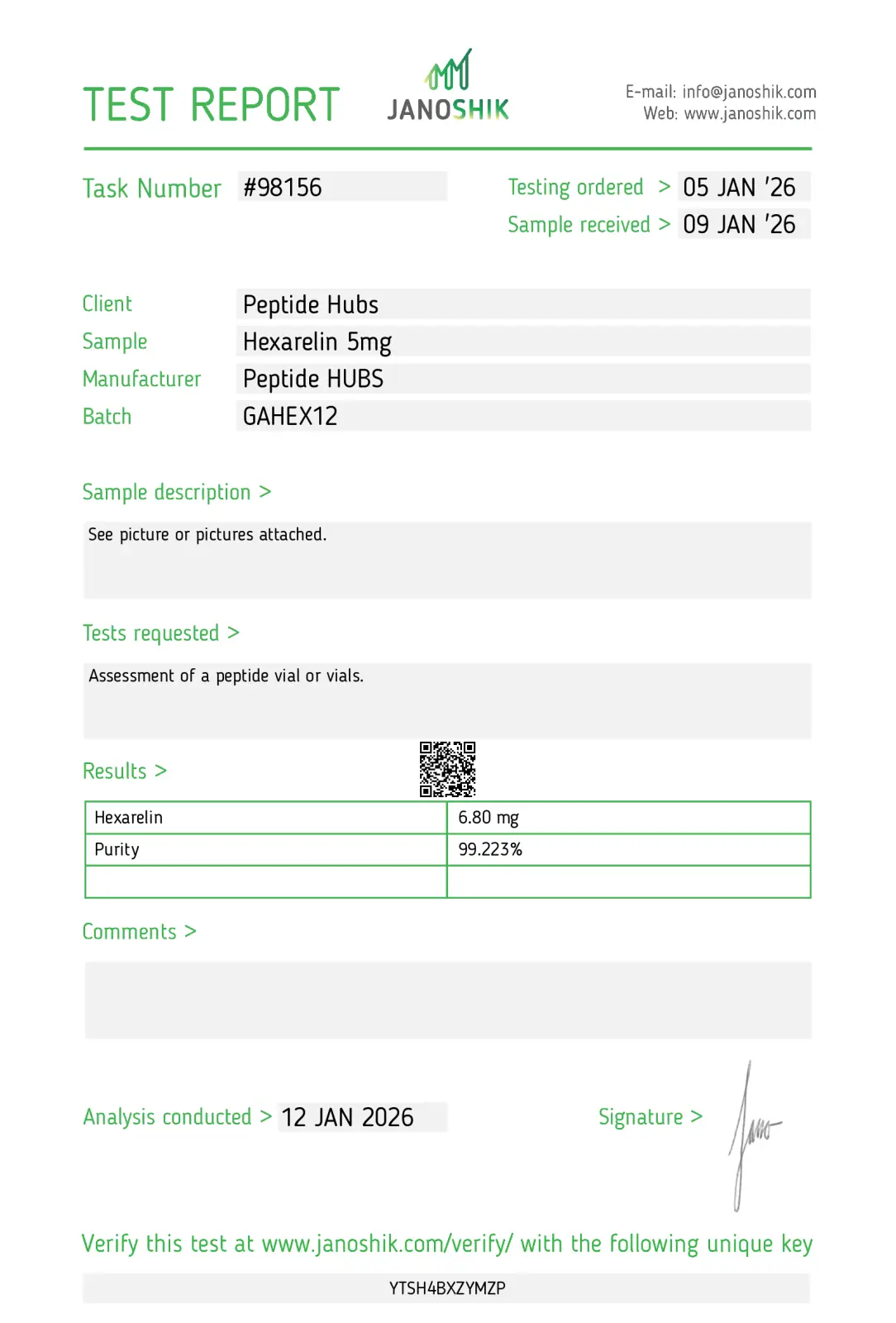
Hexarelin 5mg
- USA MADE 2-7 days delivery
- International 5-20 days delivery
THIS PRODUCT IS INTEDED AS A RESEARCH CHEMICAL ONLY.
This designation allows the use of research chemicals strictly in vitro for testing and laboratory experimentation only. All products information available on this website is for educational purposes only. Bodily introduction of any kind into humans or animals is strictly forbidden by law. This product should only be handled by licensed, qualified professional. This product is not a drug, food or cosmetic and may not be misbranded, misused or mislabled as a drug food or cosmetic.
What is Hexarelin?
Hexarelin, also known as Examorelin, is a synthetic analog of the naturally occurring peptide ghrelin. Composed of six amino acids, this compound mimics ghrelin's function by activating growth hormone secretagogue receptors (GHS-Rs), particularly the GHSR-1a subtype found throughout the hypothalamus, pituitary gland, and peripheral tissues. Unlike native ghrelin, which contains 28 amino acids and exhibits limited stability, Hexarelin incorporates non-natural amino acids that confer resistance to enzymatic degradation. This structural modification extends its functional half-life to approximately 57–71 minutes and enhances its suitability for controlled laboratory protocols.
Developed over 25 years ago as part of a class of growth hormone-releasing peptides (GHRPs), Hexarelin has since accumulated extensive research documentation. Its mechanism differs from the direct action of growth hormone-releasing hormone (GHRH) by engaging an alternative pathway mediated by GHS-R activation. This dual capacity—stimulating both pituitary GH release and modulating hypothalamic signals—positions Hexarelin as a versatile research tool for studies examining neuroendocrine regulation, metabolic homeostasis, and tissue resilience.
Hexarelin's potency surpasses that of related peptides such as GHRP-6 in multiple experimental models, and its effects extend beyond growth hormone modulation to include cardioprotective, metabolic, and anti-apoptotic activities. Researchers have noted that Hexarelin can stimulate other pituitary hormones, including adrenocorticotropic hormone (ACTH) and prolactin, which may influence experimental design considerations. Peptideshubs supplies Hexarelin at 99% purity, verified through rigorous RP-HPLC and SDS-PAGE analysis, ensuring consistency and reliability across research applications.
Hexarelin Structure
The architecture of Hexarelin possesses an order and propriety most admirable, comprising six amino acid residues of precise arrangement. Several of these constituents are, one might say, of unconventional origin—non-natural amino acids which Nature herself has not encountered, yet which the chemist has contrived most ingeniously to render resistant to enzymatic degradation.
Amino Acid Sequence: His-D-2-Methyl-Trp-Ala-Trp-D-Phe-Lys-NH₂
Molecular Formula: C₄₇H₅₈N₁₂O₆
Molecular Weight: 887.04–887.05 g/mol
CAS Number: 140703-51-1
The inclusion of D-2-methyl-tryptophan and D-phenylalanine—configurations which represent a departure from Nature's customary preferences—improves the peptide's resistance to the degradations that time and enzyme inevitably effect upon ordinary structures. The amidation at the terminus further strengthens this resistance, preventing the incursions of carboxypeptidase as one might prevent an unwanted caller at one's door.
Hexarelin Effects
Protects the Heart
It is with no inconsiderable satisfaction that one observes Hexarelin has captured the serious attention of those investigators concerned with the preservation of cardiac function. In studies conducted most carefully upon laboratory models, this peptide has demonstrated a remarkable capacity to shield the heart's cells from injury—particularly during those distressing circumstances wherein cardiac arrest threatens.
The mechanisms by which Hexarelin exerts this protection are themselves of interest most considerable. The peptide appears to engage with both the CD36 receptor and the GHSR, thereby preventing that cellular demise designated as apoptosis from overtaking the cardiac cells. In chronic administration studies, Hexarelin has attenuated the fibrosis—that excessive accumulation of connective tissue—which occurs in hypertensive hearts. The peptide accomplished this worthy effect by increasing the activities of certain matrix metalloproteinases whilst decreasing the mRNA expression of tissue inhibitor proteins.
Further investigations have revealed that when Hexarelin was administered to models experiencing acute myocardial infarction, the preservation of myocardial function proved most evident, and cardiac fibrosis was notably reduced. The peptide appeared to prevent cardiac fibroblasts from assuming that proinflammatory and fibrogenic phenotype which would otherwise lead to excessive collagen synthesis. Observations have further documented improvements in left ventricular ejection fraction—that most important measure of cardiac competence—without untoward alterations to blood pressure.
Improves Fat Measures
In matters pertaining to adipose tissue disposition and lipid metabolism regulation, Hexarelin displays propriety worthy of commendation. Where insulin resistance permits triglycerides to accumulate excessively—plasma triglycerides rising by twenty-eight percent, hepatic by thirty-two percent—Hexarelin accomplishes salutary correction. This amelioration occurs alongside redistribution of bodily composition: fat mass diminishes whilst lean mass increases, achieved through judicious upregulation of genes governing fatty acid oxidation and mitochondrial biogenesis.
The adipocytes themselves undergo transformation remarkable in beneficial character. Average adipocyte diameter decreases by approximately eleven percent, indicating shift toward smaller, metabolically active cells of superior insulin sensitivity. The mechanism engages peroxisome proliferator-activated receptor gamma coactivator 1-alpha (PGC-1α) and critical genes of substance, whilst CD36 expression enhances fatty acid uptake and oxidation. In atherosclerosis models, Hexarelin improves the HDL-cholesterol to LDL-cholesterol ratio with consistency suggesting not accident, but deliberate design.
Protects Muscle
The vulnerability of skeletal muscle to the ravages of cachexia—that devastating wasting which attends upon severe illness—has long given cause for concern among the medical profession. Hexarelin has demonstrated protective properties most encouraging in experimental models of this condition. When laboratory models were subjected to those agents which induce cachexia, the introduction of Hexarelin afforded measurable protection to the muscular apparatus.
In one instance, where catabolic conditions would ordinarily result in a 12% diminution of muscle mass, the administration of Hexarelin reduced this loss to approximately 7%—a difference of consequence not to be dismissed. Parallel investigations revealed that the peptide attenuated the reduction in muscular strength which would ordinarily accompany such catabolic stress.
The molecular foundation for these protective effects appears to rest upon Hexarelin's capacity to regulate calcium homeostasis and preserve the integrity of mitochondrial structure and function. The peptide accomplishes this by maintaining mitochondrial biogenesis, mass, and the proper fusion of these vital organelles—a preservation most essential to cellular vitality.
Hexarelin Heavily Researched
One might confidently assert that Hexarelin has achieved that distinction which comes only through sustained and rigorous scholarly attention. Since its inception, this peptide has been the subject of continuous investigation across multiple domains of scientific inquiry—endocrinology, cardiology, and metabolic science alike.
The literature concerning Hexarelin's capacity to release growth hormone has accumulated with gratifying regularity. Investigations have demonstrated that in both youthful and mature models, Hexarelin induced growth hormone levels of greater magnitude than those achieved through GHRH alone, or through GHRH combined with arginine. The peptide's ability to stimulate growth hormone release in cell lines which proved insensitive to GHRH alone provided valuable illumination regarding the distinct pathways by which GHRPs and GHRH operate—a distinction as important to the endocrinologist as the difference between principal and secondary characters in a narrative of consequence.
The cardiovascular actions of Hexarelin have been examined across multiple experimental paradigms—from those acute studies of ischaemia-reperfusion injury to chronic investigations of hypertension. Such diversity of investigation has permitted a most thorough elucidation of the peptide's molecular interactions with both the GHS-R and CD36 receptors, thereby illuminating the foundation upon which its diverse biological activities rest.
The metabolic investigations into Hexarelin's effects have expanded considerably the understanding of how growth hormone secretagogues may influence lipid handling, adipocyte function, and insulin sensitivity—matters of no small import to those concerned with metabolic health.
Feature Bullets
- Synthetic hexapeptide of elegant composition, comprising six amino acids with enhanced enzymatic stability conferred through the judicious incorporation of D-amino acids
- Growth hormone secretagogue engaging GHSR-1a receptors via G-protein-dependent signalling pathways of considerable complexity
- Most extensively researched in the scientific literature for investigations of cardiac, metabolic, and muscle tissue phenomena
- Dual receptor activity documented at both GHS-R and CD36 sites within experimental models of discernment
- Distinguished purity formulation (99%) ensuring reproducible results in controlled laboratory settings most rigorous
- Lyophilised preparation offering extended shelf-life and straightforward reconstitution protocols of practical utility
- Structural analogue of ghrelin wherein modified tryptophan confers improved stability superior to that of the endogenous ligand
Technical Specifications Table
|
Specification |
Value |
|
Product Name |
Hexarelin (Examorelin) |
|
Size |
5mg |
|
Form |
Lyophilised powder |
|
Purity |
99% |
|
Molecular Formula |
C₄₇H₅₈N₁₂O₆ |
|
Molecular Weight |
887.04 g/mol |
|
Amino Acid Sequence |
His-D-2-Methyl-Trp-Ala-Trp-D-Phe-Lys-NH₂ |
|
CAS Number |
140703-51-1 |
|
Synonyms |
Examorelin |
|
Storage (Lyophilised) |
≤ -18°C; -80°C for long-term |
|
Storage (Reconstituted) |
4°C for 2–7 days; ≤ -18°C for longer periods |
Storage Instructions
Lyophilised Form:
- The lyophilised preparation ought to be maintained at temperatures below -18°C (0°F) for periods of extended duration
- It shall remain stable at room temperature for a period not exceeding three weeks, though refrigeration at 4°C is to be preferred
- For storage of several months' duration or beyond, a temperature of -80°C (-112°F) is most advisable
- The peptide must be kept desiccated, removed from the exposure of light and moisture
Reconstituted Form:
- Once reconstituted, the preparation ought to remain at 4°C (39°F) for a duration between two and seven days
- Should extended preservation of reconstituted peptide become necessary, the investigator is advised to apportion the preparation into aliquots and store such portions below -18°C
- Repeated cycles of freezing and thawing must be scrupulously avoided, as such treatment increases susceptibility to degradation
General Handling:
- Upon opening the container, allow the peptide to attain room temperature prior to removing required quantities, thereby preventing moisture contamination—a precaution as sensible as it is necessary
- Following the extraction of the required amount, the container ought to be resealed in an atmosphere of dry, inert gas (nitrogen or argon preferred) to minimise oxidative processes
- Particular vigilance is warranted with peptides containing tryptophan residues, as present in Hexarelin, for such structures prove particularly susceptible to air oxidation

The results in our pilot studies have been reproducible every single time. For a lab working on growth hormone pathways or muscle-wasting research, having a dependable and cost-effective source like this is invaluable.
The peptide showed the expected binding affinity in our cardiac tissue assays. My only suggestion would be to provide more batch-specific data on the vial itself for easier cataloging, but the actual chemical quality is second to none.
Related Products




Highly Purified Peptides: Trusted by Researchers Worldwide
Peptide Quality You Can't Find Elsewhere!!
| Peptide Hubs | Leading Competitor | |
|---|---|---|
| 200+ Peptide Variants |  |
 |
| USA-Manufactured Research Grade | |
|
| WHO/GMP & ISO 9001:2015 Certified | |
|
| Third-Party Tested for Purity | |
|
| Certificates of Analysis Provided | |
|
| Competitive Pricing Without Compromise | |
|
| Secure & Discreet Shipping | |
|
See Peptide Hubs in Action


Insights

Sermorelin, GHRP-6 & GHRP-2: Exploring Hormonal Pathways and Synergy

PE-22-28: Cellular Interactions and Neural Research

Kisspeptin 45-54 in Focus: Hypothalamic Biology and Neuronal Research

Ipamorelin Interactions with Pituitary Sensitivity and Growth Hormone Pulsatility

99% Purity
Ensuring the highest standard with 99% purity.

Quality Ingredients
Crafted with purity and quality ingredients at the core.

Fast Shipping
Fast, reliable shipping straight to your door.

No TFA or Fillers
Nothing extra, just science: no TFA, no fillers.

Quality You Can Rely On — Guaranteed
At PeptideHubs, scientific integrity and product reliability are at the core of everything we do. Each compound is manufactured and tested under strict quality control protocols to ensure consistency, purity, and performance for research applications.
However, if for any reason our product does not meet your research expectations, we offer a 60-day money-back guarantee — providing a risk-free procurement experience for qualified researchers and institutions.
Your research deserves uncompromised quality — and we stand behind every order to ensure you receive.