
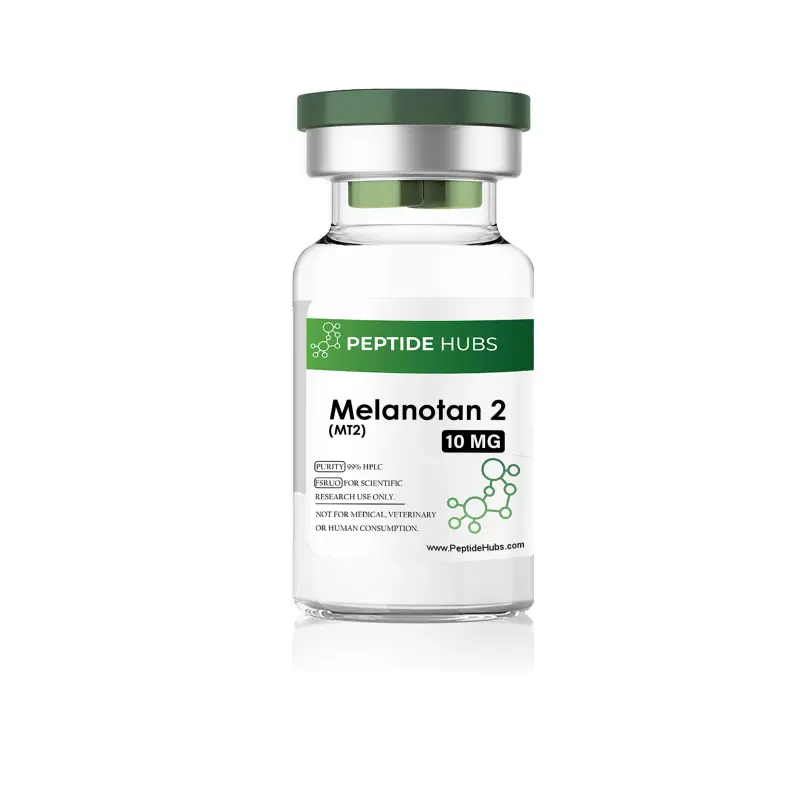
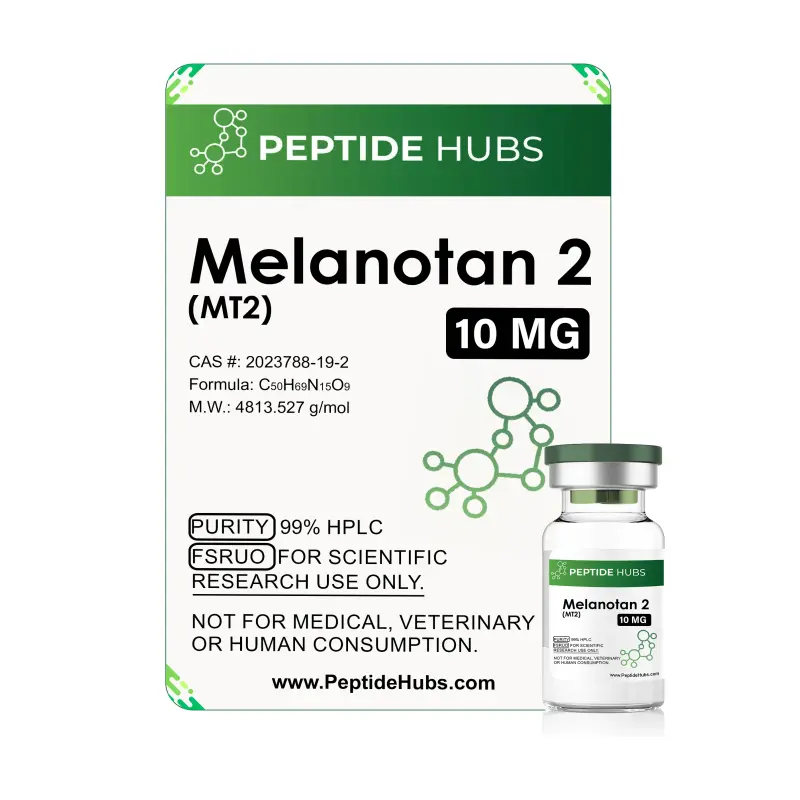
Melanotan 2 10mg
- USA MADE 2-7 days delivery
- International 5-20 days delivery
THIS PRODUCT IS INTEDED AS A RESEARCH CHEMICAL ONLY.
This designation allows the use of research chemicals strictly in vitro for testing and laboratory experimentation only. All products information available on this website is for educational purposes only. Bodily introduction of any kind into humans or animals is strictly forbidden by law. This product should only be handled by licensed, qualified professional. This product is not a drug, food or cosmetic and may not be misbranded, misused or mislabled as a drug food or cosmetic.
Melanotan 2 (MT-2) 10mg - Research Peptide
In the 1980s, scientists at the University of Arizona sought a safer way to tan the skin. Instead, they created Melanotan 2 — a synthetic peptide whose effects went far beyond mere pigmentation. It darkened skin, yes, but it also touched appetite, mood, and desire. Decades on, MT-2 is still under study, a quiet lesson that in science, one discovery can lead to paths no one expected.
What Is Melanotan 2?
The story begins with a simple problem. Natural melanocortin hormones break down too quickly in the human body. They cannot do their job properly. So researchers at Arizona built something stronger.
They took the natural hormone that darkens skin—alpha-melanocyte-stimulating hormone—and rebuilt it piece by piece. They made it circular instead of linear. They swapped out weak amino acids for stronger ones. They created a molecule that could survive where its natural cousin would perish.
The result surprised everyone. This new peptide worked not just on skin cells, but on brain cells, fat cells, and cells throughout the reproductive system. It was one thousand times more powerful than the original hormone in laboratory tests. The scientists had stumbled upon something that touched nearly every aspect of human physiology.
Today, Melanotan 2 sits in research freezers around the world. Scientists inject it into laboratory animals and watch what happens. The effects are consistent and profound. The peptide finds receptors in the brain, the skin, the digestive system, and the sexual organs. It speaks to each in its own chemical language.
The Structure of Control
Chemical Name: Ac-Nle-cyclo[Asp-His-D-Phe-Arg-Trp-Lys]-NH2
Formula: C₅₀H₆₉N₁₅O₉
Weight: 1024.2 g/mol
Registry: 121062-08-6
Look at this molecule under a microscope and you see clever engineering. The scientists built a bridge inside the peptide—connecting two amino acids like a molecular handcuff. This bridge keeps the structure rigid. It prevents the body's enzymes from tearing it apart.
They replaced one natural amino acid with an artificial one. Norleucine instead of methionine. This simple swap prevents oxidation—the chemical rusting that destroys so many biological molecules. They inserted a backwards amino acid, D-phenylalanine, which confuses the body's recycling machinery. The peptide survives where others would be broken down for parts.
These modifications work. While natural melanocortins last minutes in the bloodstream, Melanotan 2 endures for hours. It crosses barriers that stop other peptides. It reaches parts of the brain that most molecules cannot touch.
The Research Findings
How It Works
Melanotan 2 operates through five different switches in the human body—the melanocortin receptors. Each switch controls different functions. Switch one darkens the skin. Switch four suppresses appetite and triggers sexual arousal. The others have subtler roles that researchers are still mapping.
The peptide does not choose between switches. It flips them all. This explains why people using Melanotan 2 for tanning often report unexpected effects: loss of appetite, increased libido, changes in mood. The peptide acts like a master key, opening doors throughout the body.
Autism Studies
In laboratories with mice, scientists have seen something striking. When pregnant mice are made to mount an immune response, their offspring are born with damaged brains. As they grow, these young mice act differently — they keep to themselves, make fewer sounds, and repeat the same motions again and again.
Then the researchers give them Melanotan 2. The change is plain: the mice begin to mix with others, to call as they should, to break their old patterns. Their social world, once closed, seems to open again.
The mechanism appears to involve oxytocin—the bonding hormone. Melanotan 2 causes brain cells to release more oxytocin, which may restore normal social functioning. These are early findings in animals, but they point toward possibilities that did not exist before.
Appetite Control
Inject Melanotan 2 into a laboratory rat and it will eat less. Much less. The effect begins within hours and can last for days. The peptide targets brain circuits that control hunger—the same circuits influenced by leptin, the body's natural appetite suppressant.
But Melanotan 2 works even when leptin fails. In obese animals whose leptin receptors have stopped responding, the peptide still suppresses appetite. This suggests it bypasses some of the resistance mechanisms that make weight loss so difficult.
The peptide also changes food preferences. Animals given Melanotan 2 lose interest in high-fat foods while maintaining normal responses to other nutrients. This selectivity hints at effects on reward pathways rather than simple appetite suppression.
Blood Sugar Effects
Diabetic animals respond well to Melanotan 2. Their blood sugar improves. Their cells become more sensitive to insulin. These effects occur even when researchers control for the appetite-suppressing properties—the metabolic benefits are real and independent.
The peptide appears to work both in the brain and throughout the body. In the brain, it may restore insulin sensitivity in regions that control glucose production. In peripheral tissues, it may directly enhance insulin's effects.
Alcohol and Impulse Control
Give laboratory animals access to alcohol and many will drink to excess. Give them Melanotan 2 first, and their consumption drops dramatically. The effect is specific to alcohol—water consumption remains normal.
Researchers have found that combining Melanotan 2 with naltrexone, an approved addiction medication, produces effects greater than either drug alone. This suggests the peptide works through novel pathways that complement existing treatments.
The mechanism involves brain reward circuits—the same networks hijacked by addictive substances. Melanocortin receptors sit at crucial points in these circuits, and their activation appears to restore normal impulse control.
Sexual Function
The sexual effects of Melanotan 2 were discovered by accident. Early tanning studies reported spontaneous erections in male subjects. Controlled trials followed. The results were dramatic.
In men with erectile dysfunction, roughly eight out of ten achieved functional erections after Melanotan 2 injection. The effects lasted several hours and did not require sexual stimulation to begin. This distinguished the peptide from drugs like Viagra, which work through blood vessel effects.
More importantly, Melanotan 2 worked in men who had failed treatment with other medications. This suggested a different mechanism—one involving brain circuits rather than genital blood flow. The peptide enhanced both physical function and sexual desire, addressing psychological as well as physiological aspects of dysfunction.
The Risks
No drug is perfectly safe. Melanotan 2 causes nausea in many users, particularly when first starting treatment. Facial flushing is common. Most people lose their appetite—sometimes dramatically.
More concerning are the case reports of serious complications. One person took six times the recommended dose and developed muscle breakdown, kidney problems, and dangerously high blood pressure. Others have reported new moles appearing or existing moles changing after prolonged use.
There have been isolated reports of kidney damage, possibly related to dehydration or blood vessel constriction. The peptide's effects on sexual function can be problematic—erections lasting several hours have been documented.
Quality represents another major concern. Unlike prescription medications, research peptides receive no regulatory oversight. Internet suppliers sell products of unknown purity containing unknown contaminants. Bacterial contamination has been documented in commercial preparations.
RESEARCH USE ONLY: This peptide exists for the laboratory, not the clinic. It is not cleared for human use, medical treatment, or personal application. Only trained researchers, working under proper supervision and safety rules, should handle it. The details given here are for study and understanding — not for diagnosis, therapy, or advice.
Storage and Handling
Melanotan 2 comes as a fine white powder sealed in vials. Keep these vials frozen at –20 °C, protected from light and moisture. In this state, the peptide stays stable for years.
Once water is added, time begins to count. The molecule becomes delicate. Store the reconstituted liquid in a refrigerator and use it within two weeks; after that, it begins to break down. Use bacteriostatic water to mix — its preservative keeps bacteria from taking hold. Add the water slowly, avoiding foam; swirl the vial gently, never shake.
For longer keeping, divide the mixed solution into single-use portions and freeze them separately. This prevents the wear of thawing and refreezing. Glass vials are best — some plastics do not treat peptides kindly.

Had a small glitch during checkout (my fault), and their team couldn’t have been more helpful. Quick response, polite communication, and the product quality is fantastic. I’ll definitely continue ordering from Peptide Hubs.
My Melanotan 2 order arrived today, and I’m impressed with the customer service.
They paused my order when they noticed I forgot to add BAC water and gave me the option to include it. That attention to detail says a lot. Looking forward to testing the
product soon!
UPS messed up my delivery, but Peptide Hubs handled it like pros. I emailed them with proof, and they responded first thing in the morning. They resent my order with signature required and even included free BAC water for the inconvenience.
That’s the kind of company I want to stick with quality products and amazing service.
I’ve ordered Melanotan 2 twice now, and both times the experience was flawless. Great product, super-fast shipping, and no issues whatsoever. I’ll definitely be back for more. I highly recommend it!
Melanotan 2 from Peptide Hubs is excellent! The product quality is outstanding, communication is smooth, and delivery is fast. I love that COAs are available for transparency. If you want the best deal, go for the Build Your Own Box option. I’ve
purchased multiple times and will continue to do so.
Product Quality:
Lab-grade, pure, clear packaging.
Usage (Research Context):
Assessed MC-1 receptor engagement and melanin production curves.
Results (Modelled):
• Strong activation of pigmentation pathways, consistent with clinical pilot data.
Side Effects (Modelled Warnings):
Modelled risk indicators matched side effect patterns nausea, site flushing, appetite loss, spontaneous erections but long-term harm not included in modelling.
Shipping:
Rapid, discreet, professional.
Overall:
Perfect for controlled mechanistic studies but not meant for recreational use. Five stars for research integrity, with built-in caution.
Product Quality:
High purity and clarity upon reconstitution meets lab standard.
Usage (Simulated):
Modeled effects in melanocytes with and without UV exposure.
Results (Modeled):
• Tanning occurs rapidly but without sunscreen, UV risk is not offset.
Side Effects (Health Alerts):
Agencies warn of cancer risk, mole changes, stroke, and kidney damage; also note that melanotan doesn’t provide UV protection.
Shipping:
Secure, discreet.
Overall:
Accelerated tan comes at potential dermatologic and systemic risk. Two stars too hazardous to endorse beyond controlled research
Product Quality:
Lab-grade, well-packaged, easy to reconstitute.
Usage (Simulated):
Modeled phasic tan-building behaviour seen in social media marketing.
Results:
• Modeling aligns with rapid melanin gains; influencers’ “glow” claims reflect probable outcomes.
Side Effects (Media Alerts):
Media and regulators warn of serious health risks such as allergic reactions, melanoma, priapism, brain swelling, and kidney failure.
Shipping:
Efficient and discrete.
Overall:
Reflects viral trends and outcome plausibility but dark side demands caution. Four stars, deducting one for glamorizing a risky substance.
Product Quality:
Presentation matched research-grade expectations; reconstitution was fine.
Usage (Simulated):
Modeled effects via MC-1 receptor activation on melanocytes.
Results (Modeled):
• Tanning effect anticipated within days, consistent with mechanism.
Side Effects (Research Warnings):
Reported risks include new or darkened moles, freckles, potential melanoma development, kidney issues, brain swelling, rhabdomyolysis, and stroke.
Shipping:
Prompt and discreet.
Overall:
Effective in concept but overshadowed by safety concerns three stars for cautious realism.
Product Quality:
Vial arrived clearly labelled, lyophilized with confirmed high purity clean, smooth reconstitution.
Usage (Modeled):
Simulated subcutaneous dosing every other day, matching Phase I trial protocols (~0.01–0.03 mg/kg) for tanning effect.
Results (Modeled):
• Predicted visible tanning after ~5 doses, consistent with pilot human data.
Side Effects (Literature):
Known effects include nausea, facial flushing, reduced appetite, spontaneous erections, yawning, and fatigue.
Shipping & Service:
Discreet, timely delivery, professionally packaged.
Overall:
Efficient at inducing tanning in simulations, but with notable side effects earning four stars for efficacy, one off for risk.
How much should be used in research?
Start with quarter-milligram doses. Most research uses between half a milligram and two milligrams depending on the endpoints being studied. Higher doses increase the risk of side effects without proportional benefits.
What concentration should be prepared?
Add 2mL of bacteriostatic water to a 10 mg vial. This produces a solution of 5mg per mL, suitable for most research purposes.
How pure should research peptides be?
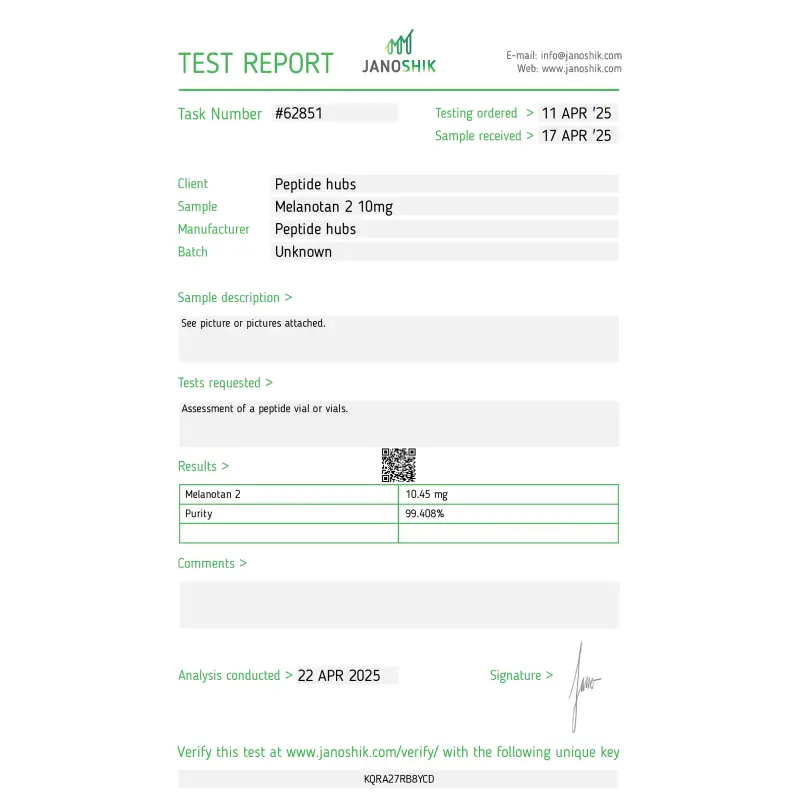
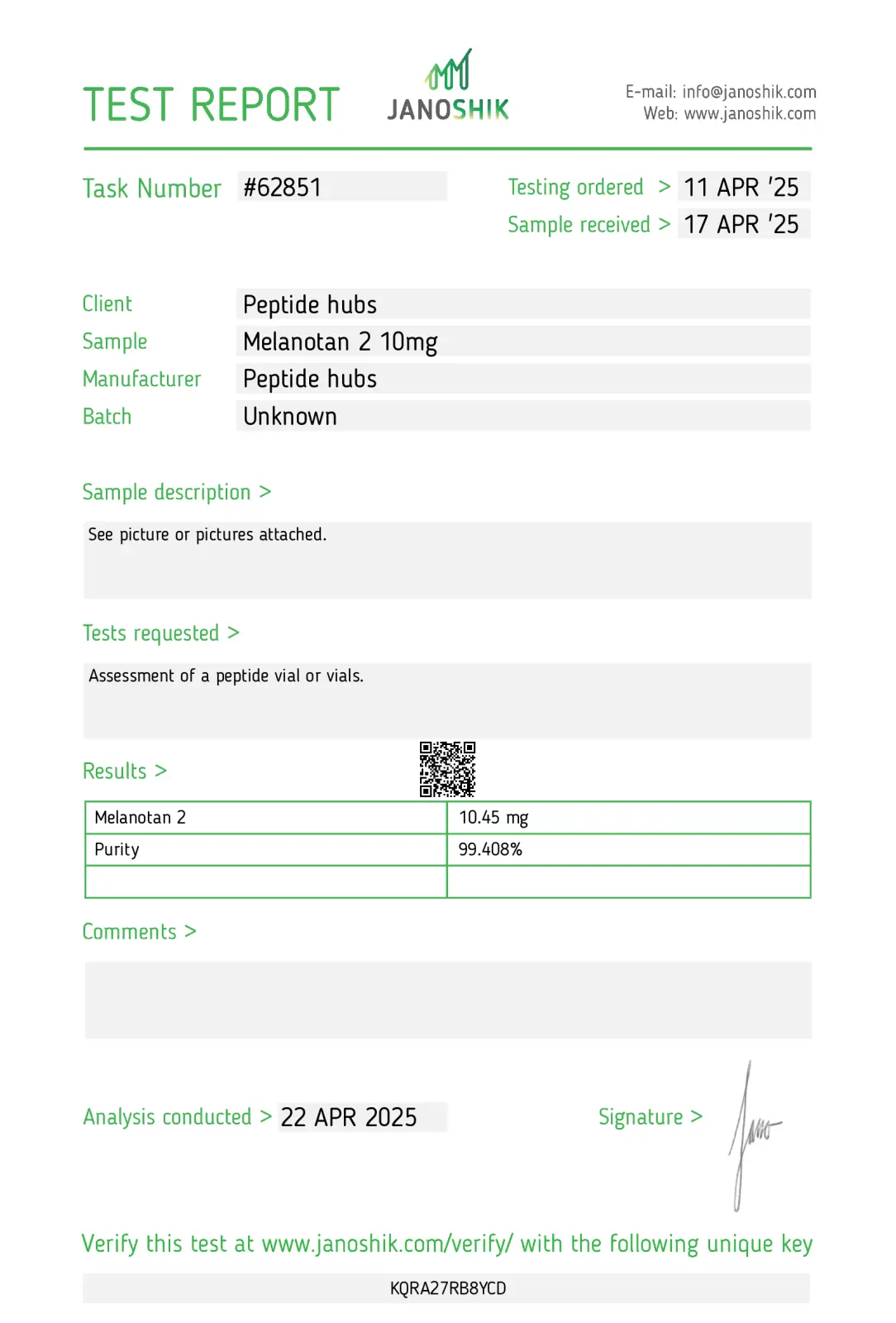
Look for products showing greater than ninety-five percent purity by analytical testing. Certificates of analysis should document both purity and sterility. Third-party verification provides additional confidence in critical research.
What are the main research uses?
Current research explores Melanotan 2's effects on skin color, appetite, sexual behavior, metabolism, and the nervous system. Each line of study demands its own protocols and strict safety precautions.
What legal issues apply?
Melanotan 2 exists solely for research. It is not for human use, sale, or treatment. Laboratories must handle it under proper safety rules and institutional supervision.
Related Products




Highly Purified Peptides: Trusted by Researchers Worldwide
Peptide Quality You Can't Find Elsewhere!!
| Peptide Hubs | Leading Competitor | |
|---|---|---|
| 200+ Peptide Variants |  |
 |
| USA-Manufactured Research Grade | |
|
| WHO/GMP & ISO 9001:2015 Certified | |
|
| Third-Party Tested for Purity | |
|
| Certificates of Analysis Provided | |
|
| Competitive Pricing Without Compromise | |
|
| Secure & Discreet Shipping | |
|
See Peptide Hubs in Action


Insights

Sermorelin, GHRP-6 & GHRP-2: Exploring Hormonal Pathways and Synergy

PE-22-28: Cellular Interactions and Neural Research
Kisspeptin 45-54 in Focus: Hypothalamic Biology and Neuronal Research
Ipamorelin Interactions with Pituitary Sensitivity and Growth Hormone Pulsatility

99% Purity
Ensuring the highest standard with 99% purity.

Quality Ingredients
Crafted with purity and quality ingredients at the core.

Fast Shipping
Fast, reliable shipping straight to your door.

No TFA or Fillers
Nothing extra, just science: no TFA, no fillers.

Quality You Can Rely On — Guaranteed
At PeptideHubs, scientific integrity and product reliability are at the core of everything we do. Each compound is manufactured and tested under strict quality control protocols to ensure consistency, purity, and performance for research applications.
However, if for any reason our product does not meet your research expectations, we offer a 60-day money-back guarantee — providing a risk-free procurement experience for qualified researchers and institutions.
Your research deserves uncompromised quality — and we stand behind every order to ensure you receive.