
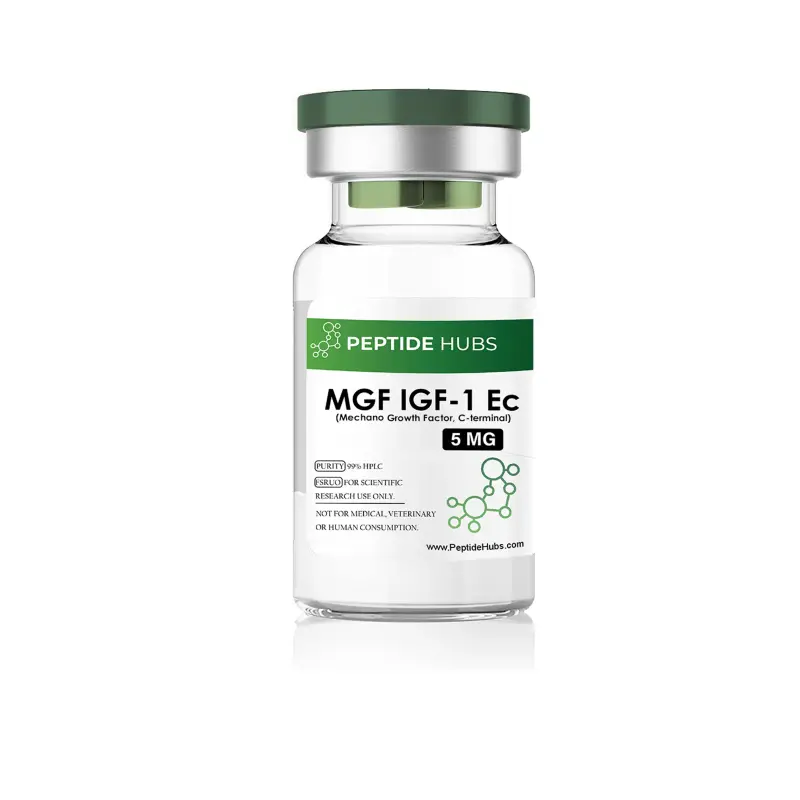
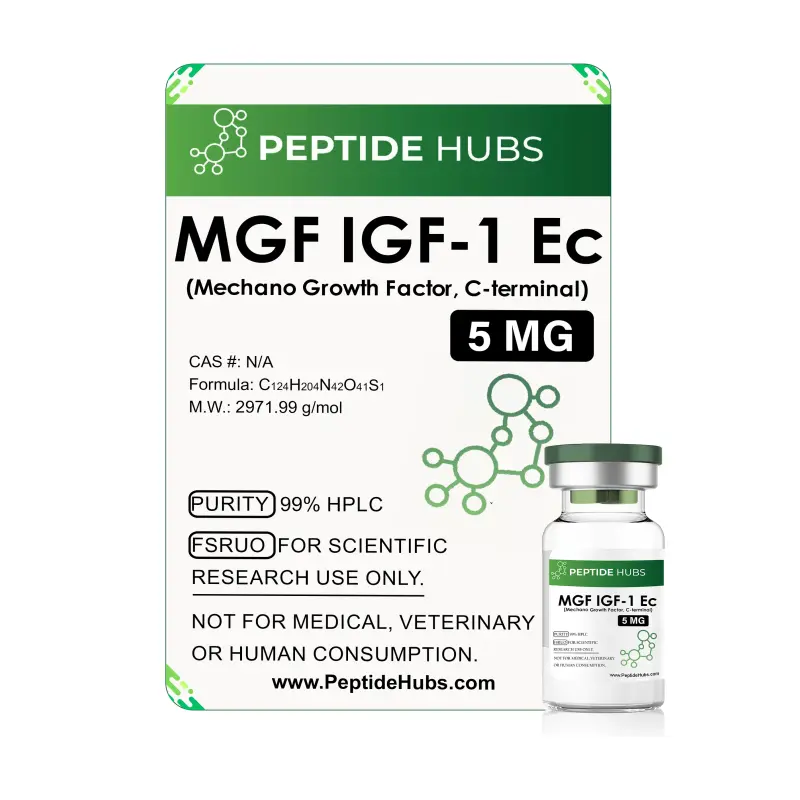
MGF IGF-1 Ec 5mg
- USA MADE 2-7 days delivery
- International 5-20 days delivery
THIS PRODUCT IS INTEDED AS A RESEARCH CHEMICAL ONLY.
This designation allows the use of research chemicals strictly in vitro for testing and laboratory experimentation only. All products information available on this website is for educational purposes only. Bodily introduction of any kind into humans or animals is strictly forbidden by law. This product should only be handled by licensed, qualified professional. This product is not a drug, food or cosmetic and may not be misbranded, misused or mislabled as a drug food or cosmetic.
MGF (IGF-1Ec) 5mg
MGF (IGF-1Ec), also known as Mechano Growth Factor, is a synthetic peptide representing the unique E-domain of the IGF-1Ec splice variant of the insulin-like growth factor-1 (IGF-1) gene. Unlike circulating IGF-1 isoforms, MGF is naturally expressed within skeletal muscle and other mechanically stressed tissues following exercise, injury, or mechanical overload. This localized expression has made MGF one of the most extensively investigated compounds in muscle physiology, tissue regeneration, satellite cell biology, and regenerative medicine research.
MGF is produced through alternative splicing of the IGF-1 gene. This process creates a unique C-terminal E-domain peptide that differs structurally from the predominant circulating IGF-1Ea isoform. Researchers believe this splice variant functions as an early signaling molecule following mechanical stress, initiating biological pathways involved in cellular adaptation and tissue repair before the expression of mature IGF-1 isoforms. Because of these characteristics, MGF has become an important research tool for investigating how tissues respond to injury and mechanical loading.
One of the primary areas of MGF research focuses on skeletal muscle regeneration. Experimental studies have demonstrated that MGF expression increases rapidly following muscle damage or intense mechanical stimulation. Scientists continue to investigate how this peptide influences satellite cells, the resident stem cells responsible for muscle repair and regeneration. Laboratory research suggests that MGF may promote satellite cell activation and proliferation, contributing to the early phases of muscle recovery and tissue remodeling. These investigations continue to improve scientific understanding of muscle adaptation and regenerative biology.
Researchers have also explored MGF in studies involving bone biology, tendon repair, cartilage regeneration, cardiac tissue remodeling, and musculoskeletal aging. Since mechanical loading affects numerous connective tissues throughout the body, MGF continues to be investigated as a signaling molecule involved in cellular responses to physical stress and tissue adaptation.
Beyond musculoskeletal research, MGF has attracted interest in investigations involving stem cell biology, wound healing, extracellular matrix remodeling, protein synthesis, and intracellular signaling pathways such as PI3K/Akt and mTOR. Scientists continue to examine how these molecular mechanisms contribute to tissue regeneration and cellular resilience following injury or metabolic stress. While MGF demonstrates significant biological activity in experimental models, it remains an investigational research compound with no approved therapeutic use in humans.
Areas of Scientific Research
MGF (IGF-1Ec) continues to be investigated in laboratory studies involving:
- Skeletal muscle regeneration
- Satellite cell activation and proliferation
- Muscle stem cell biology
- IGF-1 splice variant signaling
- Mechanical loading and tissue adaptation
- Tissue repair and regenerative medicine
- Protein synthesis pathways
- PI3K/Akt/mTOR signaling
- Connective tissue biology
- Tendon and ligament research
- Bone remodeling and musculoskeletal health
- Cardiac muscle physiology
- Healthy aging and muscle maintenance
- Wound healing and extracellular matrix remodeling
These research areas continue to expand as scientists investigate the molecular mechanisms through which mechanically induced growth factors contribute to tissue regeneration and cellular adaptation.
Product Quality
MGF (IGF-1Ec) 5mg is supplied as a lyophilized (freeze-dried) powder, providing excellent stability for laboratory storage and scientific investigation. Lyophilization minimizes moisture-related degradation while preserving peptide integrity during transportation and long-term storage until reconstitution according to laboratory protocols.
High-quality research peptides should undergo comprehensive analytical testing using recognized laboratory techniques such as High-Performance Liquid Chromatography (HPLC) and Mass Spectrometry (MS) to verify peptide identity, purity, and batch consistency. These quality-control procedures help ensure reliable, reproducible, and consistent experimental outcomes across laboratory investigations.
This product is intended exclusively for laboratory and scientific research. It is not intended for human consumption, therapeutic use, or veterinary applications.
Storage Information
Proper storage and handling are essential for maintaining the structural integrity and biological activity of MGF (IGF-1Ec). Like many growth factor-derived peptides, its stability is influenced by temperature, moisture, light exposure, and repeated freeze-thaw cycles. Following appropriate laboratory storage practices helps preserve peptide quality and experimental consistency.
Before Reconstitution
- Store unopened lyophilized vials at -20°C or below for optimal long-term stability.
- Refrigeration between 2°C and 8°C is suitable for short-term laboratory storage.
- Keep the vial tightly sealed to protect it from moisture and humidity.
- Store in a cool, dry environment away from direct sunlight and excessive heat.
- Allow frozen vials to reach room temperature before opening to minimize condensation inside the vial.
- Avoid repeated temperature fluctuations whenever possible to maintain peptide integrity.
After Reconstitution
Once reconstituted according to laboratory protocols:
- Store the prepared solution refrigerated at 2–8°C.
- Use sterile laboratory techniques throughout preparation and handling.
- Avoid repeated freeze-thaw cycles, as they may reduce peptide stability and biological activity.
- If multiple experiments are planned, divide the solution into sterile aliquots before freezing to minimize repeated handling.
- Gently swirl the vial to dissolve the peptide; avoid vigorous shaking or vortexing.
- Inspect the solution before laboratory use. If cloudiness, discoloration, or visible particulate matter develops, discard the preparation.
- Depending on laboratory preparation methods and storage conditions, reconstituted MGF is generally recommended for use within 2–4 weeks to maintain optimal stability and research consistency.
Proper storage and careful laboratory handling help preserve peptide quality, supporting reliable and reproducible research outcomes.
For Research Use Only. This product is intended solely for laboratory research and analytical purposes. It is not intended for human consumption, therapeutic use, or veterinary applications.
Related Products




Highly Purified Peptides: Trusted by Researchers Worldwide
Peptide Quality You Can't Find Elsewhere!!
| Peptide Hubs | Leading Competitor | |
|---|---|---|
| 200+ Peptide Variants |  |
 |
| USA-Manufactured Research Grade | |
|
| WHO/GMP & ISO 9001:2015 Certified | |
|
| Third-Party Tested for Purity | |
|
| Certificates of Analysis Provided | |
|
| Competitive Pricing Without Compromise | |
|
| Secure & Discreet Shipping | |
|
See Peptide Hubs in Action


Insights

Sermorelin in Focus: Exploring Growth Hormone Signaling and Evidence

Semax Research Explained: Current Evidence and Research Gaps

Ipamorelin and Growth Hormone Pathways: What the Research Shows

Inside PT-141: Biological Mechanisms and Current Research

99% Purity
Ensuring the highest standard with 99% purity.

Quality Ingredients
Crafted with purity and quality ingredients at the core.

Fast Shipping
Fast, reliable shipping straight to your door.

No TFA or Fillers
Nothing extra, just science: no TFA, no fillers.

Quality You Can Rely On — Guaranteed
At PeptideHubs, scientific integrity and product reliability are at the core of everything we do. Each compound is manufactured and tested under strict quality control protocols to ensure consistency, purity, and performance for research applications.
However, if for any reason our product does not meet your research expectations, we offer a 60-day money-back guarantee — providing a risk-free procurement experience for qualified researchers and institutions.
Your research deserves uncompromised quality — and we stand behind every order to ensure you receive.