
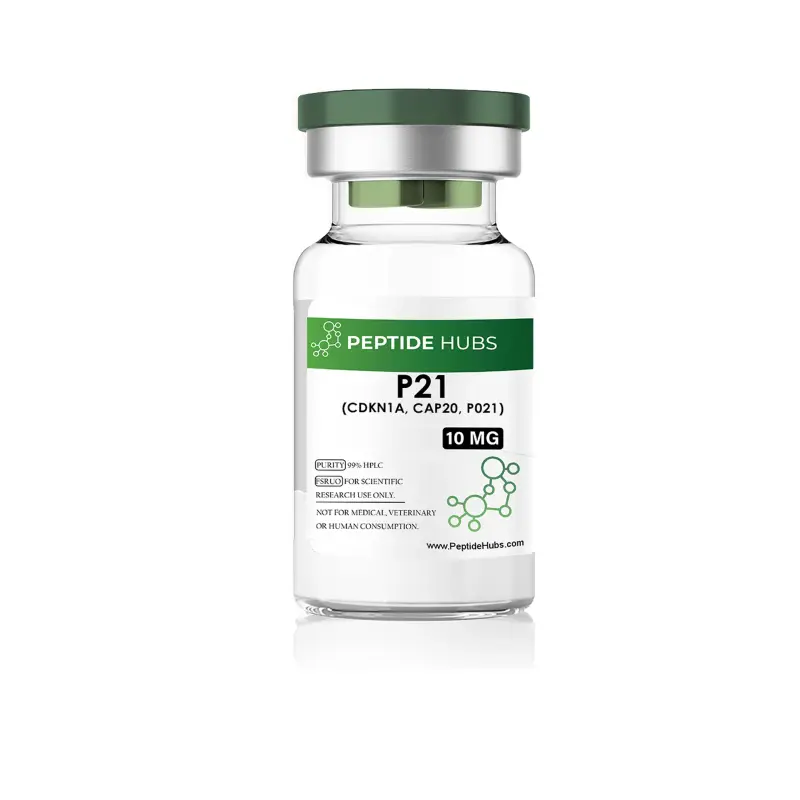
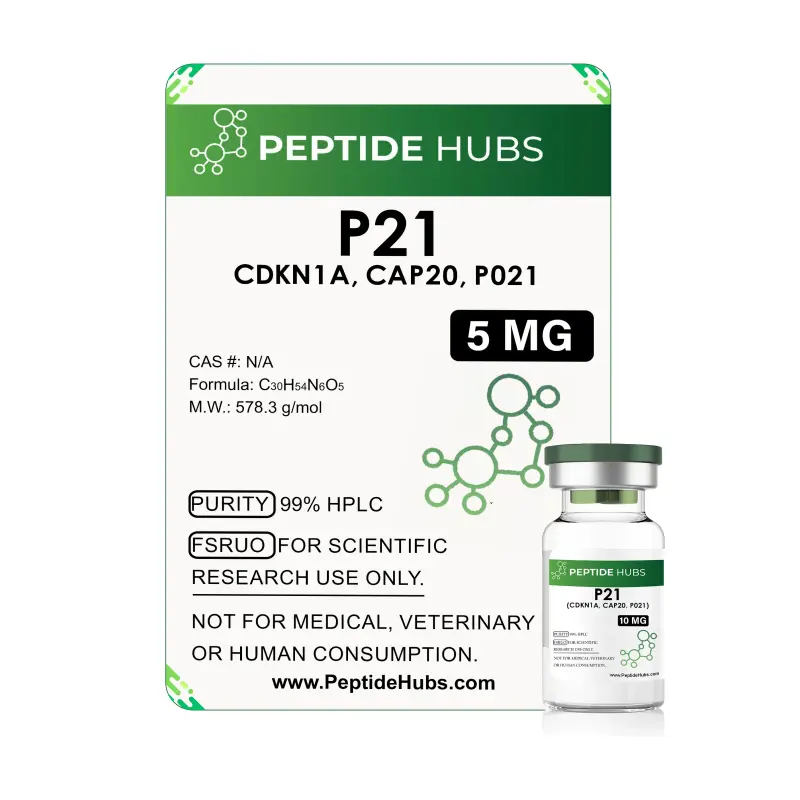
P21 5mg
- USA MADE 2-7 days delivery
- International 5-20 days delivery
THIS PRODUCT IS INTEDED AS A RESEARCH CHEMICAL ONLY.
This designation allows the use of research chemicals strictly in vitro for testing and laboratory experimentation only. All products information available on this website is for educational purposes only. Bodily introduction of any kind into humans or animals is strictly forbidden by law. This product should only be handled by licensed, qualified professional. This product is not a drug, food or cosmetic and may not be misbranded, misused or mislabled as a drug food or cosmetic.
P21 5mg
P21, also known as P021, is a synthetic ciliary neurotrophic factor (CNTF)-derived peptide mimetic developed for research involving neurogenesis, neuroprotection, cognitive function, and neurodegenerative disease models. Unlike the full-length CNTF protein, P21 was engineered to retain neurotrophic activity while improving stability, blood-brain barrier penetration, and pharmacokinetic properties. These characteristics have made P21 an emerging research compound in neuroscience, neurobiology, and regenerative medicine.
P21 was designed from the biologically active region of ciliary neurotrophic factor (CNTF), a member of the interleukin-6 (IL-6) cytokine family that plays an essential role in neuronal survival, differentiation, and maintenance. Because native CNTF exhibits poor blood-brain barrier penetration and a short biological half-life, researchers developed P21 as a smaller, modified peptide capable of reproducing many neurotrophic effects while overcoming these limitations. Experimental studies continue to investigate how this optimized peptide influences neuronal signaling and brain plasticity.
One of the primary areas of scientific investigation involves adult hippocampal neurogenesis. Laboratory studies have demonstrated that P21 may increase the formation of new neurons within the hippocampus, a brain region critical for learning, memory, and cognitive processing. Researchers continue to examine how P21 influences neuronal differentiation, synaptic plasticity, dendritic growth, and long-term neuronal survival. Experimental findings suggest these effects may be mediated through increased expression of brain-derived neurotrophic factor (BDNF) and activation of downstream signaling pathways involved in neuronal maintenance.
P21 has also attracted significant attention in Alzheimer's disease research. Preclinical animal models have reported reductions in tau hyperphosphorylation, decreased amyloid-associated pathology, preservation of synaptic integrity, and improvements in cognitive performance following experimental administration. Scientists continue to investigate these observations to better understand how neurotrophic signaling influences neurodegeneration and age-related cognitive decline. It is important to note that these findings remain limited to preclinical research, and there are currently no published human clinical trials evaluating P21.
Beyond neurodegenerative disease models, researchers are investigating P21 in studies involving traumatic brain injury, neuronal repair, oxidative stress, mitochondrial biology, neuroinflammation, and healthy brain aging. Experimental evidence suggests that P21 may influence multiple intracellular signaling pathways associated with neuronal resilience, synaptic maintenance, and cellular adaptation. While these findings remain promising, P21 continues to be classified exclusively as an investigational research peptide.
Areas of Scientific Research
P21 continues to be investigated in laboratory studies involving:
- Adult hippocampal neurogenesis
- Brain-derived neurotrophic factor (BDNF) signaling
- Neuroplasticity and synaptic function
- Learning and memory research
- Neuroprotection
- Alzheimer's disease models
- Tau protein regulation
- Amyloid pathology research
- Traumatic brain injury
- Oxidative stress
- Mitochondrial function
- Neuroinflammation
- Healthy brain aging
- Regenerative neuroscience
These ongoing investigations continue to expand scientific understanding of how CNTF-derived peptide mimetics influence neuronal communication, regeneration, and cognitive biology.
Product Quality
P21 5mg is supplied as a lyophilized (freeze-dried) powder, a formulation widely used in peptide research because it helps preserve molecular stability during storage and transportation. Lyophilization minimizes degradation caused by moisture while maintaining peptide integrity until reconstitution according to laboratory protocols.
High-quality research peptides should undergo analytical verification using recognized laboratory techniques such as High-Performance Liquid Chromatography (HPLC) and Mass Spectrometry (MS) to confirm peptide identity, purity, and batch consistency. These quality-control procedures support reliable and reproducible scientific investigations.
This product is intended exclusively for laboratory and scientific research. It is not intended for human consumption, therapeutic use, or veterinary applications.
Storage Information
Proper storage and handling are essential for preserving the structural integrity and biological stability of P21 throughout laboratory research.
Before Reconstitution
- Store unopened lyophilized vials at -20°C for optimal long-term preservation.
- Refrigeration between 2°C and 8°C is suitable for short-term laboratory storage.
- Keep the vial tightly sealed and protected from moisture and humidity.
- Store away from direct sunlight, excessive heat, and environmental contaminants.
- Allow frozen vials to reach room temperature before opening to prevent condensation inside the vial.
- Avoid repeated temperature fluctuations during storage to maintain peptide stability.
After Reconstitution
Once reconstituted according to laboratory protocols:
- Store the prepared solution refrigerated at 2–8°C.
- Use sterile laboratory techniques throughout preparation and handling.
- Avoid repeated freeze-thaw cycles, as they may reduce peptide stability.
- If multiple experiments are planned, divide the solution into sterile aliquots before freezing to minimize repeated handling.
- Protect the solution from prolonged exposure to light whenever possible.
- Inspect the solution before laboratory use. If cloudiness, discoloration, or visible particulate matter is observed, discard the preparation.
- Under appropriate laboratory storage conditions, reconstituted P21 is generally recommended for use within 2–3 weeks, depending on storage conditions and laboratory protocols.
Proper storage and careful laboratory handling help preserve peptide quality, supporting reliable, reproducible, and consistent scientific research.
For Research Use Only. This product is intended solely for laboratory research and analytical purposes. It is not intended for human consumption, therapeutic use, or veterinary applications.
Related Products




Highly Purified Peptides: Trusted by Researchers Worldwide
Peptide Quality You Can't Find Elsewhere!!
| Peptide Hubs | Leading Competitor | |
|---|---|---|
| 200+ Peptide Variants |  |
 |
| USA-Manufactured Research Grade | |
|
| WHO/GMP & ISO 9001:2015 Certified | |
|
| Third-Party Tested for Purity | |
|
| Certificates of Analysis Provided | |
|
| Competitive Pricing Without Compromise | |
|
| Secure & Discreet Shipping | |
|
See Peptide Hubs in Action


Insights

Tirzepatide & Thyroid Nodules: Exploring Safety Evidence and Risks

Can You Take NAD+ and Tirzepatide Together? Here’s What Science Says

Cagrilintide vs Retatrutide: Comparing Amylin and Triple Agonist Research

AOD-9604 vs Semaglutide: Key Differences in Weight-Loss Research

99% Purity
Ensuring the highest standard with 99% purity.

Quality Ingredients
Crafted with purity and quality ingredients at the core.

Fast Shipping
Fast, reliable shipping straight to your door.

No TFA or Fillers
Nothing extra, just science: no TFA, no fillers.

Quality You Can Rely On — Guaranteed
At PeptideHubs, scientific integrity and product reliability are at the core of everything we do. Each compound is manufactured and tested under strict quality control protocols to ensure consistency, purity, and performance for research applications.
However, if for any reason our product does not meet your research expectations, we offer a 60-day money-back guarantee — providing a risk-free procurement experience for qualified researchers and institutions.
Your research deserves uncompromised quality — and we stand behind every order to ensure you receive.