
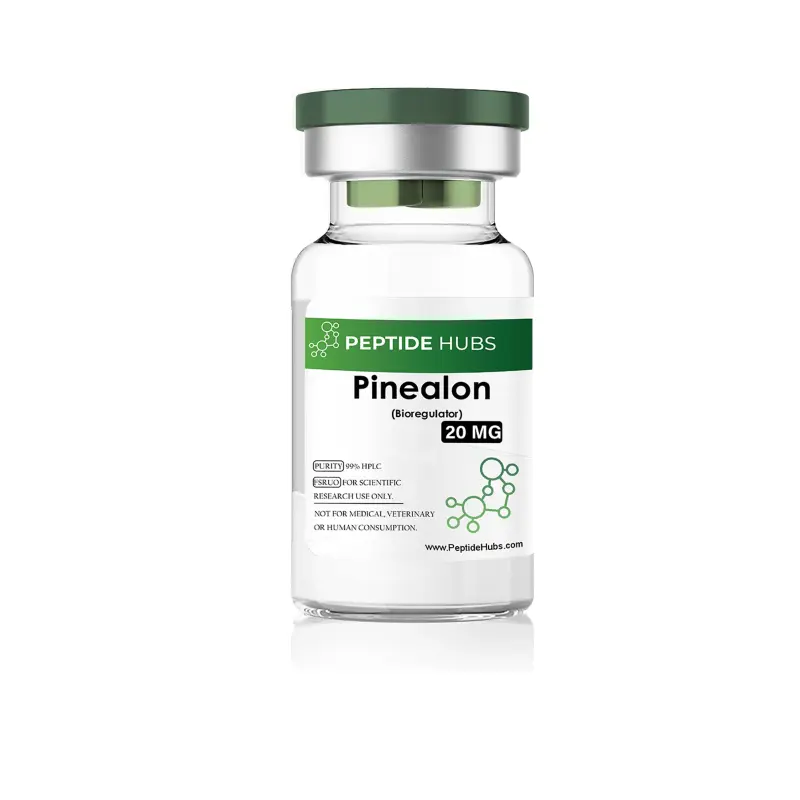
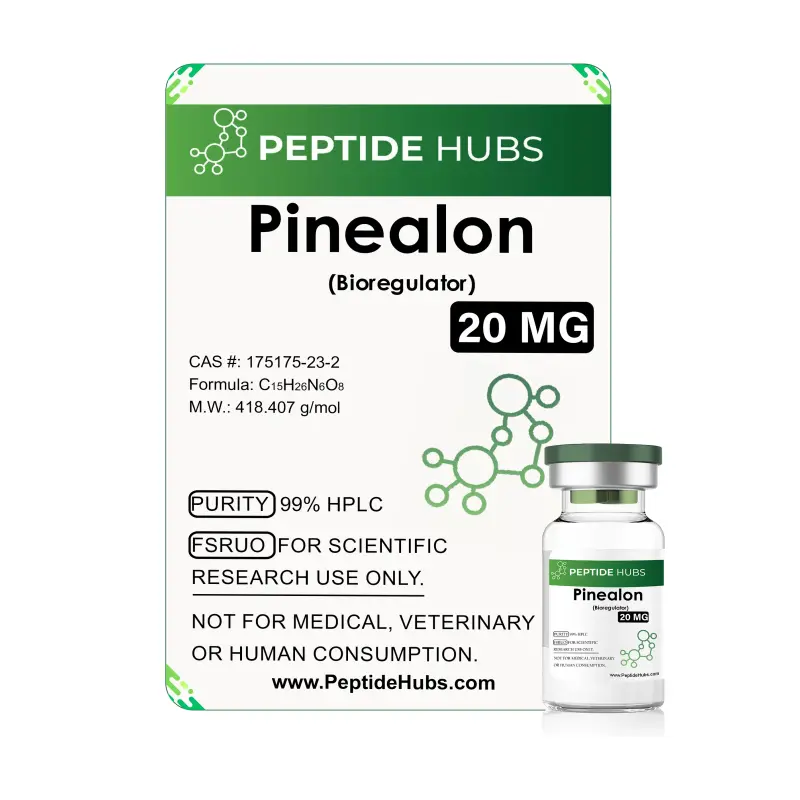
Pinealon 20mg
- USA MADE 2-7 days delivery
- International 5-20 days delivery
THIS PRODUCT IS INTEDED AS A RESEARCH CHEMICAL ONLY.
This designation allows the use of research chemicals strictly in vitro for testing and laboratory experimentation only. All products information available on this website is for educational purposes only. Bodily introduction of any kind into humans or animals is strictly forbidden by law. This product should only be handled by licensed, qualified professional. This product is not a drug, food or cosmetic and may not be misbranded, misused or mislabled as a drug food or cosmetic.
What is Pinealon?
Pinealon, also designated as the EDR peptide or T-33 peptide, is a synthetic tripeptide consisting of just three amino acids: glutamic acid (Glu), aspartic acid (Asp), and arginine (Arg). The compound belongs to a class of molecules referred to as peptide bioregulators—short synthetic sequences isolated from the polypeptide complex Cortexin, a neuroprotective agent developed through Russian biomedical research.
What distinguishes Pinealon from conventional peptides is its mechanism of cellular activity. Rather than binding to cell surface or cytoplasmic receptors, Pinealon demonstrates the capacity to traverse the cellular membrane and nuclear membrane, enabling direct interaction with the DNA molecule within the cell nucleus. This characteristic places Pinealon among a select category of bioactive compounds that may function as epigenetic regulators, potentially influencing gene expression at the transcriptional level.
The peptide has been the subject of investigation for its potential actions on the central nervous system, particularly in contexts involving oxidative stress, cellular ageing, and neuronal function. Researchers have explored its possible role in modulating behaviour, protecting various cell types against hypoxic conditions, and influencing circadian rhythm through effects on the pineal gland—the structure from which its name derives.
Pinealon Structure
The molecular architecture of Pinealon reflects elegant simplicity:
- Amino Acid Sequence: Glu-Asp-Arg (EDR)
- Molecular Formula: C₁₅H₂₆N₆O₈
- Molecular Weight: 418.40 g/mol
- CAS Number: 175175-23-2
- Alternative Designations: Glutamylaspartylarginine, T-33 peptide, EDR tripeptide, H-Glu-Asp-Arg-OH
The arrangement warrants closer consideration. Two residues of acidic character—glutamic acid and aspartic acid—are succeeded by arginine, a residue of basic disposition. This configuration produces a molecular entity possessed of distinctive electrostatic properties, enabling interactions of specificity with the phosphate groups and nitrogenous bases constituting deoxyribonucleic acid. The molecular weight of 418.40 g/mol confers upon the compound a magnitude sufficiently modest to permit cellular membrane penetration—a property deemed essential to the peptide's proposed operations.
Pinealon Interacts Directly with DNA
The behaviour of Pinealon toward genetic material occasions departure from ordinary peptide principles. Rather than constraining itself to receptor-mediated signalling, this substance demonstrates the capacity to approach deoxyribonucleic acid itself and engage in direct molecular interaction. Experimental investigations conducted within cultured HeLa cells have afforded evidence that Pinealon penetrates not merely the cellular envelope, but proceeds further, transgressing the nuclear membrane to achieve proximity with genetic material. Through spectroscopic and viscometric methodologies, researchers have ascertained that the EDR peptide forms associations with the DNA double helix, localising itself within the major groove adjacent to N7 guanine—that strategic location wherein metal ions and regulatory molecules customarily establish residence.
Molecular docking simulations have revealed that Pinealon and its corresponding nucleotide sequences form complexes of thermodynamic stability, suggesting favourable interactions. Of particular consequence to genetic investigation, potential binding sites for the EDR peptide have been identified within promoter regions of genes responsible for neuronal function and antioxidant activity, including PPARA, PPARG, TPH1, SOD2, and GPX1. The implications prove noteworthy: Pinealon may function as a modulator of transcriptional activity, thereby exerting influence upon protein synthesis essential to cellular equilibrium. This mechanism—direct epigenetic intervention—distinguishes Pinealon from the generality of bioactive peptides, conferring upon it standing of exceptional interest.
Pinealon Research
Pinealon Research and Aging
Investigations into Pinealon's effects on cellular ageing have yielded observations of potential anabolic activity within the central nervous system. Studies examining research models of polymorbidity and organic brain syndrome reported improvements in the functioning of the CNS and other vital organs following peptide exposure, compared to control conditions.
The peptide's relationship to ageing processes extends to its apparent influence on irisin expression in muscle cells. Irisin, a myokine secreted during physical activity, has been associated with telomere protection, fat metabolism, and cellular longevity pathways. Research has demonstrated a correlation between plasma irisin levels and telomere length in healthy individuals. By potentially modulating irisin levels, Pinealon may influence mechanisms connected to telomere preservation and the attenuation of age-associated cellular decline.
The peptide's proposed mechanism involving the MAPK/ERK signalling pathway provides a theoretical framework for understanding these observations. By potentially attenuating reactive oxygen species production and reducing oxidative stress-induced cellular damage, Pinealon may contribute to the maintenance of cellular integrity over extended periods.
Pinealon Research and Neuron Protection
The protection of neurons—those sentinels of nervous function—has long occupied the attention of those engaged in neuroscientific investigation. Pinealon has become the object of systematic study across multiple experimental designs, yielding observations of material consequence.
In cultures of rat cerebellar granule cells—a preparation much favoured by researchers of neuronal phenomena—Pinealon manifested capacity to reduce the accumulation of reactive oxygen species and to diminish necrotic cell death under conditions of oxidative duress. The mechanism, as it emerges from investigation, appears to involve the peptide's enhancement of endogenous antioxidant enzyme systems. In particular, Pinealon appears to augment the activity of superoxide dismutase 2 (SOD2) and glutathione peroxidase 1 (GPX1) within brain tissue, most conspicuously in animal subjects characterized by hypoxia-sensitivity. These enzymes, being constitutive elements of the cell's defences against oxidative injury, may thus be rendered more robust by Pinealon's influence, permitting neurons enhanced resilience under conditions of physiological adversity.
The phenomenon of excitotoxicity—that pernicious consequence of excessive stimulation at N-methyl-D-aspartate receptors—has likewise received the attention of those studying Pinealon. The flooding of neuronal cells with calcium, precipitated by such excessive stimulation, culminates in oxidative damage, processes which the medical literature has implicated in conditions of progressive neurological decline. Pinealon has been observed to reduce necrotic cell death in such circumstances, accompanied by a delayed activation of ERK 1/2 kinases.
In experimental models wherein prenatal elevations of homocysteine were induced—a circumstance of pathological consequence—Pinealon administration to offspring appeared to mitigate cognitive effects associated with this amino acid's elevation, though without directly inhibiting the metabolic processing of homocysteine itself. Researchers have accordingly proposed that the peptide functions to attenuate the toxic cellular consequences of the compound, rather than altering its biochemical metabolism.
Pinealon Research and Depression
Studies conducted upon isolated brain cell cultures have revealed that Pinealon stimulates serotonin expression, with quantitative assessments disclosing approximately 1.9-fold elevations in serotonin synthesis in younger cultures compared to controls. The molecular basis appears connected to Pinealon's interaction with DNA sequences within the 5-tryptophan hydroxylase (TPH) gene promoter, the rate-limiting enzyme in serotonin biosynthesis. Molecular docking simulations suggest that Pinealon's binding to nucleotide sequences within the TPH promoter may enhance transcriptional activity, leading to increased enzyme production and consequent serotonin elevation.
Pinealon Protects Cells from Caspase-3 and Cell Death
The cascade of molecular events terminating in programmed cell death—apoptosis—culminates in the activation of caspase-3, that executioner protease which executes the final degradation of cellular constituents. The dysregulation of caspase-3 activity has become implicated in numerous pathological conditions, among them the progressive deterioration of nervous tissue and injury consequent to ischaemia.
Research examining Pinealon in experimental models of ischaemic stroke has disclosed evidence that the peptide modulates the levels of caspase-3 enzyme, thereby attenuating the apoptotic cascade under conditions of oxygen deprivation. These observations have been accompanied by apparent normalisation of inflammatory markers—interleukin-6 and tumour necrosis factor-alpha, those cytokines attendant upon cellular stress—suggesting that Pinealon's protective effects may operate through multiple mechanisms.
The anti-apoptotic properties of Pinealon extend beyond the confines of nervous tissue. In experimental models of myocardial infarction, the peptide appeared to reduce caspase-3 expression following cardiac events, thereby suggesting potential utility in circumstances involving ischaemic tissue damage of cardiac origin. Furthermore, investigations conducted upon cultures of dermal and epidermal cells have revealed that Pinealon promotes cellular proliferation whilst reducing apoptotic processes, potentially enhancing regenerative capacity in both young and aged tissue preparations.
These observations have led researchers to advance a proposition of considerable elegance: that Pinealon's capacity to modulate caspase-3 activity represents a convergent mechanism underlying its protective effects across diverse cellular populations and pathological conditions of varied character.
Pinealon Research and Sleep Regulation
The pineal gland, from which Pinealon derives its nomenclature, functions as the primary neuroendocrine organ regulating circadian rhythmicity through melatonin secretion. Disruptions to circadian function have been associated with adverse effects on cognitive performance, metabolic regulation, and overall physiological homeostasis.
Research has indicated that Pinealon may contribute to resetting pineal gland function in instances of circadian rhythm disruption. The peptide has been observed to influence parameters associated with sleep quality and circadian rhythm markers in preliminary clinical investigations, though sample sizes have been limited.
The potential mechanisms underlying these effects remain under investigation. Given Pinealon's proposed capacity for direct DNA interaction and gene expression modulation, researchers have hypothesised that the peptide may influence circadian clock gene expression or melatonin biosynthetic pathways. Such mechanisms could account for observed effects on sleep-wake cycle regulation and pineal gland function.
Professional truck drivers experiencing neurotic disorders related to circadian disruption have been subjects of research examining Pinealon's effects, with observations suggesting potential benefits for sleep regulation and associated neurological parameters.
Feature Bullets
- Tripeptide of Elegant Simplicity: Three amino acids (Glu-Asp-Arg) with capacity to traverse cellular and nuclear membranes
- Direct DNA Interaction: Engages specific nucleotide sequences in gene promoter regions, distinguishing itself from receptor-dependent peptides
- Neuroprotective Properties: Studied for effects on oxidative stress, neuronal viability, and antioxidant enzyme activation
- Highest Purity Standard: 99% purity lyophilized powder ensuring research-grade reproducibility
- Cellular Aging Studies: Investigated for influence on telomere-associated pathways via irisin modulation
- Serotonin Pathway Research: Examined for effects on 5-tryptophan hydroxylase gene expression
- Apoptosis Modulation: Studied for capacity to influence caspase-3 activity and cell survival pathways
Technical Specifications
|
Parameter |
Specification |
|
Product Name |
Pinealon |
|
Synonyms |
EDR Peptide, Glutamylaspartylarginine, T-33 Peptide |
|
Sequence |
Glu-Asp-Arg (EDR) |
|
Molecular Formula |
C₁₅H₂₆N₆O₈ |
|
Molecular Weight |
418.40 g/mol |
|
CAS Number |
175175-23-2 |
|
Size |
20mg |
|
Form |
Lyophilized (freeze-dried) powder |
|
Purity |
99% |
|
Appearance |
White to off-white lyophilized solid |
|
Solubility |
Aqueous soluble |
|
Storage |
Desiccated below -18°C (lyophilized); 2–8°C (reconstituted, short-term) |
Storage Instructions
The preservation of peptide compounds requires attention to protocol most rigorous, for the integrity of such substances is readily compromised through neglect of proper precautions:
- Lyophilized Form: The desiccated peptide must be maintained at temperatures below -18°C (-0.4°F) for the purposes of long-term preservation. When maintained in a state of thorough desiccation, lyophilized peptides demonstrate stability at room temperature for the duration of approximately three months; however, the extension of storage beyond this interval necessitates exposure to freezing conditions.
- Reconstituted Form: Having been restored to aqueous solution, the peptide should be maintained at temperatures within the range of 2–8°C (36–46°F) for brief periods of application, not exceeding 2–21 days in duration. Should an extended storage interval be required, the reconstituted material must be preserved at -18°C or at still lower temperatures.
- Conditions to Avoid: Repeated cycles of freezing and thawing must be eschewed, as must the employment of frost-free freezers, which subject stored materials to temperature fluctuations during their defrost cycles. Light exposure, contamination by moisture, and prolonged exposure to ambient air must likewise be avoided with diligent care.
- Handling Procedures: The container housing the peptide must be permitted to reach room temperature prior to opening, thereby preventing the condensation of moisture upon its cold surfaces. Where practicable, the vessel should be resealed in an atmosphere of inert gas—nitrogen or argon being equally suitable—to minimise the risks of oxidative degradation.
- Suitable Containers: The peptide ought to be housed in vessels constructed of clean glass or polypropylene of chemically resistant character, with dimensions proportionate to the quantity of peptide to be contained.
Related Products




Highly Purified Peptides: Trusted by Researchers Worldwide
Peptide Quality You Can't Find Elsewhere!!
| Peptide Hubs | Leading Competitor | |
|---|---|---|
| 200+ Peptide Variants |  |
 |
| USA-Manufactured Research Grade | |
|
| WHO/GMP & ISO 9001:2015 Certified | |
|
| Third-Party Tested for Purity | |
|
| Certificates of Analysis Provided | |
|
| Competitive Pricing Without Compromise | |
|
| Secure & Discreet Shipping | |
|
See Peptide Hubs in Action


Insights

Vesugen Peptide: Current Research on Aging and Vascular Biology

PE-22-28 Peptide: Exploring Its Mechanism and Scientific Potential

DSIP Peptide Research: Sleep Regulation, Evidence, and Safety
Cardiogen Peptide: Scientific Evidence and Potential Applications

99% Purity
Ensuring the highest standard with 99% purity.

Quality Ingredients
Crafted with purity and quality ingredients at the core.

Fast Shipping
Fast, reliable shipping straight to your door.

No TFA or Fillers
Nothing extra, just science: no TFA, no fillers.

Quality You Can Rely On — Guaranteed
At PeptideHubs, scientific integrity and product reliability are at the core of everything we do. Each compound is manufactured and tested under strict quality control protocols to ensure consistency, purity, and performance for research applications.
However, if for any reason our product does not meet your research expectations, we offer a 60-day money-back guarantee — providing a risk-free procurement experience for qualified researchers and institutions.
Your research deserves uncompromised quality — and we stand behind every order to ensure you receive.