
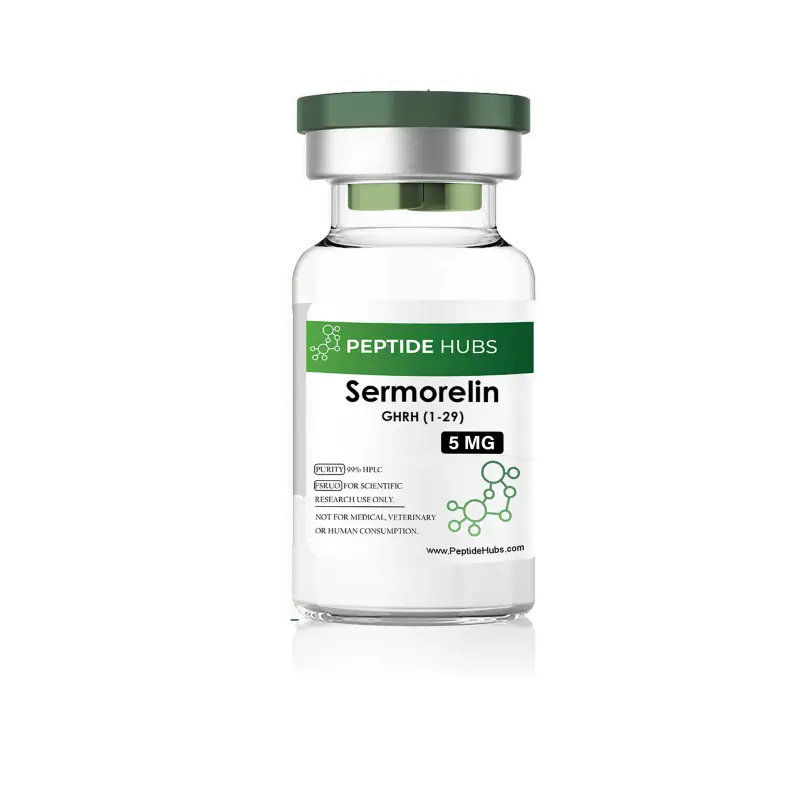
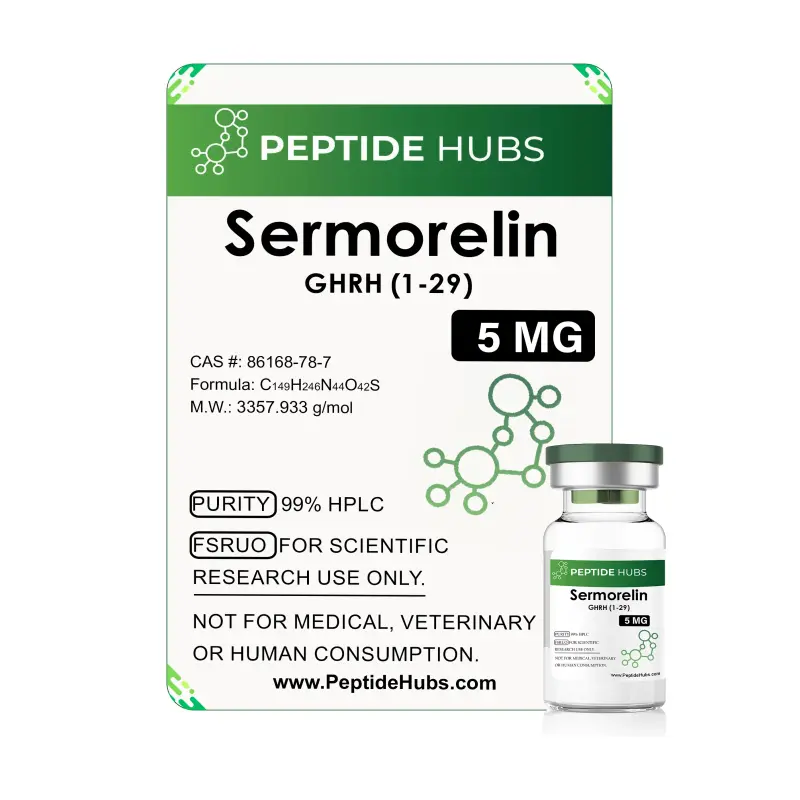
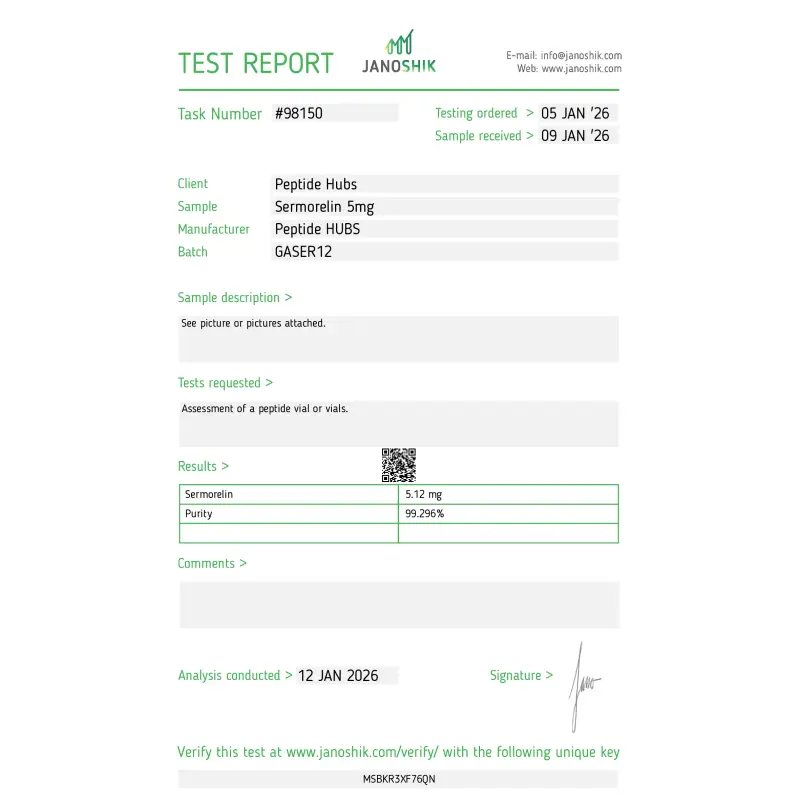
Sermorelin 5mg
- USA MADE 2-7 days delivery
- International 5-20 days delivery
THIS PRODUCT IS INTEDED AS A RESEARCH CHEMICAL ONLY.
This designation allows the use of research chemicals strictly in vitro for testing and laboratory experimentation only. All products information available on this website is for educational purposes only. Bodily introduction of any kind into humans or animals is strictly forbidden by law. This product should only be handled by licensed, qualified professional. This product is not a drug, food or cosmetic and may not be misbranded, misused or mislabled as a drug food or cosmetic.
What is Sermorelin?
Sermorelin represents a synthetic, 29-amino acid peptide analog of growth hormone-releasing hormone (GHRH), the naturally occurring hormonal messenger consisting of 44 amino acids. This truncated structure—comprising only the amino-terminal segment of native GHRH—maintains the essential biological recognition properties required to engage GHRH receptors located on the anterior pituitary gland. Researchers have identified sermorelin as the shortest synthetic peptide capable of initiating the receptor-binding cascade associated with endogenous growth hormone signaling. The peptide's selective receptor specificity suggests minimal interference with other endocrine systems, making it a valuable investigative tool across multiple research disciplines examining growth hormone physiology and related metabolic pathways.
Since its initial characterization in the early 1980s, sermorelin has been the subject of extensive laboratory and preclinical investigation. Early studies employing animal models established the peptide's capacity to modulate growth hormone secretion through physiological feedback mechanisms rather than the constant, non-physiological stimulation characteristic of direct hormone administration. This distinction has sustained continued research interest across neuroscience, cardiovascular biology, metabolic disease modeling, and neurological disorder investigation.
Sermorelin Peptide Structure
Sermorelin derives its excellence from the precise arrangement of its constituent parts. The molecular formula—C₁₄₉H₂₄₆N₄₄O₄₂S—expresses a molecular weight of 3357.93 g/mol, a figure of considerable specificity. The amino acid sequence follows: Tyr-Ala-Asp-Ala-Ile-Phe-Thr-Asn-Ser-Tyr-Arg-Lys-Val-Leu-Gly-Gln-Leu-Ser-Ala-Arg-Lys-Leu-Leu-Gln-Asp-Ile-Met-Ser-Arg (with C-terminal amidation).
The amidated C-terminus enhances peptide stability and receptor-binding affinity—an improvement as notable as the distinction between a gentleman of established character and one of questionable propriety. The peptide's estimated half-life in circulation—approximately 11 to 12 minutes—indicates episodic release kinetics wholly consistent with physiological hormone secretion patterns.
Sermorelin Peptide Research
Sermorelin and Heart Health
Sermorelin has emerged as an object of considerable interest within cardiovascular research, particularly amongst those examining post-infarction tissue remodelling—a process of evident consequence to the afflicted organism. A landmark 2015 investigation conducted upon swine demonstrated, with persuasive experimental evidence, that sermorelin exposure appeared to diminish the extent of cardiac remodelling observed following experimentally-induced myocardial infarction.
The investigating researchers reported with evident satisfaction that GHRH agonists—inclusive of sermorelin—appeared to reduce inflammatory responses within cardiac tissue and might facilitate healing mechanisms by governing fibrosis and apoptotic pathways with due discretion. The peptide's reported capacity to decrease scar formation, enhance angiogenesis (the proliferation of new blood vessels), and improve diastolic function suggests potential applications worthy of sustained investigation within the field of post-cardiac injury recovery.
Mechanistically considered, sermorelin is theorised to activate growth hormone-dependent signalling cascades that promote the survival of cardiomyocytes—those essential cells comprising the cardiac musculature. The peptide appears to augment extracellular matrix production within damaged regions and stimulate capillary proliferation in zones of ischaemic distress. The peptide's discriminating GHRH receptor specificity implies that its cardiovascular effects operate through growth hormone–mediated pathways rather than through pleiotropic hormone disruption—a most agreeable economy of action.
Researchers note, with evident conviction, that GHRH agonists "reduce inflammatory responses post-MI and may consequently improve mechanisms of healing and cardiac remodelling"—a conclusion of evident clinical promise.
Sermorelin and Epilepsy
Sermorelin has become the subject of respectable neurological investigation, with particular attention directed toward seizure threshold modulation—a matter of considerable significance to those whose nervous systems require stabilisation. Laboratory investigations employing murine models of seizure activity have observed, with methodical consistency, that GHRH analogs—inclusive of sermorelin—activate gamma-aminobutyric acid (GABA) receptor signalling and suppress seizure initiation with apparent efficacy. GABA represents the primary inhibitory neurotransmitter within the central nervous system—a substance of such manifest importance that one might consider it the arbiter of neuronal propriety. Compounds enhancing GABAergic tone reduce central nervous system electrical excitability and raise seizure thresholds, much as the influence of a sensible confidante might moderate excessive inclinations of volatile temperament. Growth hormone signalling appears to modulate seizure-related neuronal loss through extracellular signal-regulated kinase (ERK) and phosphoinositide 3-kinase/protein kinase B (PI3K/Akt) pathways—molecular mechanisms of considerable intricacy.
Sermorelin and Sleep
Sermorelin demonstrates relevance to sleep architecture investigation, particularly concerning slow-wave sleep (SWS) dynamics and restorative mechanisms. Growth hormone secretion exhibits circadian coupling to deeper sleep stages. A functional GHRH signalling axis appears prerequisite for orexin production—the potent hypothalamic neuropeptide governing sleep-wake cycles. Sermorelin exposure is hypothesised to enhance orexin secretion, thereby improving sleep efficiency through increased slow-wave sleep allocation. Unlike direct growth hormone administration, which operates through constant, unphysiological delivery and triggers tachyphylaxis (receptor desensitisation), sermorelin stimulates episodic, physiologically-patterned hormone release, permitting sustained effects without compensatory receptor down-regulation.
Sermorelin Preferred to Growth Hormone
Sermorelin possesses distinct mechanistic advantages over direct exogenous growth hormone (rhGH) administration—advantages sufficiently material to merit the serious consideration of any investigator of sound judgment. Direct GH injection delivers constant, decidedly unphysiological hormone concentrations that suppress endogenous GHRH secretion through negative feedback, much as excessive encouragement might diminish a person's natural inclination toward independent action. This process eventually leads to pituitary desensitisation and tachyphylaxis—a phenomenon wherein receptors become unresponsive despite the continued presence of ligand, as if wearied by ceaseless importuning.
Sermorelin, by most agreeable contrast, stimulates endogenous growth hormone release via GHRH receptor activation upon somatotroph cells. This mechanism preserves the native growth hormone neuroendocrine axis with admirable fidelity and maintains episodic (pulsatile) rather than basal GH secretion patterns—patterns more consistent with the body's natural modes of operation.
The peptide does not suppress the pituitary's intrinsic capacity for hormone production. Indeed, evidence suggests that sermorelin may upregulate GHRH receptor expression, thereby promoting sustained responsiveness of gratifying durability. Consequently, sermorelin-mediated GH elevation avoids the feedback suppression and receptor down-regulation characteristic of exogenous hormone replacement—a circumstance which potentially permits prolonged efficacy without the development of tolerance and its attendant disappointments.
Additionally, sermorelin's receptor specificity—binding primarily to GHRH receptors with proper restraint—minimises ancillary endocrine disruption (as, for instance, dysregulation of prolactin, insulin, or cortisol) that may accompany direct GH therapy with its characteristic want of discrimination.
Feature Highlights
- 29-amino acid GHRH analog with selective receptor specificity and episodic release kinetics
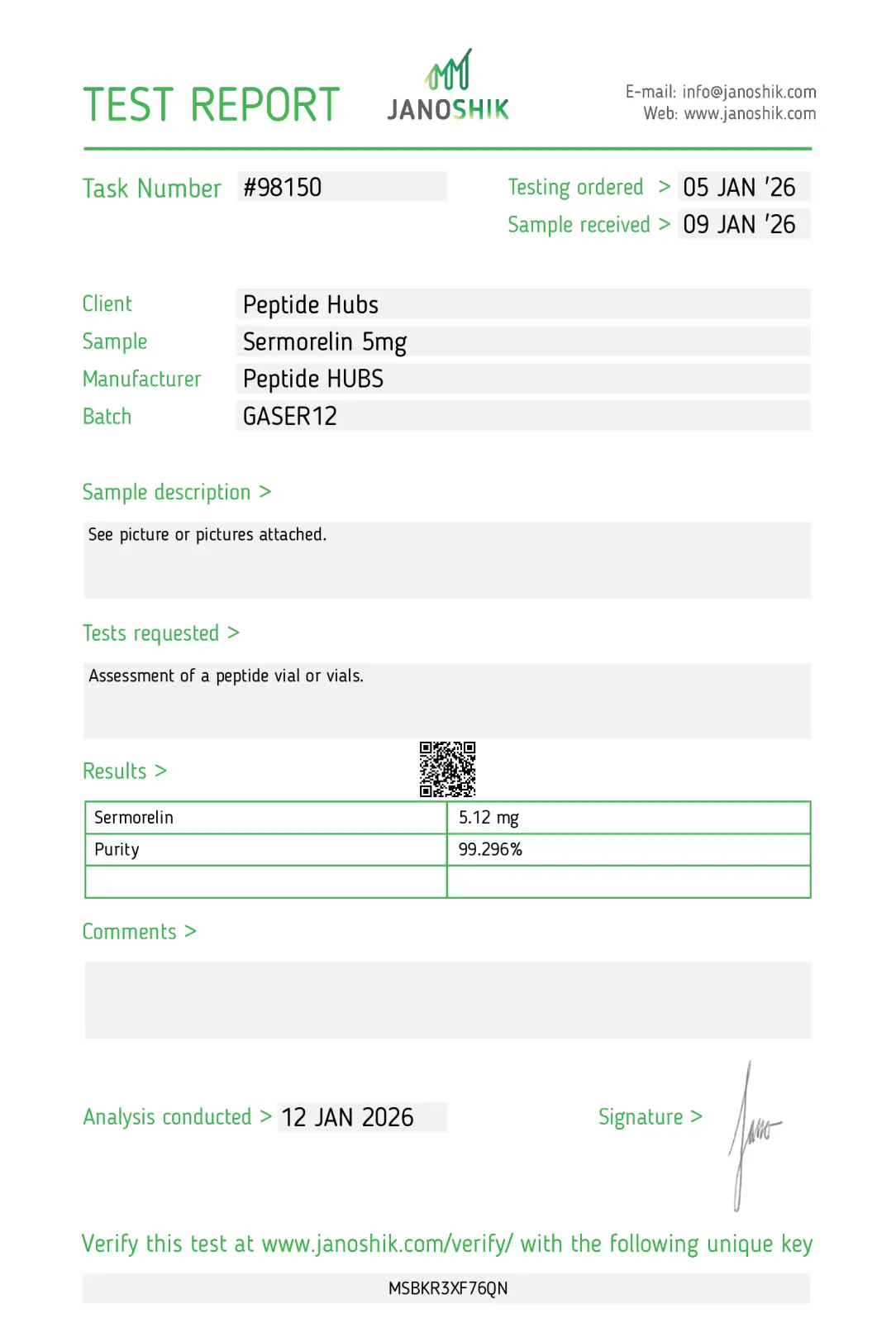
- 99% purity verified through analytical standards for research reliability
- Lyophilized powder formulation ensuring long shelf-life under proper refrigeration
- Rapid clearance profile (11–12 minute half-life) supporting physiological investigation
- Minimal ancillary endocrine effects due to GHRH receptor selectivity
- Consistent receptor responsiveness without tachyphylaxis development in laboratory models
- Stable, research-grade synthesis meeting specifications for reproducible experimental protocols
Technical Specifications
|
Parameter |
Value |
|
Concentration |
5mg per vial |
|
Form |
Lyophilised powder |
|
Purity |
99% |
|
Molecular Formula |
C₁₄₉H₂₄₆N₄₄O₄₂S |
|
Molecular Weight |
3357.93 g/mol |
|
Amino Acid Count |
29 |
|
Half-life |
11–12 minutes |
|
Storage Temperature |
2–8°C (36–46°F) |
|
Storage Form |
Original sealed vial, dark, dry environment |
Storage Instructions
Sermorelin 5mg is supplied as a lyophilised powder requiring controlled preservation to maintain peptide integrity with proper attention—much as a valuable manuscript requires protection from the elements and the depredations of careless handling.
The vial must be maintained between 2°C and 8°C (36°F to 46°F)—a specification of considerable exactitude—to preserve long-term stability and potency. The container must remain sealed within its original packaging and stored in an environment decidedly dry and sheltered from direct light exposure, which may degrade the peptide structure with regrettable consequence. Freezing must be assiduously avoided; temperatures below 0°C (32°F) may inflict irreversible damage through the formation of ice crystals and subsequent structural disruption—a calamity as lamentable as the frost's effect upon the delicate flower.
Short-term exposure to room temperature—up to 72 hours within an insulated, light-protected vessel—is tolerable to the peptide's constitution. However, extended periods beyond the specified refrigeration range shall accelerate peptide degradation with inevitable consequence. Once the lyophilised peptide has been reconstituted with bacteriostatic water or such appropriate solvent as may be deemed suitable, the resulting solution maintains stability for approximately 30 days whilst maintained under refrigeration—a period of utility of material significance.
Store with conscientious care away from heat sources, direct sunlight, and those humidity-prone environments (such as the bathroom, that most damp of domestic chambers) wherein moisture accumulates with troublesome regularity. Consistent temperature control is of paramount importance; temperature fluctuations exceeding 8°C shall reduce potency with demonstrable speed and compromise the research utility of this most precise reagent.

Related Products




Highly Purified Peptides: Trusted by Researchers Worldwide
Peptide Quality You Can't Find Elsewhere!!
| Peptide Hubs | Leading Competitor | |
|---|---|---|
| 200+ Peptide Variants |  |
 |
| USA-Manufactured Research Grade | |
|
| WHO/GMP & ISO 9001:2015 Certified | |
|
| Third-Party Tested for Purity | |
|
| Certificates of Analysis Provided | |
|
| Competitive Pricing Without Compromise | |
|
| Secure & Discreet Shipping | |
|
See Peptide Hubs in Action


Insights

Survodutide in 2026: The Dual Agonist Changing Liver Fat & Weight Loss Research
Semaglutide for Weight Loss: Key Research Breakthroughs and Insights

SARMs or Peptides? Choosing the Right Compound for Your Fitness Goals
Cellular Regeneration & Anabolism: Top Muscle Peptides for 2026

99% Purity
Ensuring the highest standard with 99% purity.

Quality Ingredients
Crafted with purity and quality ingredients at the core.

Fast Shipping
Fast, reliable shipping straight to your door.

No TFA or Fillers
Nothing extra, just science: no TFA, no fillers.

Quality You Can Rely On — Guaranteed
At PeptideHubs, scientific integrity and product reliability are at the core of everything we do. Each compound is manufactured and tested under strict quality control protocols to ensure consistency, purity, and performance for research applications.
However, if for any reason our product does not meet your research expectations, we offer a 60-day money-back guarantee — providing a risk-free procurement experience for qualified researchers and institutions.
Your research deserves uncompromised quality — and we stand behind every order to ensure you receive.