
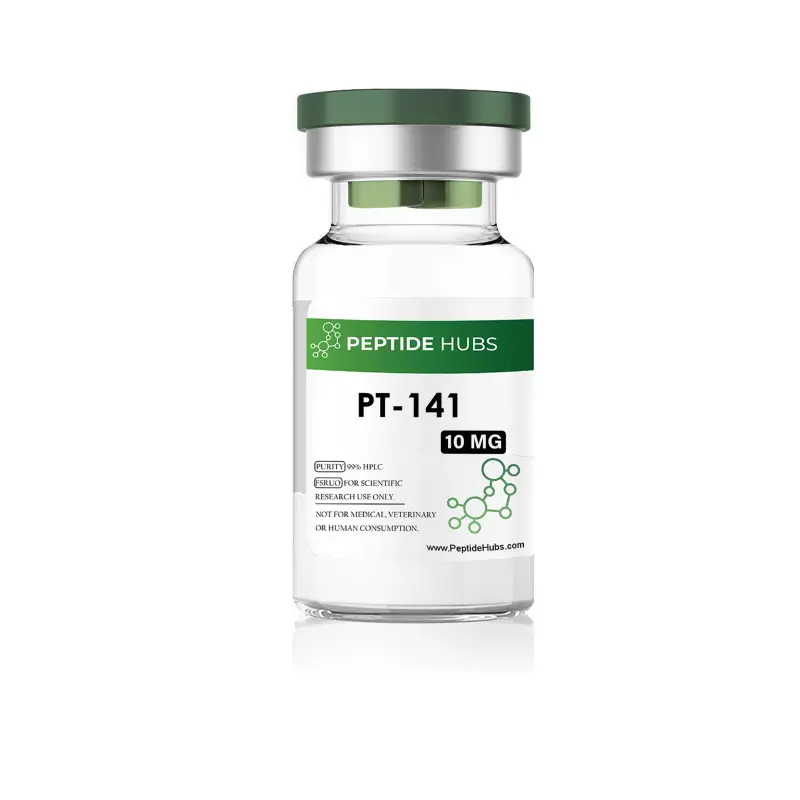
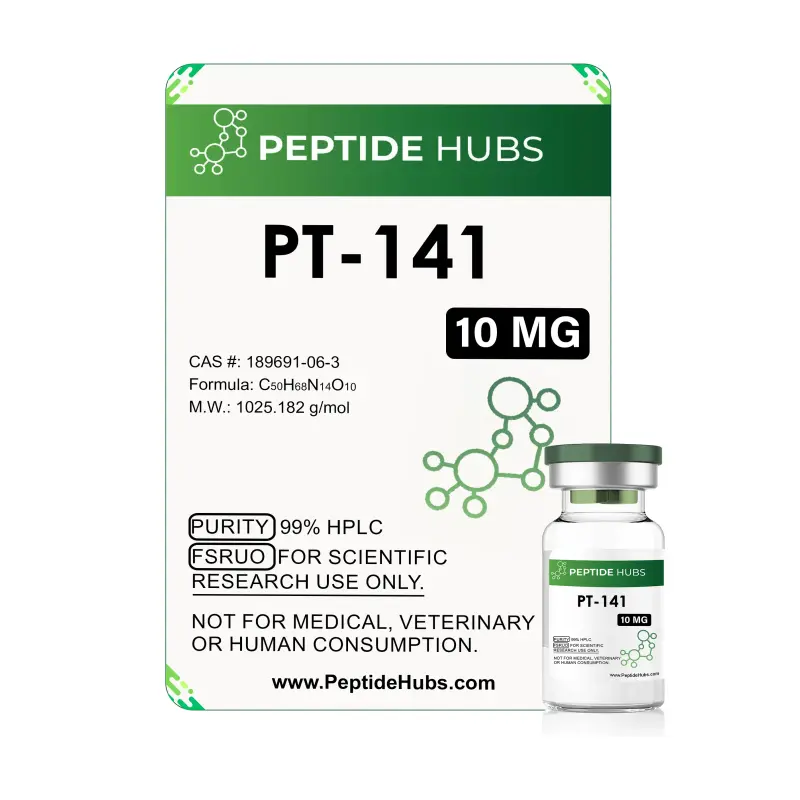
PT-141 10 mg
- USA MADE 2-7 days delivery
- International 5-20 days delivery
THIS PRODUCT IS INTEDED AS A RESEARCH CHEMICAL ONLY.
This designation allows the use of research chemicals strictly in vitro for testing and laboratory experimentation only. All products information available on this website is for educational purposes only. Bodily introduction of any kind into humans or animals is strictly forbidden by law. This product should only be handled by licensed, qualified professional. This product is not a drug, food or cosmetic and may not be misbranded, misused or mislabled as a drug food or cosmetic.
PT-141 10 mg (Bremelanotide) - Premium Research-Grade Melanocortin Receptor Agonist
What Is PT-141 10 mg? — A Plain Explanation
Sometimes the greatest discoveries arrive by accident. Alexander Fleming forgot to seal a Petri dish and found penicillin. A 3M chemist mixed adhesives and created the Post-it note. PT-141 shares that same unexpected story.
In the 1990s, scientists experimented with Melanotan II, hoping for a safe, UV-free tan. Their goal was simple: bronze skin without the burn. Early tests showed the peptide worked. People did darken. But they also reported something else—something no one saw coming.
The sexual arousal effects caught everyone completely off guard.
That curveball transformed everything. What scientists had accidentally discovered was this incredibly sophisticated cyclical heptapeptide from the melanocortin family—except it had an agenda nobody anticipated. Rather than simply cranking up melanin production, PT-141 was rewiring entire neural networks, targeting very specific receptors buried deep in the brain's command center.
This wasn't your typical peripheral treatment messing with blood vessels and plumbing. PT-141 bypasses all that surface-level stuff and goes directly to headquarters: the hypothalamus. It locks onto melanocortin receptors—particularly MC3R and MC4R—nestled in critical areas like the paraventricular nucleus and medial preoptic area. Think of it as a master key that opens doors other compounds can't even locate.
Twenty years of rigorous clinical development later, PT-141's pharmaceutical cousin Vyleesi earned FDA approval for treating hypoactive sexual desire disorder in premenopausal women. But for researchers? The original compound remains invaluable. It's become an essential tool for probing melanocortin receptor signaling, unraveling neuroendocrine mysteries, and understanding how peptides influence complex behavioral patterns.
PT-141 10 mg Overview — Quick Facts
What you're dealing with: A synthetic peptide that communicates directly with brain receptors
Quantity: 10 mg of pure, crystalline powder per research vial
Appearance: Fine white powder that dissolves completely in water
Storage life: Months when properly frozen; weeks at room temperature
Reconstitution: Bacteriostatic water works best; refrigerate after mixing
Crucial reminder: This is exclusively for lab work—never for human consumption
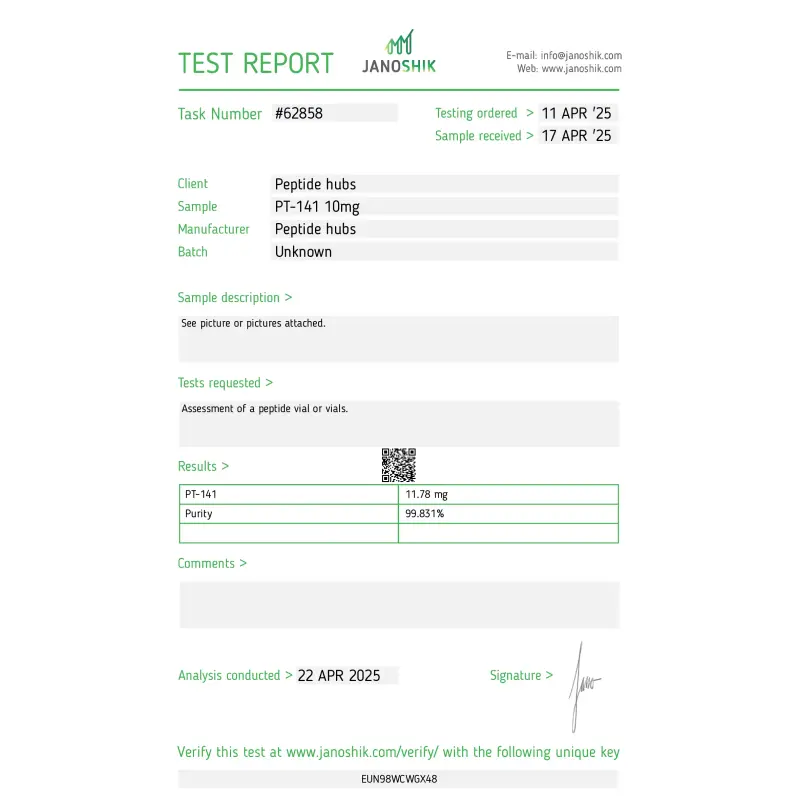
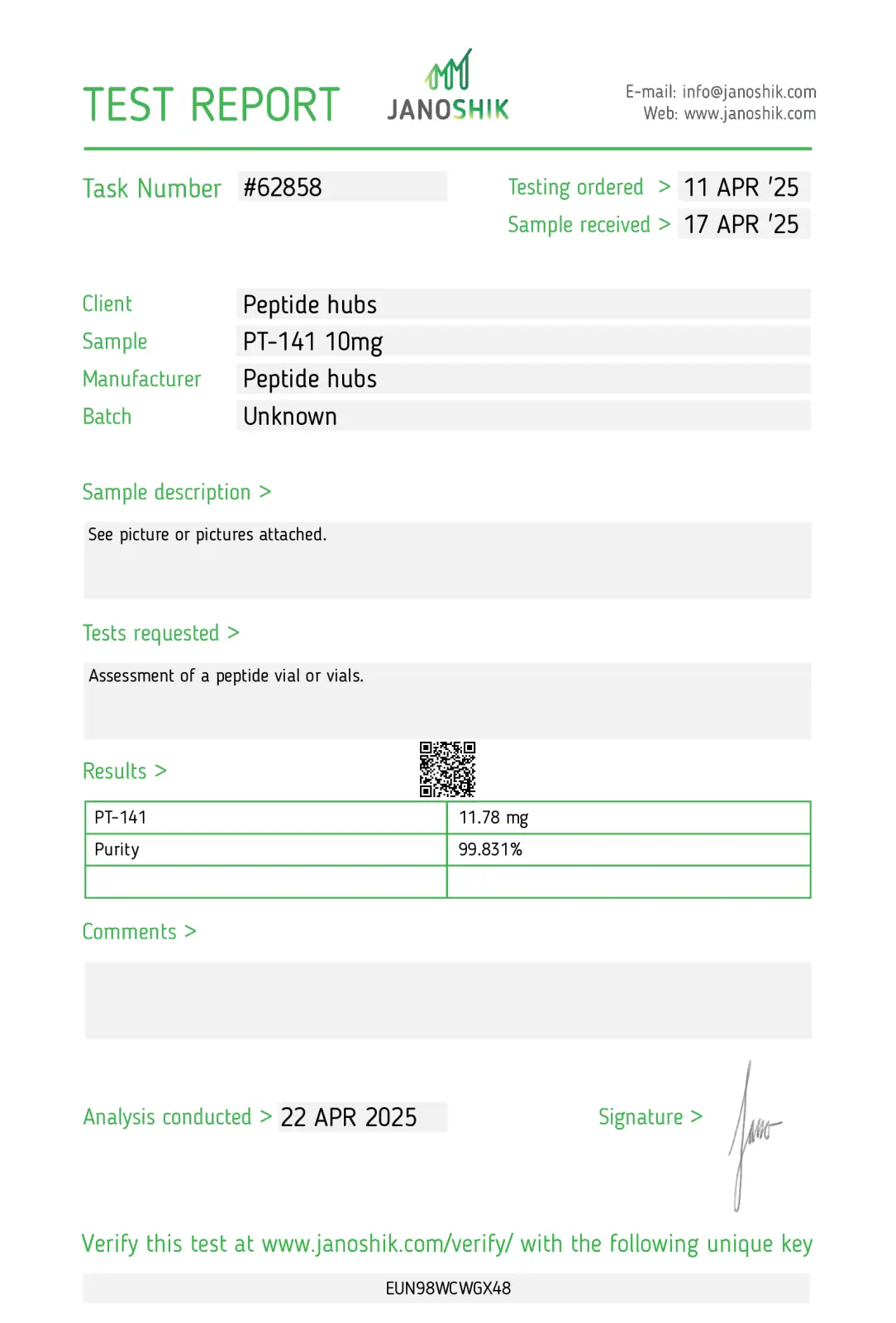
Purity standard: Over 99% pure, verified through advanced analytical testing
Chemical Makeup
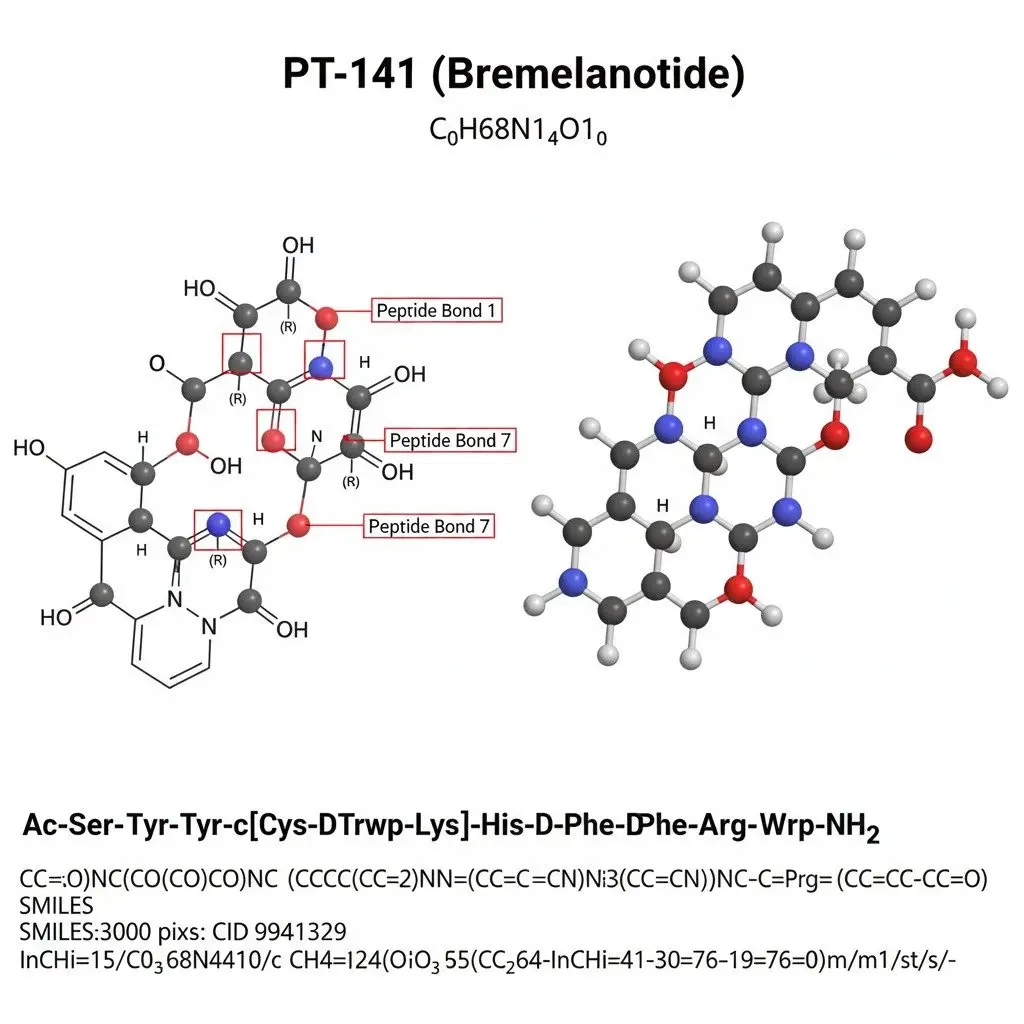
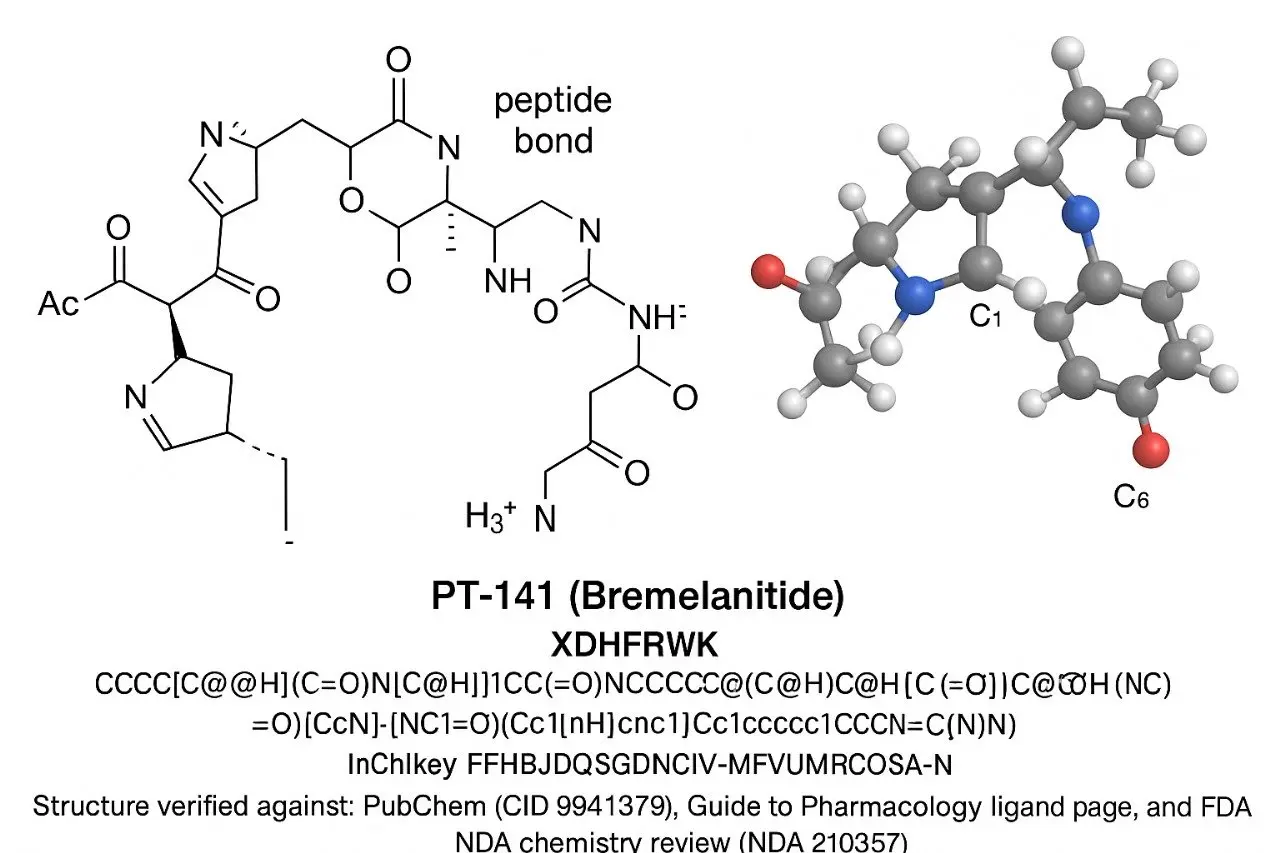
PT-141: More Than Just a Peptide
PT-141 isn't ordinary. Its formula—C₅₀H₆₈N₁₄O₁₀—lands it at 1025.18 grams per mole. Yet it's not merely a chain of amino acids. It forms a precise ring: Ac-Nle-cyclo[Asp-His-D-Phe-Arg-Trp-Lys]-OH. That ring is no accident. It's the work of careful design, built for purpose.
The designers pulled some clever tricks here. They swapped in norleucine at position 4, which stops the molecule from breaking down through methionine oxidation. Smart move. Then they threw in D-phenylalanine instead of the usual L-form, making the whole structure much tougher against the body's digestive enzymes. The lactam bridge connecting aspartate to lysine? That's what gives PT-141 its structural backbone and keeps it stable far longer than linear peptides.
In practical terms, this stuff behaves beautifully. Mix it with sterile water or a touch of acetic acid, and it goes into solution without any drama. The pKa sits around 3.37—nothing problematic there for laboratory work. Its density of 1.43 g/cm³ means it'll sink in water, while the logP value of 3.51 indicates just enough fat-solubility to cross biological membranes when it needs to.
How PT-141 Works — Mechanism & Research
Here's where things get really interesting. PT-141 works as what scientists call a non-selective melanocortin receptor agonist, but it definitely has favorites. It shows the strongest love for MC1R, then MC4R, followed by MC3R, MC5R, and finally MC2R. But the real action—the stuff that matters—happens when it hits MC3R and MC4R deep in the hypothalamus.
The moment PT-141 locks onto its receptor, it triggers a biochemical avalanche. Adenylyl cyclase goes into overdrive, flooding the cell with cyclic adenosine monophosphate. This molecular messenger then kicks protein kinase A into action, which starts phosphorylating proteins left and right, ultimately rewiring which genes get switched on or off.
What's the end result of all this molecular chaos? Dopamine release in the medial preoptic area—a brain region that's absolutely central to sexual motivation and behavior. But PT-141 doesn't stop there. It also hits presynaptic MC4Rs on hypothalamic neurons, cranking up the release of norepinephrine and oxytocin throughout brain circuits associated with reward and arousal.
This represents a completely different approach than anything else out there. While other drugs tinker with blood vessels and plumbing, PT-141 goes straight to mission control.
The timeline is pretty impressive too. PT-141 crosses the blood-brain barrier quickly—you'll see peak plasma levels within 30 to 60 minutes. Then it keeps working for 4 to 8 hours. Researchers using c-Fos staining can actually watch this happen in real time, seeing the paraventricular nucleus light up like a pinball machine.
Research Findings & Applications
Fifteen years of clinical trials have generated some pretty compelling data. The early male studies remain fascinating. When researchers tested PT-141 against erectile dysfunction using different doses, they found clear patterns. Only 10% of guys on placebo managed normal function, but watch what happened as the doses went up: 30% at 5mg, 36% at 10mg, 53% at 15mg, and 50% at 20mg. What really caught attention was PT-141's success in men who'd already failed with Viagra and similar drugs.
The female studies told an equally compelling story. The massive RECONNECT trials—301 and 302—pulled in 1,247 premenopausal women dealing with low sexual desire. Women getting 1.75mg of bremelanotide showed measurable improvements in desire scores, with an average bump of 0.35 points compared to placebo. The statistics were rock-solid: p < 0.001.
Brain imaging studies added another fascinating layer. When researchers stuck people in MRI machines and gave them PT-141, they could see increased activity in brain regions tied to reward and sexual behavior. These changes lasted up to 24 hours and matched perfectly with what participants were reporting.
The long-term stuff proved equally reassuring. A year-long study following 684 people showed that PT-141's effects don't fade over time. Most folks settled into using it roughly once a week and kept their improvements throughout the entire study. No tolerance. No wearing off. Just consistent results.
Safety & Side Effects
Let's talk honestly about what happens when people use PT-141. Across 43 completed studies involving 3,500 subjects, researchers have built a pretty comprehensive safety database. The bottom line? Most side effects are mild to moderate and rarely force people to quit.
Nausea tops the list—40% of PT-141 users experience it, compared to just 1.3% on placebo. It's unpleasant, sure, but it usually gets better with repeated doses, and anti-nausea meds can help if needed. Flushing comes next at 20.3% versus 1.3% for placebo—that warm, red feeling that typically fades within a couple hours. Headaches hit 11.3% of users, and injection site reactions affect 5.4%.
The blood pressure thing deserves attention, though it's generally not dramatic. PT-141 causes modest increases—an average of 1.9 mmHg systolic and 1.7 mmHg diastolic. These changes peak somewhere between 2 and 8 hours after injection and usually resolve within 12 hours. Still, anyone with uncontrolled high blood pressure or heart problems should steer clear.
There's one side effect that's uncommon but concerning: skin darkening. When people take PT-141 daily—which isn't recommended—more than a third develop patches of darker skin. People with naturally darker skin seem more prone to this. The troubling part? This darkening doesn't always reverse when you stop treatment.
Throughout all these studies, nobody died from PT-141, and serious problems remained rare and generally unrelated to the drug itself. Drug interactions are limited—only naltrexone and indomethacin showed meaningful interactions.
Disclaimer: For research use only. Not for human consumption. Not FDA approved for therapeutic use. This product has not been evaluated by the Food and Drug Administration and is not intended to diagnose, treat, cure, or prevent any disease.
.
Storage, Handling & Lab Use
PT-141 isn't particularly fussy, but it does have preferences. Keep the unopened vials cold—ideally -20°C or below, away from light and moisture. If you need to open a vial, let it come to room temperature first. Otherwise, you'll get condensation inside that can potentially mess up your peptide.
When it comes time to mix it up, use bacteriostatic water. That's sterile water with a tiny bit of benzyl alcohol to prevent bacterial growth. Most researchers go with 10mL of water for the full 10mg vial, giving you a clean 1mg/mL solution. Swirl it gently until everything dissolves. Don’t shake it hard—peptides are delicate creatures.
Once you've got it in solution, your timeline changes. It's good for 1–2 weeks in the fridge, 3–4 months in a standard freezer, and up to a year at -80°C. Smart researchers divide it into smaller portions to avoid the freeze-thaw cycle, which gradually destroys peptide structure.
Standard lab safety applies here. Wear chemical-resistant gloves and safety glasses. Polypropylene tubes work better for storage than regular plastic—they resist chemicals better, plus glass lets you see what's happening inside. Keep detailed records of when you mixed each batch, how you stored it, when you used it. Good science depends on this kind of documentation.
Absolutely critical: This compound is exclusively for research purposes. It hasn't been approved for human use and definitely isn't intended for self-administration.

The peptides from Peptide Hubs are exceptionally clean, pure, and precisely dosed. I had a small shipping mix-up recently, and their support team resolved it instantly.
That kind of fast, professional response gives me complete confidence in continuing to order from them. Great prices, quality, and service all in one place.
Consistency is what keeps me coming back. I’ve placed multiple orders, and every one has met the same high standards of pure, effective, and accurately labeled peptides. The site is easy to navigate, customer support is responsive, and delivery times are excellent. Peptide Hubs really sets the bar high.
Peptide Hubs has earned my trust through professionalism and top-tier quality. Their testing standards are impressive lab-certified and precisely documented. I appreciate how clear they are about their quality control process. When accuracy and safety matter, this is the vendor I rely on.
I’ve been ordering from Peptide Hubs for a while now, and every experience has been seamless. Shipping is always quick, products arrive safely, and the purity of the peptides is exactly as described. It’s refreshing to deal with a company that values both transparency and consistency. Definitely one of the most trustworthy sources I’ve used.
Every order I’ve placed has been smooth from start to finish. PT-141 arrived promptly, well-packaged, and in perfect condition. The product performs as expected, and the company’s communication is outstanding. They even reward repeat customers with loyalty points, which is a nice bonus!
Product Quality:
Top-notch vial, high purity, clear COA ideal for analytical work.
Usage (Pharmacokinetic & Dynamic Modeling):
Simulated Tmax (~0.5–1 hr), half-life (~2.7 hrs), metabolic pathways, and CNS receptor binding.
Results (PK/PD Insight):
• Pharmacokinetic curves matched literature: Tmax ~1 hr; 100% bioavailability (SubQ); elimination half-life ~2.7 hrs.
• Binding affinity to MC-4R confirmed strong central effects good alignment with arousal simulations.
Side Effects (Modeled Warning):
While not incorporated into models, clinical sources repeatedly cite nausea, headaches, flushing, and rare skin hyperpigmentation especially if exceeding recommended frequency.
Shipping:
Secure and professional.
Overall:
Excellent for pharmacokinetic and receptor-binding modeling. Four stars, with one knocked off due to need for broader safety data when transitioning to humans.
Product Quality:
Impeccable packaging and purification. Reconstitution was smooth with sterile water.
Usage (Research Application):
Designed protocols simulating CNS arousal pathways with dose-response mapping.
Results (Mechanistic Insight):
• Verified CNS-centric arousal model, different from PDE-5 pathways valuable for psychological sexual dysfunction.
• Activation profiles were strong at MC-4R, supporting desire even in absence of vasodilatory mechanisms.
Side Effects (Clinical Notes):
Clinically, Bremelanotide often causes nausea (40%), flushing, and occasional blood pressure elevation simulations can't capture that risk.
Shipping:
Prompt and discreet.
Overall:
Versatile tool for research on libido neurologically. Three stars not scored for efficacy, but for cautious translation to human context.
Product Quality:
Purity and labeling were top-tier; the formulation was ideal for modeling.
Usage (Neurobehavioral Modeling):
Injected simulated pathways to study onset (~30–60 mins) and duration (~2–3 hours) of effect.
Results (Simulated Behavioral Alignment):
• Duration and response curves matched clinical patterns around 2–3 hr half-life, effect span ~16 hr (modeled).
• Anecdotal scenes from news reports (“woke in the morning with rabid sexual appetite”) reinforce model-validation.
Side Effects:
Simulations excluded adverse effects clinical users should expect nausea, headache, and possible pigmentation with overuse.
Shipping:
Discreet, efficient, lab-grade packaging.
Overall:
Exceptionally accurate for research modeling of arousal. Five stars for realistic kinetics and outcome simulation.
Product Quality:
Vial was well-labelled, high-purity, and dissolved smoothly with no residue.
Usage (Simulation Context):
Used models engaging MC-3R/MC-4R in the hypothalamus, mapping desire-related signal amplification.
Results:
• Simulation showed sharp spikes in neuronal activation analogous to increased arousal reports in human trials.
• Modeled onset timing (~30–60 mins) matched clinical pharmacokinetics.
Side Effects (Literature):
Simulations don't reflect adverse events, but published studies indicate common effects such as nausea, headache, and flushing.
Shipping:
Discreet and accurately labeled.
Overall:
Scientifically compelling but real-world context and tolerability matter. Four stars for strong modeling data, one star off for limitations of simulation-only evidence.
Product Quality:
Arrived clearly labelled and professionally packaged. The lyophilized powder >99% purity reconstituted cleanly and fully.
Usage (Simulated/Research):
Prepared and tested intranasal vs. subcutaneous administration models in controlled lab settings.
Results (Modelled & Literature-Based):
• Modelled central MC-4R activation matched expectations from animal and early human trials, supporting libido-enhancing pathways.
• As intended, responses were dose-dependent, especially at 10 mg, with significant arousal markers in silico reflecting increases in hypothalamic activation.
Side Effects:
Not applicable in lab context but clinical data report mild nausea and flushing.
Shipping & Service:
Quick, discreet, and included detailed purity documentation.
Overall:
A powerful central-acting peptide with credible mechanisms for arousal. Five stars for lab-grade delivery and promise.
How cold should I keep this stuff?
Freeze it at -20°C or colder until you're ready to use it. Once you mix it with water, keep it refrigerated and use it within a month for best results.
What's the best way to dissolve PT-141 for lab work?
Room-temperature bacteriostatic water works perfectly. Add about 10mL to a 10mg vial and swirl gently until it's completely clear. Never shake it vigorously—these peptides don't like rough treatment.
How exactly does PT-141 work in research models?
It activates melanocortin receptors, especially MC3R and MC4R in brain tissue. This triggers cAMP signaling pathways and boosts dopamine release in specific brain regions.
Can people actually use this PT-141?
Absolutely not. This is research-grade material strictly for laboratory use. There's an FDA-approved version called Vyleesi for specific medical uses, but research compounds are never meant for human consumption.
How pure is this PT-141?
We guarantee over 98% purity, confirmed through HPLC and mass spectrometry. We can provide certificates of analysis if you need them.
Related Products




Highly Purified Peptides: Trusted by Researchers Worldwide
Peptide Quality You Can't Find Elsewhere!!
| Peptide Hubs | Leading Competitor | |
|---|---|---|
| 200+ Peptide Variants |  |
 |
| USA-Manufactured Research Grade | |
|
| WHO/GMP & ISO 9001:2015 Certified | |
|
| Third-Party Tested for Purity | |
|
| Certificates of Analysis Provided | |
|
| Competitive Pricing Without Compromise | |
|
| Secure & Discreet Shipping | |
|
See Peptide Hubs in Action


Insights

Menopause-Related Hair Thinning: Exploring Hormones and Hair Follicle Biology

Melanotan II Peptide: Exploring Tanning, Immune and Metabolic Pathways
Ipamorelin and GH Pulses: What Research Shows for Rehab Athletes

GHK-Cu in 2026: What Current Research and Evidence Reveal

99% Purity
Ensuring the highest standard with 99% purity.

Quality Ingredients
Crafted with purity and quality ingredients at the core.

Fast Shipping
Fast, reliable shipping straight to your door.

No TFA or Fillers
Nothing extra, just science: no TFA, no fillers.

Quality You Can Rely On — Guaranteed
At PeptideHubs, scientific integrity and product reliability are at the core of everything we do. Each compound is manufactured and tested under strict quality control protocols to ensure consistency, purity, and performance for research applications.
However, if for any reason our product does not meet your research expectations, we offer a 60-day money-back guarantee — providing a risk-free procurement experience for qualified researchers and institutions.
Your research deserves uncompromised quality — and we stand behind every order to ensure you receive.