
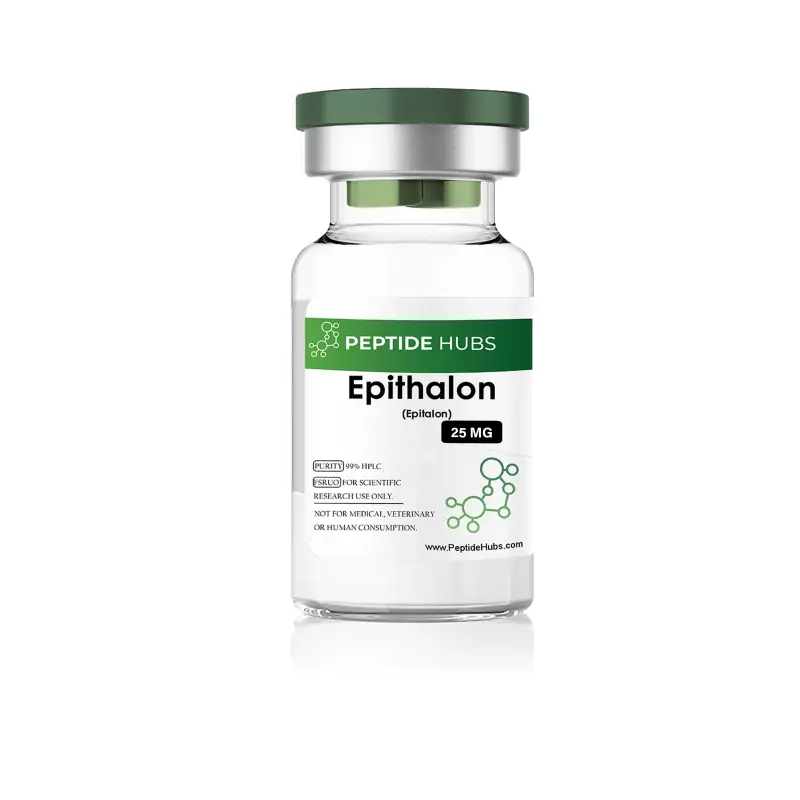
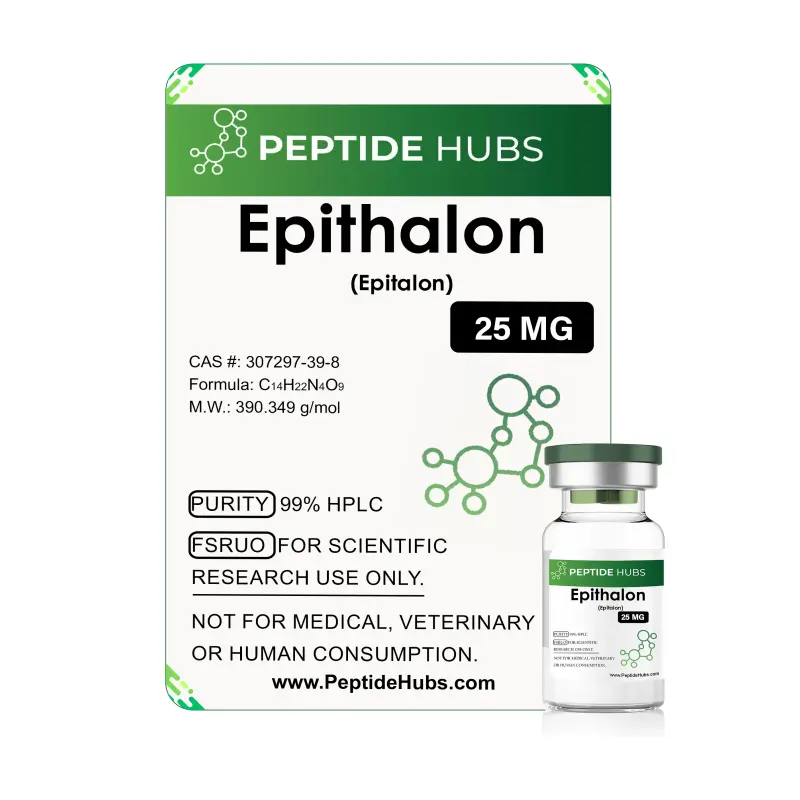
Epitalon 25mg
- USA MADE 2-7 days delivery
- International 5-20 days delivery
THIS PRODUCT IS INTEDED AS A RESEARCH CHEMICAL ONLY.
This designation allows the use of research chemicals strictly in vitro for testing and laboratory experimentation only. All products information available on this website is for educational purposes only. Bodily introduction of any kind into humans or animals is strictly forbidden by law. This product should only be handled by licensed, qualified professional. This product is not a drug, food or cosmetic and may not be misbranded, misused or mislabled as a drug food or cosmetic.
Epithalon (Epitalon)
A synthetic tetrapeptide possessed of the singular capacity to animate telomerase activity and to extend the cellular lifespan beyond the boundaries prescribed by nature's customary design.
Epithalon, a synthetic tetrapeptide of the sequence Ala-Glu-Asp-Gly, stands as a most extraordinary compound derived from the naturally occurring Epithalamin of the pineal gland. This peptide, refined through more than three decades of rigorous investigation at the esteemed St. Petersburg Institute of Bioregulation and Gerontology, possesses the remarkable faculty to stimulate telomerase activity and thereby induce telomere elongation in human somatic cells, permitting them to surpass the conventional Hayflick limit and extend their replicative capacity beyond the boundaries prescribed by nature. Beyond such telomeric preservation, Epithalon exerts multiple anti-aging mechanisms of considerable consequence—amongst these being epigenetic regulation through chromatin remodeling, enhancement of antioxidant enzyme activity, restoration of circadian rhythm through melatonin synthesis, and judicious modulation of longevity-related gene expression—rendering it a compound of genuine scientific merit for those engaged in cellular aging research.
1. What is Epithalon? An Overview of Its Character
Epitalon (variously styled as Epithalon or Epithalone) presents itself to the scientific community as a synthetic tetrapeptide of most particular composition: alanine, glutamic acid, aspartic acid, and glycine, arranged in the sequence Ala-Glu-Asp-Gly. The peptide owes its origin to Epithalamin, an extract derived from the bovine pineal gland, though subsequent investigations revealed Epitalon's natural occurrence within pineal polypeptide preparations. Over the course of five-and-twenty years, this tetrapeptide has occupied the attention of those engaged in gerontological and neuroendocrine research, establishing itself as a subject worthy of serious inquiry.
Such investigations as have been conducted suggest that Epitalon may operate through a multiplicity of mechanisms—telomerase activation, antioxidant properties, the modulation of gene expression, and the regulation of circadian rhythms being among the most frequently observed. Its remarkable capacity to interact with both cytoplasmic and nuclear components positions Epitalon as an instrument of considerable value for researchers investigating the mechanisms of cellular aging, DNA-protein interactions, and epigenetic regulation.
Epithalon Structure
The molecular constitution of Epithalon exhibits characteristics of considerable precision, such as must command the attention of any discerning investigator. The tetrapeptide maintains a molecular formula of C₁₄H₂₂N₄O₉, its molecular weight being 390.35 grammes per mole. Its structure comprises four amino acids connected through α-peptide bonds in the following arrangement: alanine situated at the N-terminus, succeeded by glutamic acid, aspartic acid, and glycine at the C-terminus. The peptide exists as a single polypeptide chain, non-glycosylated in nature, presenting itself as a white lyophilized powder when properly prepared. Molecular dynamics simulations reveal that Epithalon forms stabilizing intramolecular bonds which significantly constrain its conformational freedom, thereby contributing to its structural integrity when dissolved.
Technical Specifications
|
Parameter |
Specification |
|
Product Designation |
Epitalon (Epithalon) |
|
Sequence |
Ala-Glu-Asp-Gly (AEDG) |
|
Molecular Formula |
C₁₄H₂₂N₄O₉ |
|
Molecular Weight |
390.34 grams per mole |
|
Form |
Lyophilized powder |
|
Concentration |
25 milligrams per vial |
|
Purity |
>98% |
|
CAS Number |
307297-39-8 |
|
Storage |
-20°C to -80°C (lyophilized); 4°C short-term |
|
Appearance |
White to off-white powder |
|
Solubility |
Soluble in sterile water, bacteriostatic water, or dilute acetic acid |
3. Epithalon Research: Investigations of Considerable Merit
3.1 The Role of Telomerase—A Matter of Scientific Consequence
Telomerase activation represents one of the most extensively studied mechanisms associated with Epitalon, and it is a mechanism deserving of serious consideration. Telomerase is that enzyme responsible for maintaining telomeres—those protective DNA-protein structures situated at chromosome ends that shorten with each cellular division. Research has demonstrated that Epitalon can induce telomerase activity and promote telomere elongation in human somatic cell cultures—findings that must command attention.
In studies employing human fetal lung fibroblasts, the addition of Epitalon to telomerase-negative cell cultures induced expression of the catalytic subunit of telomerase, activated enzymatic activity, and resulted in measurable telomere elongation. Treated fibroblasts demonstrated extended replicative capacity, dividing beyond forty-four passages compared with thirty-four passages in untreated controls, effectively bypassing the Hayflick limit—that maximum number of divisions which normal cells may undergo.
Recent investigations in breast cancer cell lines revealed that Epitalon treatment for four days produced dose-dependent increases in telomere length, with significant elongation observed at concentrations of 0.5 to 1 microgram per millilitre. Primary cells, it must be observed, required extended treatment periods of three weeks to demonstrate comparable effects—a circumstance suggesting that Epitalon's properties vary according to cell type and treatment duration.
3.2 Epithalon and Gene Expression—Observations Most Particular
Epitalon's capacity to modulate gene expression through DNA and chromatin interactions represents a significant area of molecular inquiry. Studies have demonstrated that the peptide can directly interact with promoter regions of specific genes including Tram1, IL-2, CD5, and MMP2, potentially enhancing their expression—a property of considerable interest. These genes fulfill diverse roles in immune function and extracellular matrix maintenance—subjects which cannot be neglected by serious researchers.
Research employing gingival mesenchymal stem cells has elucidated potential epigenetic mechanisms by which Epitalon influences gene expression. The peptide appeared to bind preferentially with histones H1/6 and H1/3 at specific sites that interact with DNA. This binding may alter chromatin structure, potentially acting as a histone mimic that facilitates changes in chromatin dynamics—a most remarkable property indeed.
Through this mechanism, Epitalon may engage in competitive binding with histones at DNA interaction sites, thereby increasing transcriptional accessibility for genes involved in neuronal differentiation. In experimental models, treatment led to upregulation of neurogenic markers including Nestin, GAP43, β Tubulin III, and Doublecortin, with expression increasing by 1.6 to 1.8 times—improvements that must be accounted material.
3.3 Epithalon and Dermal Structures—Studies of Notable Interest
Research investigating Epitalon's effects upon dermal fibroblasts has revealed potential mechanisms relevant to tissue repair and cellular aging studies. The peptide has been observed to influence expression of MMP2, an enzyme involved in extracellular matrix breakdown and tissue remodeling. Studies in murine models demonstrated that Epitalon exposure resulted in thirty to forty-five percent higher activation of fibroblasts compared with control groups—an improvement that must be considered substantial.
Research has indicated that Epitalon may enhance expression of Ki-67 and CD98hc—markers associated with cellular proliferation—which typically decline during cellular aging processes. Investigations into cellular senescence pathways revealed that Epitalon appeared to inhibit synthesis of MMP-9, which typically increases with cellular aging, while simultaneously enhancing cellular proliferation processes.
3.4 Epithalon and Tumor Growth—Observations of Serious Import
Epitalon has been investigated in various cancer research models to examine its effects upon spontaneous tumor development. Studies in female C3H/He mice bearing spontaneous reproductive organ tumors observed that Epitalon administration over six months appeared to reduce tumor burden. In control animals, three out of nine tumor-bearing mice developed metastases, whereas no metastases were detected in Epitalon-treated experimental animals—a difference that must strike any observer.
Research in HER-2/neu transgenic mice demonstrated that Epitalon treatment reduced the cumulative number of mammary tumors and decreased maximum tumor size compared with saline-treated controls. The treatment also influenced tumor distribution: the number of mice bearing a single mammary tumor increased, while the number bearing two or more tumors decreased.
It is absolutely essential to emphasize that these findings derive exclusively from laboratory and animal research models. No therapeutic, preventive, or treatment claims are made or implied for human applications—a distinction that must be perfectly understood by all persons of sense.
3.5 Epithalon and Melatonin—The Regulation of Circadian Function
Studies conducted upon laboratory animal models suggest Epithalon may regulate melatonin synthesis and secretion through influence upon arylalkylamine-N-acetyltransferase and pCREB transcription proteins, enzymes of recognised importance. These regulatory proteins appear crucial for melatonin production and the control mechanisms governing circadian hormone release. Research in primate models observed potential restoration of normal physiological melatonin levels following Epithalon administration, though specific mechanisms require further elucidation. The peptide's interaction with pineal gland function represents a significant area for chronobiology research applications, one which merits continued attention.
3.6 Epithalon and Vision—Studies Concerning Retinal Function
Laboratory studies employing rat models of retinitis pigmentosa have examined Epithalon's effects upon retinal function and structure, with outcomes of particular note. Research reports indicated improvement outcomes in approximately 90% of experimental subjects, suggesting potential protective mechanisms for retinal tissue. Studies demonstrate the peptide's apparent ability to preserve overall eye structure whilst enhancing retina bioelectric function, which researchers consider essential for optimal visual processing. The mechanisms underlying these protective effects remain under investigation, with particular focus upon retinal cellular preservation and functional maintenance.
Key Features
- High-Purity Research Tool: Exceeding 98 percent purity as verified by high-performance liquid chromatography—suitable for telomerase activation and telomere elongation studies
- Gene Expression Modulation: Investigated for DNA-histone interactions and chromatin structure modulation in epigenetic research
- Oxidative Stress Investigations: Studied for antioxidant properties in cellular aging and oxidative damage models
- Neuroendocrine Applications: Examined for effects upon melatonin biosynthesis pathways and circadian rhythm regulation
- Cellular Senescence Studies: Utilized in research investigating proliferation markers and cellular longevity mechanisms
- Standardized Format: Supplied as lyophilized powder in 25 mg concentration for consistent protocols
- Laboratory-Grade Specifications: Molecular formula C₁₄H₂₂N₄O₉, molecular weight 390.34 g/mol, sequence Ala-Glu-Asp-Gly
Storage Instructions: Proper Handling of a Valuable Substance
Concerning the Storage of Lyophilized Powder:
Store unopened vials at temperatures of -20 °C or -80 °C in an environment both dry and dark, protected from light and moisture—conditions that any well-regulated laboratory should be capable of providing. For short-term storage not exceeding 4 weeks, the lyophilized peptide may be maintained at 4 °C or room temperature—though the former is decidedly preferable. Before opening any vial, allow it to equilibrate to room temperature in a desiccator, thereby preventing atmospheric moisture condensation upon the peptide powder—a most important precaution, as peptides are hygroscopic substances and moisture exposure significantly reduces long-term stability.
Upon the Storage of Reconstituted Solutions:
Once reconstituted with sterile water or appropriate solvent (a procedure requiring careful attention), peptide solutions should be stored at 4 °C for short-term use—a period not exceeding one to two weeks at the utmost. For longer storage periods, freeze reconstituted solutions at -20 °C or -80 °C—temperatures that ensure preservation. To prevent degradation from repeated freeze-thaw cycles (a phenomenon most injurious to peptide stability), prepare multiple aliquots immediately after reconstitution and freeze individual portions—a practice that reflects both prudence and scientific good sense.
Handling Precautions—Matters Requiring Serious Attention:
Handle peptides employing sterile technique in appropriate laboratory environments—a requirement that ought to be self-evident to all qualified researchers. Peptides containing certain amino acids (Cysteine, Methionine, Tryptophan—substances of particular sensitivity) are especially susceptible to oxidation and should be protected from air exposure with the utmost care. Store in tightly capped vials, and consider purging with nitrogen or argon gas to minimize oxidative degradation—a precaution that prudent investigators will not neglect. Reconstituted solutions should be prepared in sterile buffers at pH 5 to 6 for optimal stability—conditions that any competent laboratory ought to maintain without difficulty.
What is the amino acid sequence of Epitalon?
Epitalon is a synthetic tetrapeptide comprising the sequence Ala-Glu-Asp-Gly, derived from the naturally occurring pineal peptide Epithalamin. The peptide consists of 4 amino acids connected through standard α-peptide bonds—a structure of elegant simplicity.
What storage conditions are recommended for lyophilized Epitalon?
Store lyophilized Epitalon at -20 °C or -80 °C in an environment both dry and dark. For short-term storage (not exceeding four weeks), the product may be kept at 4 °C. Always allow the vial to equilibrate to room temperature before opening.
For what research applications is Epitalon 25mg suitable?
Epitalon is utilized in telomerase activation studies, cellular aging research, gene expression modulation investigations, oxidative stress pathway studies, circadian rhythm and melatonin biosynthesis research, epigenetic mechanism investigations, and cellular senescence pathway studies—applications that span a considerable range of scientific inquiry.
What degree of purity is provided for this peptide?
This Epitalon 25mg product is supplied at greater than ninety-nine percent purity, verified by high-performance liquid chromatography—a specification making it suitable for demanding quantitative and qualitative research applications requiring peptide quality of the highest standard.
How ought reconstituted Epitalon solutions be stored?
Reconstituted solutions should be stored at 4 °C for short-term use (one to two weeks at the utmost) or frozen at -20 °C to -80 °C for longer storage periods. Avoid repeated freeze-thaw cycles by preparing multiple aliquots.
Related Products





Highly Purified Peptides: Trusted by Researchers Worldwide
Peptide Quality You Can't Find Elsewhere!!
| Peptide Hubs | Leading Competitor | |
|---|---|---|
| 200+ Peptide Variants |  |
 |
| USA-Manufactured Research Grade | |
|
| WHO/GMP & ISO 9001:2015 Certified | |
|
| Third-Party Tested for Purity | |
|
| Certificates of Analysis Provided | |
|
| Competitive Pricing Without Compromise | |
|
| Secure & Discreet Shipping | |
|
See Peptide Hubs in Action


Insights

Bronchogen Side Effects and Safety: A Research Overview

GHK-Cu Safety Profile: Side Effects and Current Research

PEG MGF Side Effects: Safety, Tolerability, and Research Findings

PT-141 Safety Insights: Side Effects and Clinical Evidence

99% Purity
Ensuring the highest standard with 99% purity.

Quality Ingredients
Crafted with purity and quality ingredients at the core.

Fast Shipping
Fast, reliable shipping straight to your door.

No TFA or Fillers
Nothing extra, just science: no TFA, no fillers.

Quality You Can Rely On — Guaranteed
At PeptideHubs, scientific integrity and product reliability are at the core of everything we do. Each compound is manufactured and tested under strict quality control protocols to ensure consistency, purity, and performance for research applications.
However, if for any reason our product does not meet your research expectations, we offer a 60-day money-back guarantee — providing a risk-free procurement experience for qualified researchers and institutions.
Your research deserves uncompromised quality — and we stand behind every order to ensure you receive.