
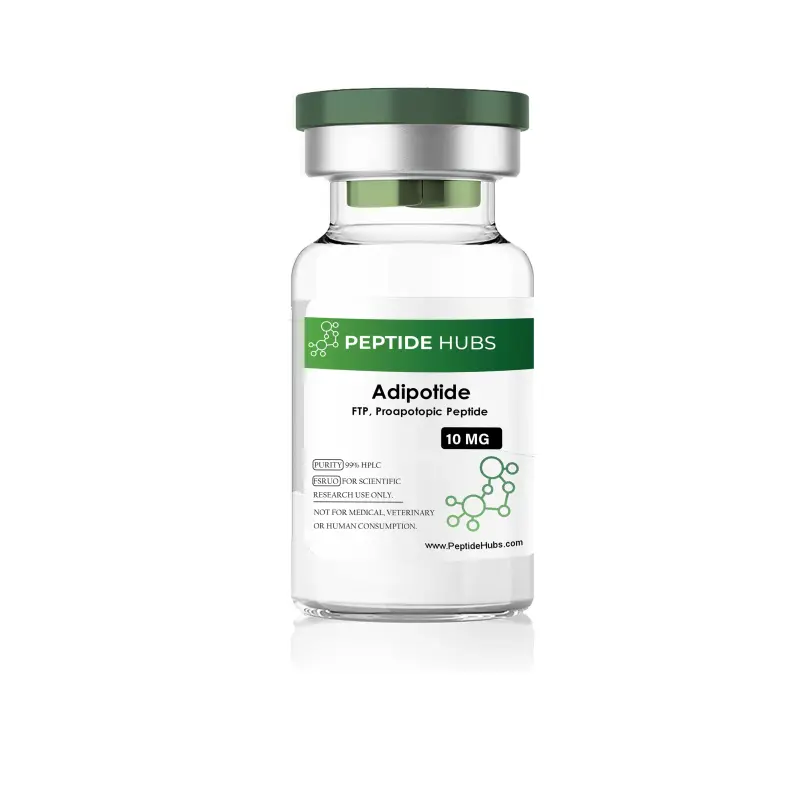
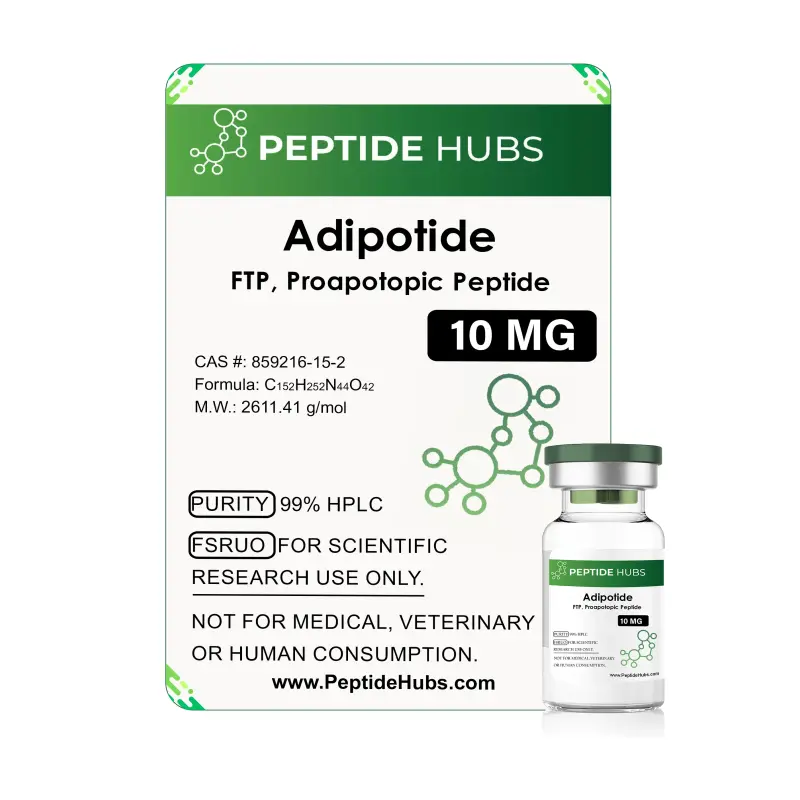
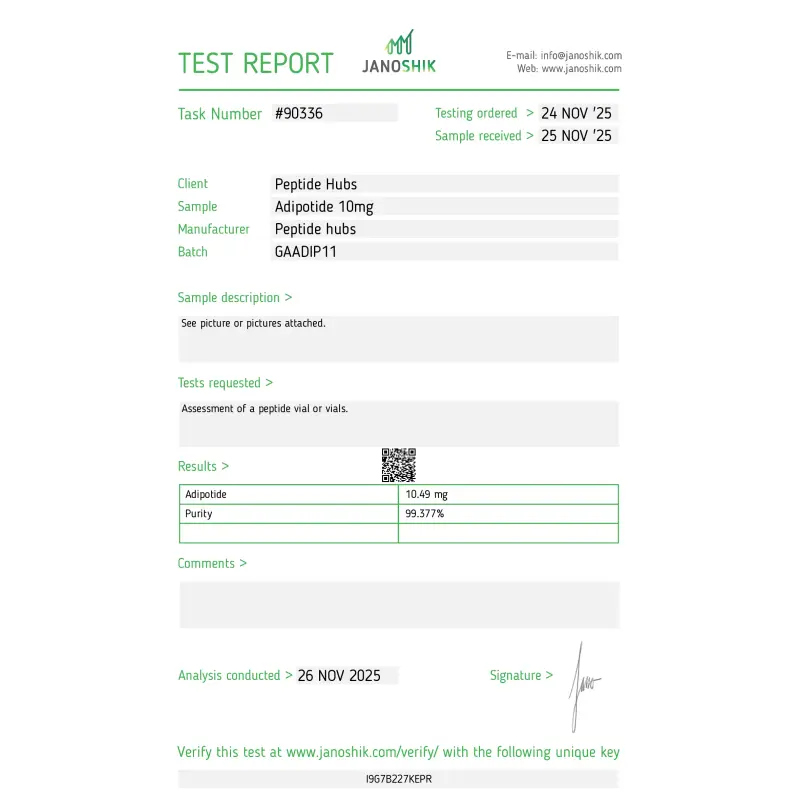
Adipotide 10mg
- USA MADE 2-7 days delivery
- International 5-20 days delivery
THIS PRODUCT IS INTEDED AS A RESEARCH CHEMICAL ONLY.
This designation allows the use of research chemicals strictly in vitro for testing and laboratory experimentation only. All products information available on this website is for educational purposes only. Bodily introduction of any kind into humans or animals is strictly forbidden by law. This product should only be handled by licensed, qualified professional. This product is not a drug, food or cosmetic and may not be misbranded, misused or mislabled as a drug food or cosmetic.
1. What is Adipotide?
Adipotide, also known as FTPP (Fat-Targeted Proapoptotic Peptide) or prohibitin-targeting peptide 1, is an experimental peptidomimetic compound engineered to induce selective apoptosis in the vascular endothelium of white adipose tissue. Unlike conventional metabolic agents, Adipotide operates through a ligand-directed mechanism that distinguishes blood vessels supplying adipose tissue from those elsewhere in the body. The peptide comprises two functional domains: a homing sequence (CKGGRAKDC) that binds to prohibitin and annexin A2 receptors on adipose vasculature, and a proapoptotic sequence (D(KLAKLAK)₂) that disrupts mitochondrial membranes upon internalization, triggering programmed cell death in targeted endothelial cells.
Research in rhesus monkeys demonstrated that Adipotide administration over four weeks resulted in an average 11% reduction in body weight, alongside a 27% decrease in abdominal fat mass and marked improvements in body mass index and waist circumference. Magnetic resonance imaging and dual-energy X-ray absorptiometry confirmed substantial reductions in white adipose tissue following treatment. The peptide's selectivity stems from its affinity for prohibitin, a membrane protein expressed predominantly on endothelial cells of white adipose vasculature and certain cancer tissues, but not on vessels serving other organ systems.
2. Adipotide Structure
The molecular architecture of this peptide reveals the careful consideration of its designers, much as the construction of a well-managed estate reflects the judgment of its proprietor. The complete sequence reads thus: Cys-Lys-Gly-Gly-Arg-Ala-Lys-Asp-Cys—Gly-Gly--(Lys-Leu-Ala-Lys-Leu-Ala-Lys)₂, with a molecular formula of C₁₅₂H₂₅₂N₄₄O₄₂ and a molecular weight of 2611.41 g/mol. One observes in this configuration a most judicious division of labor, not unlike the proper distribution of responsibilities within a household of good management.
The nine-amino-acid N-terminal sequence functions as the targeting element, a homing mechanism of singular purpose, demonstrating binding affinity for prohibitin receptors localized to white adipose tissue endothelium. This sequence was originally isolated through combinatorial phage display screening—a process not unlike the careful scrutiny applied to eligible candidates in society, wherein only those of suitable properties are selected for advancement.
The C-terminal proapoptotic sequence D(KLAKLAK)₂ represents an amphipathic peptidomimetic of admirable design, composed of alternating lysine and leucine residues in D-amino acid configuration. The use of D-amino acids confers resistance to proteolytic degradation, an endurance which may be compared to the staying power of a woman of good sense and steady principle. The glycine-glycine linker separating these domains provides structural flexibility, much as a certain degree of independence of thought may benefit even the most carefully arranged of partnerships.
3. Adipotide Research
3.1 Adipotide and Fat Loss
Initial investigations conducted in rhesus monkey models examined Adipotide's interaction with white adipose tissue vasculature over a period of four weeks—a duration sufficient for the discerning observer to note considerable alterations in circumstance. The experimental subjects demonstrated a reduction in body weight of approximately eleven percent, and a decrease in fat deposits of some thirty-nine percent, changes as remarkable in their degree as any sudden shift in fortune.
Most remarkably, these alterations occurred without deliberate modifications to diet or exercise protocols—a circumstance suggesting direct mechanisms of action rather than mere consequence of restricted means. The peptide appears to exert its effects through selective binding to prohibitin, which upon the endothelial cells of adipose vasculature operates as a most discriminating marker.
3.2 Adipotide and Cancer
Prohibitin, the molecular target of Adipotide's designs, has been identified within the vasculature of certain malignant tissues—a correspondence of considerable import to those engaged in oncological investigation. Cancerous growths depend upon extensive angiogenesis much as a dependent relation depends upon the favour of a wealthy patron; Adipotide's capacity to target prohibitin-expressing vessels may facilitate vascular-disrupting strategies of precision and restraint.
3.3 Adipotide and Glucose Tolerance
Adipotide administration in subjects of considerable corpulence produced improvements in glucose tolerance of most remarkable celerity—improvements observable within two to three days of treatment, a precipitation most remarkable and most gratifying to the investigator's hopes and expectations. Fasting glucose levels decreased by 25%, whilst insulin resistance measurements improved by 51% within the first week, suggesting with compelling evidence that such metabolic benefits are achieved with becoming independence from mere weight reduction alone, and operate through mechanisms distinct and separate from simple caloric deficit. Microarray analysis revealed alterations in gene expression within adipose tissue itself, affecting pathways related to mitochondrial function, oxidative phosphorylation, and amino acid metabolism—changes that suggest a profound alteration in the tissue's fundamental character and metabolic disposition. These glucose regulatory improvements occurred independently of changes in circulating adipokines, marking a distinction of considerable scientific significance.
4. Future Adipotide Research
The trajectory of Adipotide's scientific utility suggests pathways of inquiry yet to be fully explored, much as a young woman of considerable promise possesses qualities intimating possibilities not yet demonstrated to society. The anti-angiogenic properties of this peptide command the attention of oncological investigators, positioning Adipotide as a candidate of merit for investigations into tumor vasculature and vascular-targeted therapeutic development that spares surrounding healthy tissue from unnecessary injury. Future studies may profitably explore Adipotide's role in modulating immune cell infiltration within adipose tissue and the production of cytokines, with emerging evidence suggesting reduction in pro-inflammatory mediators such as TNF-α, IL-6, and MCP-1, whilst supporting anti-inflammatory cytokines that promote metabolic equilibrium.
The study of prohibitin's multifaceted functions in fatty acid transport and mitochondrial dynamics presents a fruitful direction for investigation, with Adipotide serving as a valuable pharmacological instrument for such endeavors. The peptide's capacity to produce rapid metabolic improvements independent of weight loss warrants continued mechanistic investigation of considerable depth. Future research must necessarily attend to the possibility of off-target effects across diverse tissue types, ensuring that legitimate enthusiasm for this peptide's promise does not obscure potential complications or unanticipated consequences.
Key Research Features
- Selective vascular targeting: Demonstrates specific affinity for prohibitin-expressing endothelial cells in white adipose tissue
- Dual-domain architecture: Combines targeting sequence with proapoptotic domain for bifunctional research utility
- Metabolic research applications: Enables investigation of glucose tolerance and insulin sensitivity independent of weight changes
- Anti-angiogenic properties: Provides research tool for studying vascular disruption mechanisms
- Receptor complex interactions: Facilitates examination of ANXA2-prohibitin-CD36 complexes in fatty acid transport
- Rapid metabolic effects: Permits investigation of glucose improvements within days
- Research-grade purity: Supplied at 99% purity as lyophilized powder
Technical Specifications
|
Parameter |
Specification |
|
Product Name |
Adipotide (FTPP) |
|
Concentration |
10 mg per vial |
|
Form |
Lyophilized powder |
|
Purity |
>99% |
|
Molecular Formula |
C₁₅₂H₂₅₂N₄₄O₄₂ |
|
Molecular Weight |
2611.41 g/mol |
|
Sequence |
Cys-Lys-Gly-Gly-Arg-Ala-Lys-Asp-Cys-Gly-Gly-D(KLAKLAK)₂ |
|
Storage Temperature |
-20°C (short-term); -80°C (long-term) |
|
Appearance |
White to off-white lyophilized powder |
Storage Instructions
Lyophilized Adipotide (FTPP) 10mg should be stored at -20°C in a tightly sealed container, protected from light and moisture. For short-term storage of up to two months, refrigeration at 4°C is acceptable, though freezer storage is preferred for maintaining long-term stability. Peptides are often hygroscopic; therefore, vials should be warmed to room temperature in a desiccator before opening to prevent moisture adsorption. The vial should be opened only briefly for weighing and resealed immediately.
For extended storage periods exceeding several months, storage at -80°C is recommended to maximize peptide stability. Avoid repeated freeze-thaw cycles, as these accelerate degradation. Frost-free freezers should not be used, as temperature fluctuations during defrost cycles compromise peptide integrity. Once reconstituted with bacteriostatic water or sterile saline, Adipotide should be stored at 2-8°C and used within a few weeks. All storage conditions should maintain protection from bright light and atmospheric moisture to ensure product stability over time.

Related Products






Highly Purified Peptides: Trusted by Researchers Worldwide
Peptide Quality You Can't Find Elsewhere!!
| Peptide Hubs | Leading Competitor | |
|---|---|---|
| 200+ Peptide Variants |  |
 |
| USA-Manufactured Research Grade | |
|
| WHO/GMP & ISO 9001:2015 Certified | |
|
| Third-Party Tested for Purity | |
|
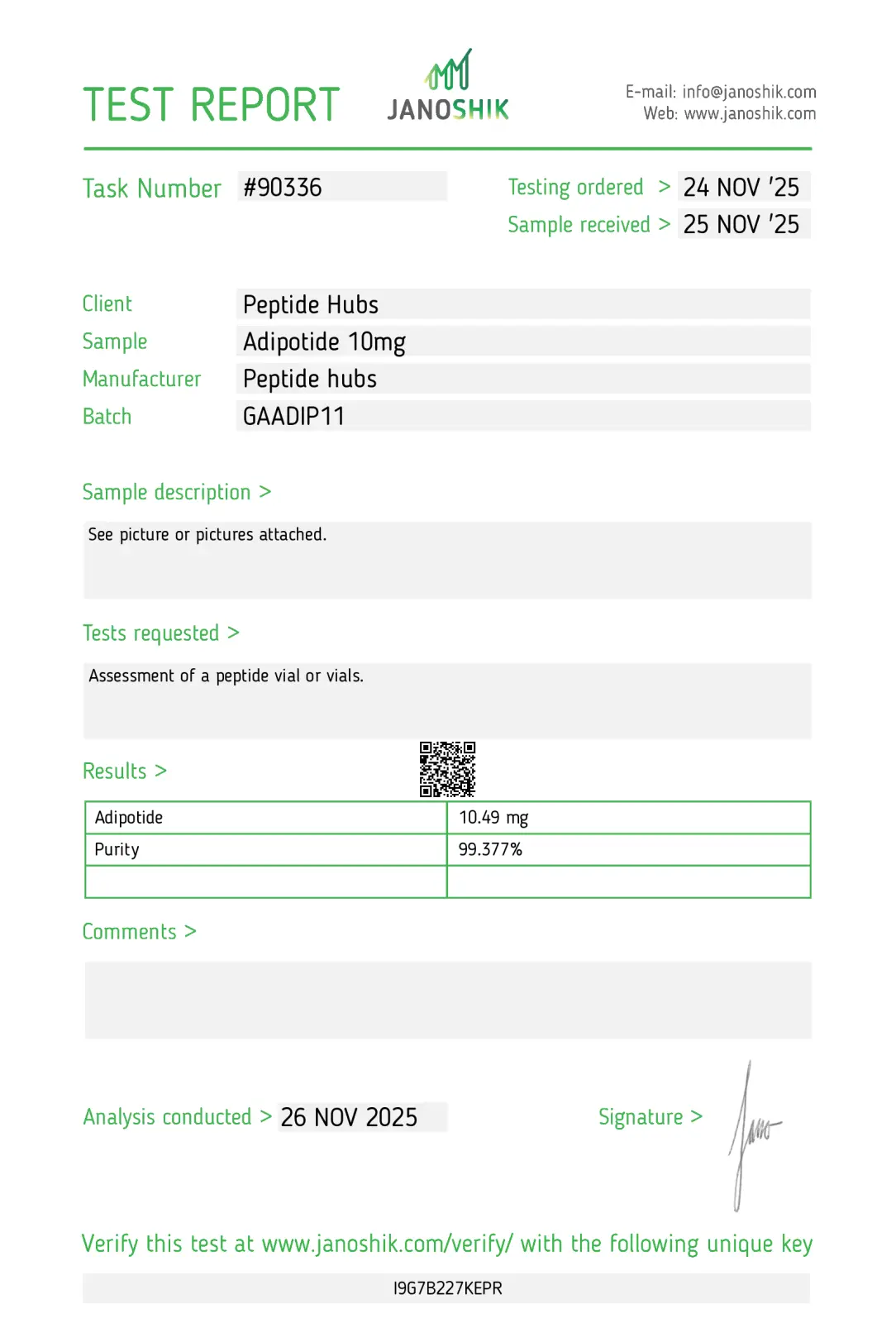
| Certificates of Analysis Provided | |
|
| Competitive Pricing Without Compromise | |
|
| Secure & Discreet Shipping | |
|
See Peptide Hubs in Action


Insights

Bronchogen Side Effects and Safety: A Research Overview

GHK-Cu Safety Profile: Side Effects and Current Research

PEG MGF Side Effects: Safety, Tolerability, and Research Findings

PT-141 Safety Insights: Side Effects and Clinical Evidence

99% Purity
Ensuring the highest standard with 99% purity.

Quality Ingredients
Crafted with purity and quality ingredients at the core.

Fast Shipping
Fast, reliable shipping straight to your door.

No TFA or Fillers
Nothing extra, just science: no TFA, no fillers.

Quality You Can Rely On — Guaranteed
At PeptideHubs, scientific integrity and product reliability are at the core of everything we do. Each compound is manufactured and tested under strict quality control protocols to ensure consistency, purity, and performance for research applications.
However, if for any reason our product does not meet your research expectations, we offer a 60-day money-back guarantee — providing a risk-free procurement experience for qualified researchers and institutions.
Your research deserves uncompromised quality — and we stand behind every order to ensure you receive.