
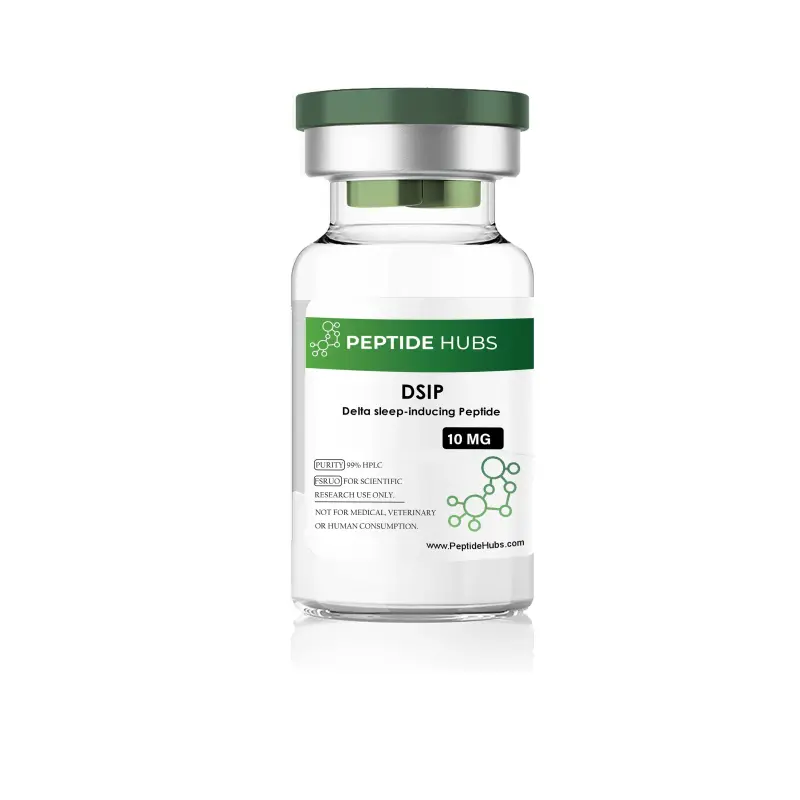
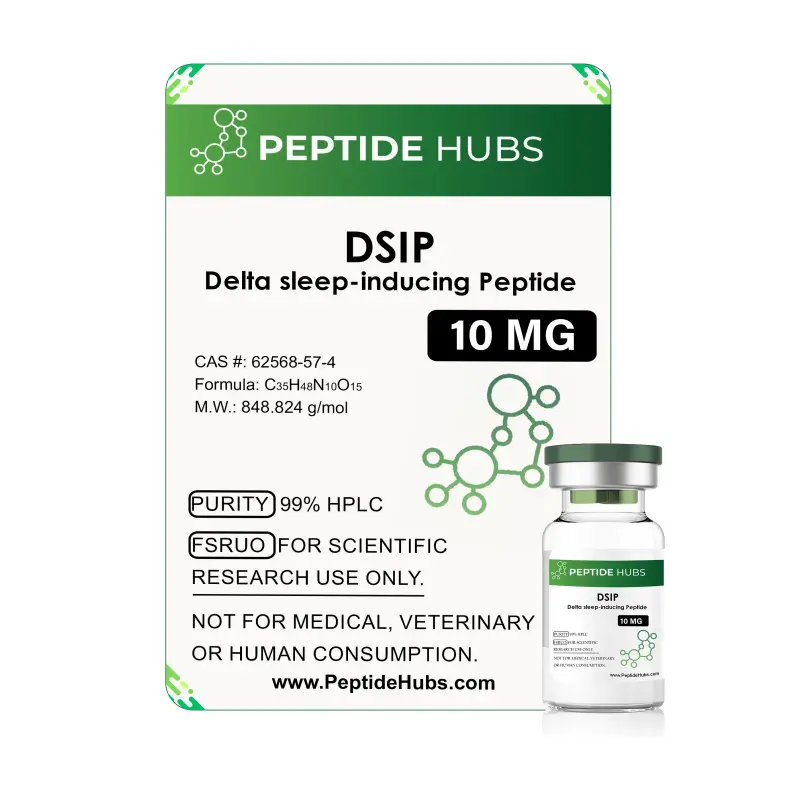
DSIP 10mg
- USA MADE 2-7 days delivery
- International 5-20 days delivery
THIS PRODUCT IS INTEDED AS A RESEARCH CHEMICAL ONLY.
This designation allows the use of research chemicals strictly in vitro for testing and laboratory experimentation only. All products information available on this website is for educational purposes only. Bodily introduction of any kind into humans or animals is strictly forbidden by law. This product should only be handled by licensed, qualified professional. This product is not a drug, food or cosmetic and may not be misbranded, misused or mislabled as a drug food or cosmetic.
1. What is DSIP?
Delta Sleep-Inducing Peptide (DSIP) is a naturally occurring nonapeptide composed of nine amino acids that has served as a focal point in neuroscience research since its initial characterization in the 1970s. Originally isolated from the central nervous system during investigations of electrically induced sleep, DSIP has garnered sustained scientific attention owing to its broad spectrum of physiological interactions. The peptide's nomenclature reflects its foundational research context, though contemporary investigations reveal its engagement with multiple systemic pathways extending far beyond sleep regulation.
DSIP functions as a neuropeptide with documented interactions across the central and peripheral nervous systems. Its amphiphilic molecular character facilitates cellular permeability, contributing to its documented effects on neural signaling pathways, hormonal secretion, and metabolic processes. Scientific investigation spanning five decades has positioned DSIP as a subject of considerable interest in preclinical research contexts, with particular emphasis on its potential influence on sleep architecture, stress tolerance, and endocrine function.
2. DSIP Structure
The molecular architecture of this peptide possesses a particularity and elegance most deserving of detailed examination. DSIP, being an amphiphilic nonapeptide, presents a molecular weight of 848.82 g/mol and is constituted of the following amino acid sequence: Trp-Ala-Gly-Gly-Asp-Ala-Ser-Gly-Glu, or in the abbreviated notation commonly employed by those conversant with such matters: WAGGDASGE.
The molecular formula—C₃₅H₄₈N₁₀O₁₅—reveals a compound of satisfactory complexity. Its amphiphilic character, which is to say its possession of both hydrophilic and hydrophobic properties, speaks to a substance possessed of considerable sophistication in its interactions with cellular membranes and the receptors thereupon situated. It is a most curious and, one might venture to say, revealing circumstance that nature should compose so elegant a molecule.
The matter of DSIP's stability, however, presents considerations of a more sobering character. In vitro examinations have disclosed that this peptide exhibits a half-life of approximately fifteen minutes, a brevity occasioned by the attentions of aminopeptidase-like enzymatic activity. Such susceptibility to degradation has prompted learned speculation amongst researchers: whether DSIP might complex with carrier proteins in biological systems to forestall its destruction, or whether it exists as a component of some larger precursor molecule as yet unidentified. These questions remain, at present, matters of appropriate scientific inquiry and suitable humility.
3. DSIP Research
3.1 The Relationship of DSIP to Sleep
The investigation of DSIP's influence upon the architecture and quality of sleep has produced findings of considerable interest, though not without their complexities and contradictions—circumstances which ought to render the matter all the more worthy of the scientific investigator's serious attention. In studies conducted upon feline models, DSIP's administration appeared to produce an elevation in both total sleep duration and slow-wave sleep (commonly abbreviated as SWS) most remarkable in its consistency. Indeed, such increases in slow-wave sleep manifested themselves within the first hour following peptide introduction and appeared to sustain themselves across a period of seven hours—a duration which cannot be regarded as insignificant.
Slow-wave sleep, or what those more poetically inclined might term "deep sleep," represents a stage within the non-rapid eye movement category of supreme importance to proper physiological function, characterized as it is by low-frequency, high-amplitude delta waves upon electroencephalogram recordings. The sleep cycle itself, being a matter of considerable intricacy, alternates betwixt the several NREM stages (designated N1, N2, and N3) and periods of rapid eye movement sleep, with N3 representing the profoundest sleep state one might achieve.
Clinical investigations of DSIP have suggested its potential to produce immediate elevations in sleep pressure—a circumstance of potential significance to those troubled by sleep disturbance. One study reported a sixty-percent increase in sleep within two hours of DSIP administration, accompanied by potential enhancements in sleep efficiency through shortened sleep onset. Yet, one must acknowledge with appropriate candor that research outcomes have not proven uniformly consistent across all experimental models. Some investigations have discovered minimal influence upon sleep patterns, whilst others have noted DSIP appeared to demonstrate preference for slow-wave or paradoxical sleep. Certain research groups observed an apparent period of arousal during the first hour, succeeded by sedation in the subsequent hour. The totality of evidence, taken with proper circumspection, suggests that DSIP may contribute to normalized sleeping patterns and the potential reduction of sleep cycle dysfunction.
Polysomnographic studies examining models of chronic insomnia have suggested improvements in sleep structure and decreased sleep latency of statistically significant character, though it behoves the careful investigator to acknowledge that additional research remains a matter of necessity.
3.2 DSIP Research and Chronic Pain
The matter of DSIP's potential application in ameliorating chronic pain conditions has attracted the scrutiny of those researchers most devoted to understanding pain's complex mechanisms. A clinical pilot study, published in the year 1984, examined seven patients presenting with conditions including migraine episodes, vasomotor headaches, chronic tinnitus, and psychogenic pain attacks—a collection of afflictions most varied and distressing. Following intravenous administration conducted on five consecutive days, succeeded by injections administered at intervals of forty-eight to seventy-two hours, DSIP appeared to lower pain levels most considerably in six of seven patients studied.
Of particular note and, one must confess, of considerable interest to the discerning observer, was a simultaneous significant reduction in concomitantly occurring depressive states. This phenomenon speaks to an interconnectedness between pain and mood which has long warranted serious investigation. DSIP has further been examined for potential effects upon neuropathic pain—a condition which, it must be acknowledged, proves often resistant to conventional therapeutic approaches. The peptide's putative interactions with opioid receptors and its apparent modulation of pain signal transmission pathways have been proposed by researchers as potential mechanisms underlying such observed effects.
3.3 DSIP Research and Metabolism
Metabolic investigations have illuminated DSIP's capacity to influence cellular respiration patterns under conditions of oxygen deprivation—a quality of manifest significance for those concerned with cellular resilience. Research conducted upon rat models revealed that DSIP administration may facilitate the maintenance of mitochondrial oxidative phosphorylation even during hypoxic stress, thus preserving cellular function when oxygen availability is compromised. This demonstrated capacity to support metabolic efficiency under adverse circumstances positions DSIP as a molecule of considerable relevance to investigations encompassing ischemic injury, metabolic recovery, and stress tolerance at the cellular level.
Furthermore, DSIP exhibits antioxidative properties of notable consequence. Research indicates that the peptide may inhibit malonic dialdehyde accumulation—a byproduct of lipid peroxidation associated with oxidative stress—through mechanisms that remain subjects of active inquiry. The peptide appears to operate through enhancement of endogenous antioxidant enzyme systems, including superoxide dismutase, catalase, and ceruloplasmin. One observes in this multi-pathway mechanism a parallel to those virtuous individuals whose good character manifests itself through multiple and complementary accomplishments—the peptide, like such a person, operates through means both diverse and harmonious.
3.4 Depression, Chemical Imbalances, and DSIP
The scientific examination of DSIP's potential role in modulating mitochondrial activity under hypoxic conditions has revealed certain findings most germane to our understanding of depressive processes. Researchers have observed that DSIP may influence the activity and levels of monoamine oxidase type A (MAO-A) and serotonin itself—factors of established relevance to depressive symptomatology. This connexion, though not yet fully elucidated, warrants the earnest attention of those devoted to understanding mood disorders.
An observation of particular salience emerges from the discovery that DSIP abundance has been found to be notably diminished in cerebrospinal fluid of research models presenting with depressive symptoms, compared with appropriate control specimens. Given the well-established relationship between sleep and depression—a connexion which any observer of human nature must surely acknowledge—a molecule capable of regulating sleep may reasonably be supposed to exert influence upon depressive behavior.
Further investigations have revealed that DSIP bears a connexion to alterations in the hypothalamic-pituitary-adrenal axis, often denominated the HPA axis—a system of considerable importance to stress response and emotional regulation. The presence of immunoreactive DSIP at all three levels of the HPA axis appears most significant, particularly given DSIP's demonstrated effects upon this system's activity. Most notably, decreased plasma and cerebrospinal fluid levels of immunoreactive DSIP have been documented in patients presenting with major depression, and reduced cerebrospinal fluid concentrations have been described in patients afflicted with schizophrenia. These findings suggest a compound of considerable potential significance to those studying disorders of mood and cognition.
3.5 DSIP Research in Withdrawal and Addiction
Investigations into substance withdrawal employed DSIP in animal models of ethanol and opioid dependency, yielding results of considerable interest to those concerned with the neurobiological foundations of addiction. Research documented recovery rates of 97% in ethanol withdrawal models—a result approaching perfection, though perfection, as we know, remains elusive even in the natural sciences. In opioid withdrawal scenarios, recovery rates achieved 87%, a figure which, while somewhat lower, suggests the more persistent nature of neuroadaptation associated with opioid dependency, much as certain affections of the heart prove more obstinate than others.
Of particular note, opioid withdrawal appeared to require extended DSIP exposure, reflecting the protracted neurobiological adjustments inherent to opioid dependency. These preliminary findings suggest DSIP's potential influence upon reward pathway signaling and withdrawal-associated symptoms, though the mechanistic basis underlying such effects requires further characterization through rigorous investigation.
3.6 DSIP Research and Cancer Prevention
Longevity studies constitute a subdiscipline of investigation of particular consequence, and certain experiments examining DSIP's effects upon tumoral incidence warrant our attention. Female mice administered DSIP for five consecutive days monthly, beginning at three months of age and continuing throughout their natural lifespan, demonstrated a 2.5-fold reduction in spontaneous tumor development compared to their untreated counterparts. This reduction represents a finding of substantial significance, one that speaks to the preventive potential residing within this modest nonapeptide.
Additionally noteworthy, DSIP exposure correlated with a 23% reduction in chromosomal aberrations within bone marrow tissue—a finding suggesting cellular-level protective mechanisms of apparent consequence. Most remarkably, lifespan extension of approximately 24% was observed in treated groups, a result that invites us to contemplate DSIP's potential relevance to aging-related pathways and mechanisms of cellular protection. Such findings, though preliminary and requiring replication and expansion, suggest avenues of inquiry worthy of the most serious scientific attention.
3.7 DSIP Being Tested as Cancer Adjuvant
The hypothesis underlying DSIP's potential utility as an anticancer agent centers upon a proposition of elegant simplicity: that sleep, when enhanced in quality and duration, facilitates heightened immune surveillance capacity. Elevated sleep quality and increased slow-wave sleep duration enable enhanced immune function, potentially facilitating the recognition and timely elimination of aberrant cellular development prior to malignant transformation and metastatic dissemination. This elegant mechanism, should it prove operative, suggests that the humble nonapeptide might serve as an adjunct to existing therapeutic strategies.
Research into this application remains preliminary in its current state, and a comprehensive understanding awaits expanded investigation across diverse tumor models and species contexts. Yet the theoretical foundation merits our confidence, and future inquiry may well vindicate the hypothesis.
3.8 DSIP May Have Widespread Physiologic and Muscle-Building Effects
Contemporary investigation reveals DSIP's interactions extending substantially beyond the narrow confines of sleep regulation, suggesting a molecule of broader physiological significance than initial observations might have intimated. Endocrine investigations documented DSIP-mediated elevation of luteinizing hormone within thirty minutes of administration in rodent models—a rapidity of effect suggesting direct hypothalamic action. Evidence of enhanced growth hormone secretion through both hypothalamic and pituitary mechanisms has similarly emerged.
The peptide's capacity to inhibit somatostatin—a protein produced in muscle that suppresses myogenic proliferation—invites speculation regarding potential relevance to skeletal muscle physiology. While direct effects upon muscle mass or strength remain incompletely characterized, the theoretical framework suggests avenues of investigation worthy of pursuit. Broader physiological investigations indicate DSIP's involvement in thermoregulation, cardiovascular regulation, lymphoid function, and blood pressure homeostasis—an array of effects suggesting DSIP functions as a pleiotropic regulatory peptide with influence distributed across multiple organ systems.
Indeed, certain researchers have designated DSIP a hypothalamic hormone, a classification reflecting its widespread tissue distribution in both central and peripheral compartments. Such designation speaks to the peptide's fundamental importance in maintaining physiological equilibrium—much as a woman of true worth contributes to the harmony and well-being of all those within her sphere of influence.
Feature Highlights
- 99% Purity Certified: Meets the rigorous standards demanded of research-grade preparations, offering assurance of quality befitting the most discerning investigator
- Lyophilized Stability: A formulation that permits long-term storage at sub-zero temperatures whilst maintaining peptide integrity across the seasons
- Nine Amino Acid Nonapeptide of Precise Construction: The amino acid sequence (Trp-Ala-Gly-Gly-Asp-Ala-Ser-Gly-Glu) ensures reproducible research outcomes, as befits molecules of established worth
- Multi-System Research Applications: Documented interactions encompassing sleep pathways, endocrine regulation, metabolic function, and cellular stress responses—a versatility of application worthy of note
- Decades of Scientific Investigation Provide Foundation: Extensive peer-reviewed research foundation extending from 1977 to the present day, representing the accumulated wisdom of generations of investigators
- CNS and Peripheral Bioavailability: An amphiphilic structure conferring the capacity to facilitate cellular penetration within both central and peripheral compartments, demonstrating a sort of molecular grace
Technical Specifications
|
Specification |
Detail |
|
Compound Name |
Delta Sleep-Inducing Peptide (DSIP) |
|
Purity |
99% |
|
Amino Acid Sequence |
Trp-Ala-Gly-Gly-Asp-Ala-Ser-Gly-Glu |
|
Molecular Formula |
C₃₅H₄₈N₁₀O₁₅ |
|
Molecular Weight |
848.82 g/mol |
|
Concentration |
10 mg per vial |
|
Form |
Lyophilized powder |
|
Physical Appearance |
White to off-white lyophilized powder |
|
Packaging |
Sterile sealed vial |
|
Storage (Unopened) |
Below -18°C preferred; -20°C to -80°C recommended for long-term stability |
|
Solubility Medium |
Sterile bacteriostatic water (not included) |
Storage Instructions
DSIP 10mg is supplied as a lyophilized (freeze-dried) powder in a sterile vial. Proper storage conditions are essential for maintaining peptide stability and integrity.
For lyophilized powder (unopened vial): Store in a desiccated environment at temperatures below -18°C, preferably at -20°C or -80°C for extended storage. Protect from light and moisture. Under these conditions, lyophilized DSIP maintains stability for multiple years. Room temperature storage is acceptable for short-term periods (up to 3 weeks), provided the vial remains sealed and protected from humidity and light exposure.
Upon reconstitution: Reconstitute using sterile, bacteriostatic water in a certified laboratory environment under appropriate biosafety protocols. Following reconstitution, store solutions at 2–8°C (refrigerated conditions) for short-term use (typically 3–4 weeks) or in aliquoted form at -20°C or lower for extended storage. Avoid repeated freeze-thaw cycles, as these accelerate peptide degradation. When storing reconstituted solutions for prolonged periods, preparation of sterile aliquots prior to initial freezing is strongly recommended to minimize thawing events.
Protect all storage containers from exposure to intense light and maintain desiccation through storage in sealed, opaque containers with desiccant packets where applicable. Do not allow the lyophilized powder to contact moisture during storage.

Related Products






Highly Purified Peptides: Trusted by Researchers Worldwide
Peptide Quality You Can't Find Elsewhere!!
| Peptide Hubs | Leading Competitor | |
|---|---|---|
| 200+ Peptide Variants |  |
 |
| USA-Manufactured Research Grade | |
|
| WHO/GMP & ISO 9001:2015 Certified | |
|
| Third-Party Tested for Purity | |
|
| Certificates of Analysis Provided | |
|
| Competitive Pricing Without Compromise | |
|
| Secure & Discreet Shipping | |
|
See Peptide Hubs in Action


Insights

Bronchogen Side Effects and Safety: A Research Overview

GHK-Cu Safety Profile: Side Effects and Current Research

PEG MGF Side Effects: Safety, Tolerability, and Research Findings
PT-141 Safety Insights: Side Effects and Clinical Evidence

99% Purity
Ensuring the highest standard with 99% purity.

Quality Ingredients
Crafted with purity and quality ingredients at the core.

Fast Shipping
Fast, reliable shipping straight to your door.

No TFA or Fillers
Nothing extra, just science: no TFA, no fillers.

Quality You Can Rely On — Guaranteed
At PeptideHubs, scientific integrity and product reliability are at the core of everything we do. Each compound is manufactured and tested under strict quality control protocols to ensure consistency, purity, and performance for research applications.
However, if for any reason our product does not meet your research expectations, we offer a 60-day money-back guarantee — providing a risk-free procurement experience for qualified researchers and institutions.
Your research deserves uncompromised quality — and we stand behind every order to ensure you receive.