
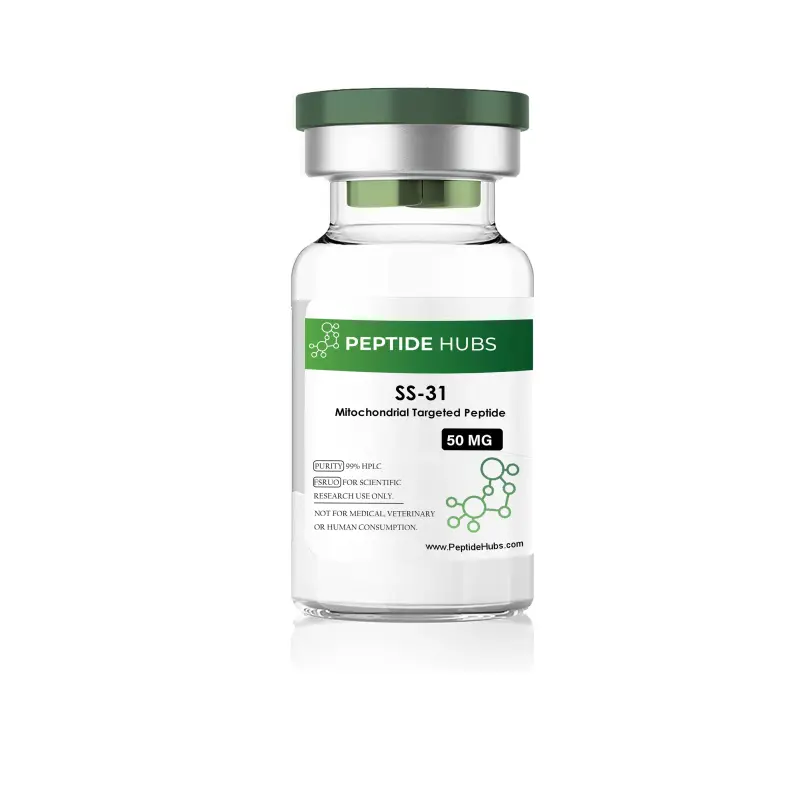
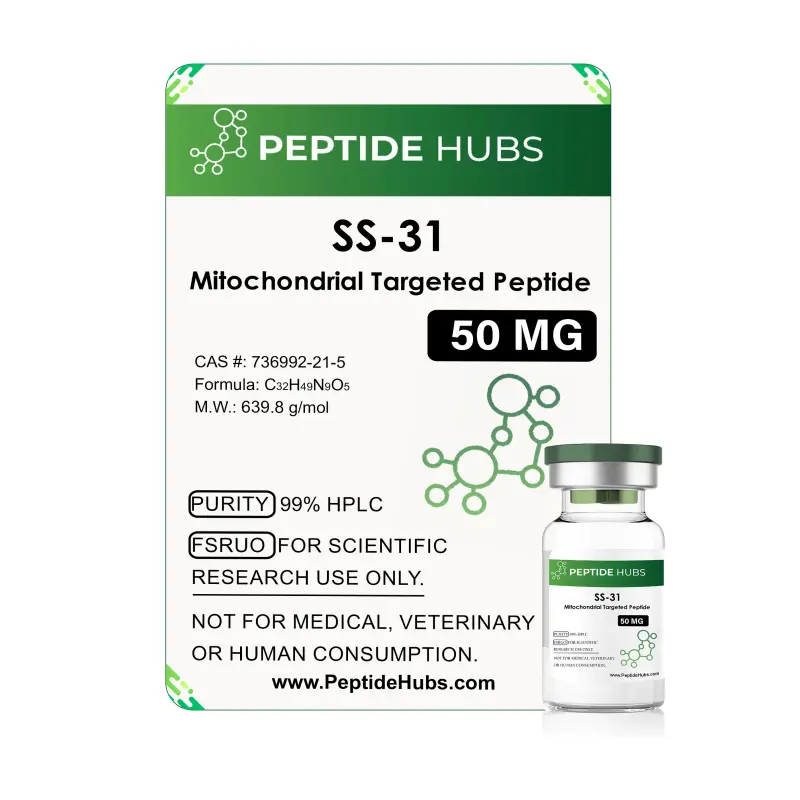
SS-31 50mg
- USA MADE 2-7 days delivery
- International 5-20 days delivery
THIS PRODUCT IS INTEDED AS A RESEARCH CHEMICAL ONLY.
This designation allows the use of research chemicals strictly in vitro for testing and laboratory experimentation only. All products information available on this website is for educational purposes only. Bodily introduction of any kind into humans or animals is strictly forbidden by law. This product should only be handled by licensed, qualified professional. This product is not a drug, food or cosmetic and may not be misbranded, misused or mislabled as a drug food or cosmetic.
1. What is SS-31?
SS-31, also known as elamipretide or MTP-131, is a synthetic tetrapeptide developed specifically for targeted mitochondrial research. This aromatic peptide is engineered with a distinctive cationic charge (+3 at physiological pH), enabling it to permeate cell membranes and cross the blood-brain barrier with remarkable efficiency. Unlike conventional antioxidants that disperse throughout the cellular environment, SS-31 possesses an extraordinary capacity for selective accumulation—concentrating at levels over 1,000 times greater within the inner mitochondrial membrane than in plasma. This selective targeting distinguishes SS-31 as a precision research tool for investigators examining mitochondrial dysfunction across diverse experimental models.
At the molecular level, SS-31 functions as a research compound for studying mitochondrial biology through its interaction with cardiolipin, an anionic phospholipid essential to inner mitochondrial membrane architecture. Cardiolipin plays a pivotal role in the electron transport chain and ATP production machinery. Dysfunction of cardiolipin has been implicated in numerous pathological states, including neurodegenerative conditions, metabolic disorders, and age-related phenomena. SS-31 serves as an investigative tool for researchers examining how stabilization of this critical phospholipid influences cellular bioenergetics and oxidative metabolism.
2. SS-31 Structure
The chemical composition of SS-31, being the product of rational design most deliberate, doth warrant explication in particulars:
Peptide Sequence: D-Arg-Dmt(dimethylTyr)-Lys-Phe-NH₂
Molecular Formula: C₃₂H₄₉N₉O₅
Molecular Mass: 639.8 g/mol
Registry Designation (CAS): 736992-21-5
Alternative Nomenclature: Elamipretide, MTP-131, Bendavia
Structural Character: One shall observe in this peptide an alternating arrangement of aromatic and cationic residues, productive of marked consequence. The N-terminal terminus, anchored by D-arginine, confers both stereochemical stability and positive charge of the most dependable character. This is succeeded by dimethyltyrosine, which furnishes aromatic character and resistance against oxidative degradation—a most prudent inclusion. Lysine follows, contributing both basic charge and hydrophilic properties conducive to membrane engagement. The C-terminal phenylalanine amide completes the arrangement, enhancing membrane penetration whilst resisting hydrolytic cleavage.
The net effect of this architecture proves most advantageous: the composite positive charge promotes electrostatic attraction to the negatively charged cardiolipin phospholipid resident in the inner mitochondrial membrane. The aromatic residues, meanwhile, facilitate the hydrophobic interactions requisite for proper membrane localization and cardiolipin binding. Thus doth the structure serve function with elegant economy.
3. SS-31 Research
3.1 Mitochondrial Improvement
Mitochondrial dysfunction, being prevalent in numerous conditions characterized by compromised ATP production, stands as a circumstance of considerable concern to those engaged in biological inquiry. The corpus of research pertaining to SS-31 demonstrates, through repeated and careful observation, its capacity to enhance mitochondrial bioenergetics across diverse experimental contexts of considerable variety.
In studies wherein renal tissue has been subjected to ischemia followed by reperfusion, SS-31 has proven protective, accelerating the recovery of ATP production during the reperfusion phase whilst reducing cellular death. Subsequent investigations have revealed that this mechanism—SS-31's interaction with cardiolipin upon the inner mitochondrial membrane—doth operate as a principle of general applicability, efficacious against mitochondrial dysfunction arising from diverse causes.
Of particular interest are investigations conducted upon aged specimens of laboratory mice. Eight weeks of SS-31 exposure appeared to reverse age-associated declines in mitochondrial ATP production capacity and enhanced the efficiency of oxidative phosphorylation—remarkable improvements occurring notwithstanding unchanged or even reduced mitochondrial protein expression. This circumstance suggests enhancement of existing mitochondrial function rather than proliferation of mitochondrial organelles. These energetic improvements accompanied rebalanced redox homeostasis, with glutathione redox status restored and age-associated cysteine modifications in skeletal muscle proteomes apparently reversed. Aged animals receiving SS-31 demonstrated enhanced fatigue resistance and increased muscle mass in comparison to control specimens, thereby linking improved mitochondrial function to observable physiological outcomes of undeniable significance.
Research conducted upon cardiac tissue, both from animal models and from human heart samples obtained under appropriate scientific circumstances, demonstrates SS-31's capacity to improve mitochondrial oxygen flux and accelerate ATP production. Studies employing isolated mitochondrial preparations document increases in specific activities of electron transport chain components, with improvements in mitochondrial respiration metrics correlating with enhanced cardiac function. In chronic heart failure models, SS-31 exposure improved left ventricular function and reduced adverse cardiac remodeling, supporting a role for mitochondrial enhancement in preserving organ-level integrity.
3.2 Ischemia
The ischemic insult—tissue damage resulting from oxygen deprivation and interrupted perfusion—imposes upon mitochondrial function a stress of considerable severity. The cristae structure of the inner mitochondrial membrane deteriorates during ischaemic episodes, thereby impairing the electron transport chain's capacity for ATP production. Pre-treatment with SS-31 demonstrated protective efficacy in renal ischemia-reperfusion models, wherein the peptide preserved cristae architecture, prevented pathological mitochondrial swelling, and enabled expeditious ATP recovery upon restoration of perfusion. This prompt ATP restoration facilitated the expeditious repair of ATP-dependent cellular processes, including the reconstruction of the cytoskeletal apparatus and restoration of cellular polarity—processes of cardinal importance to the maintenance of tubular barrier function and the prevention of subsequent cellular death.
Cardiac investigations have revealed that SS-31 merits examination for its capacity to improve mitochondrial respiration and ATP synthesis in the context of cardiac failure. Studies conducted in animal models afflicted with advanced heart failure indicated that prolonged SS-31 administration enhanced left ventricular function, with improvements in mitochondrial respiration measurements correlating strongly with overall improvements in cardiac function. Furthermore, in acute myocardial infarction research, SS-31 administration was attended by reduced circulating concentrations of HtrA2, a marker of cardiomyocyte programmed cell death, suggesting that the peptide may operate through anti-apoptotic mechanisms to preserve cardiac tissue from ischaemic injury.
3.3 Diabetes
Type 2 diabetes involves mitochondrial dysfunction of considerable complexity, contributing to hyperglycemia, oxidative damage to blood vessels, and the progression of microvascular complications of most regrettable character. Recent research hath focused upon SS-31's potential to address mitochondrial-mediated oxidative stress in diabetic pathology.
In studies examining leukocytes obtained from individuals afflicted with type 2 diabetes, SS-31 exposure reduced both total and mitochondrial reactive oxygen species production in comparison to untreated specimens. Simultaneously, SS-31 decreased expression of endoplasmic reticulum stress markers (GRP78, CHOP) and modulated autophagy-related proteins with admirable precision. Additionally, SS-31 increased levels of SIRT1, a protein associated with improved insulin sensitivity and reduced inflammatory signaling—a most desirable outcome. SS-31 also modulated leukocyte-endothelium interactions, reducing leukocyte adhesion and rolling flux whilst enhancing rolling velocity—parameters of evident relevance to vascular inflammation in diabetes.
In murine models of diabetic retinopathy, four months of SS-31 exposure improved structural integrity of retinal capillaries, refined basement membrane composition, decreased permeability of the inner blood-retinal barrier, and enhanced expression of tight junction proteins claudin-5 and occludin. These improvements accompanied reduced markers of oxidative stress (acrolein, 8-OHdG, nitrotyrosine) and inflammatory signaling (NF-κB, Bax, caspase-3), whilst protective proteins Bcl-2 and Trx-2 were elevated. These findings suggest SS-31 may preserve retinal vascular structures against oxidative damage in diabetic circumstances.
3.4 Reduces Inflammation
A unifying principle observed across the corpus of SS-31 research concerns its capacity to suppress oxidative stress and inflammatory activation—matters intimately connected and mutually reinforcing. The peptide reduces mitochondrial reactive oxygen species production through mechanisms manifold: direct cardiolipin stabilization (reducing cytochrome c peroxidase activity), scavenging of mitochondrial ROS through its dimethyltyrosine residue, and prevention of mitochondrial permeability transition pore opening—a stress response that converts mitochondria from ATP factories into ROS-generating organelles of considerable destructive capacity.
Investigations conducted in cell culture and animal models document SS-31's suppression of inflammatory markers, including reduced expression of FIS1 (a mitochondrial protein elevated in neurodegeneration and malignancy), decreased CD-36 and activated MnSOD (markers of oxidative stress), suppressed NADPH oxidase function, and inhibited NF-κB p65 signaling. NF-κB represents a central inflammatory transcription factor chronically active in numerous inflammatory diseases of consequence. By maintaining proper mitochondrial function, SS-31 prevents inflammasome activation and preserves the mitochondrial shift away from ROS overproduction. This mitochondrial-focused anti-inflammatory action distinguishes SS-31 most notably from conventional antioxidants operating in extramitochondrial compartments.
Research conducted in murine models of traumatic brain injury revealed that SS-31 reduced neuroinflammatory markers, decreased secondary neuronal injury, and enhanced expression of neuroprotective pathways including SIRT1 and PGC-1α-mediated mitochondrial biogenesis, collectively suggesting neuroprotection through mitochondrial restoration.
3.5 SS-31 Summary
SS-31 emerges as an instrument of considerable merit within the domain of targeted mitochondrial research, addressing dysfunction through multiple converging mechanisms: the stabilisation of cardiolipin, the neutralisation of reactive oxygen species through the dimethyltyrosine-mediated antioxidant activity, the inhibition of cytochrome C-mediated cardiolipin peroxidation, the restoration of ATP production capacity, and the modulation of inflammatory signaling cascades. The peptide's selective accumulation within the inner mitochondrial membrane—coupled with its demonstrated capacity to enhance electron transport chain efficiency without necessitating increased mitochondrial protein synthesis—renders it distinguished from conventional antioxidants of broader application, and validates its utility as a tool of precision for investigating mitochondrial biology across diverse experimental contexts. Current scholarly investigations continue to explore SS-31 applications within models of neurodegenerative disease, cardiovascular dysfunction, metabolic disorder, and the pathological phenotypes attending advanced age.
FEATURE BULLETS
- 99% Purity of Excellent Character – Research-grade tetrapeptide possessed of high purity specification, most suitable for rigorous scientific applications of consequence
- Lyophilized Powder Format Most Convenient – Stable, shelf-ready form requiring no refrigeration during manufacture and transport; offering convenience to the diligent laboratory investigator
- Mitochondrial Targeting of Marked Specificity – Selectively accumulates in inner mitochondrial membrane at concentrations exceeding plasma by >1000-fold, enabling focused investigation of mitochondrial biology
- Cardiolipin-Interactive Design Most Judicious – Engineered tetrapeptide sequence (D-Arg-Dmt-Lys-Phe-NH₂) promotes high-affinity binding to cardiolipin phospholipid, preserving electron transport chain integrity
- ATP Production Enhancement Well-Documented – Research documented to improve mitochondrial oxidative phosphorylation efficiency and accelerate ATP recovery during metabolic stress of various descriptions
- Broad Research Applications of Manifest Utility – Applicable across aging biology, metabolic dysfunction, ischemic injury, neurodegeneration, and inflammation research domains
- Cell-Permeable Architecture of Elegant Design – Cationic charge and amphipathic structure enable rapid cellular uptake and blood-brain barrier traverse without dependence upon active transporters
Technical Specifications
|
Specification |
Details |
|
Active Compound |
SS-31 (elamipretide) tetrapeptide |
|
Size |
50mg |
|
Form |
Lyophilized powder |
|
Purity |
>99% |
|
Concentration |
50mg total peptide per container |
|
Molecular Weight |
639.8 g/mol |
|
Sequence |
D-Arg-dimethylTyr-Lys-Phe-NH₂ |
|
CAS Number |
736992-21-5 |
|
Storage Temperature |
2-8°C |
|
Container |
Sealed vial |
Storage Instructions
Storage Medium: Lyophilized (freeze-dried) powder of suitable preparation
Long-Term Storage: Store at −20°C or −80°C in a sealed container of moisture-proof character. Under such conditions, lyophilized SS-31 maintains stability for extended periods of considerable duration.
Short-Term Storage: Store in refrigerator (2–8°C) when in active use, maintaining the sealed vial to prevent moisture absorption of the most injurious sort.
Environmental Stability: Lyophilized SS-31 in powder form maintains stability for several weeks even at elevated ambient temperatures, though cool storage is recommended to ensure longevity and preserve the compound's character.
Handling: Protect from light and moisture with diligent care. Use aseptic technique when handling to maintain sterility most strictly. Store in original vials or transfer to new sealed containers suitable for laboratory use.

Related Products







Highly Purified Peptides: Trusted by Researchers Worldwide
Peptide Quality You Can't Find Elsewhere!!
| Peptide Hubs | Leading Competitor | |
|---|---|---|
| 200+ Peptide Variants |  |
 |
| USA-Manufactured Research Grade | |
|
| WHO/GMP & ISO 9001:2015 Certified | |
|
| Third-Party Tested for Purity | |
|
| Certificates of Analysis Provided | |
|
| Competitive Pricing Without Compromise | |
|
| Secure & Discreet Shipping | |
|
See Peptide Hubs in Action


Insights

Bronchogen Side Effects and Safety: A Research Overview

GHK-Cu Safety Profile: Side Effects and Current Research

PEG MGF Side Effects: Safety, Tolerability, and Research Findings

PT-141 Safety Insights: Side Effects and Clinical Evidence

99% Purity
Ensuring the highest standard with 99% purity.

Quality Ingredients
Crafted with purity and quality ingredients at the core.

Fast Shipping
Fast, reliable shipping straight to your door.

No TFA or Fillers
Nothing extra, just science: no TFA, no fillers.

Quality You Can Rely On — Guaranteed
At PeptideHubs, scientific integrity and product reliability are at the core of everything we do. Each compound is manufactured and tested under strict quality control protocols to ensure consistency, purity, and performance for research applications.
However, if for any reason our product does not meet your research expectations, we offer a 60-day money-back guarantee — providing a risk-free procurement experience for qualified researchers and institutions.
Your research deserves uncompromised quality — and we stand behind every order to ensure you receive.